
|
Getting your Trinity Audio player ready...
|
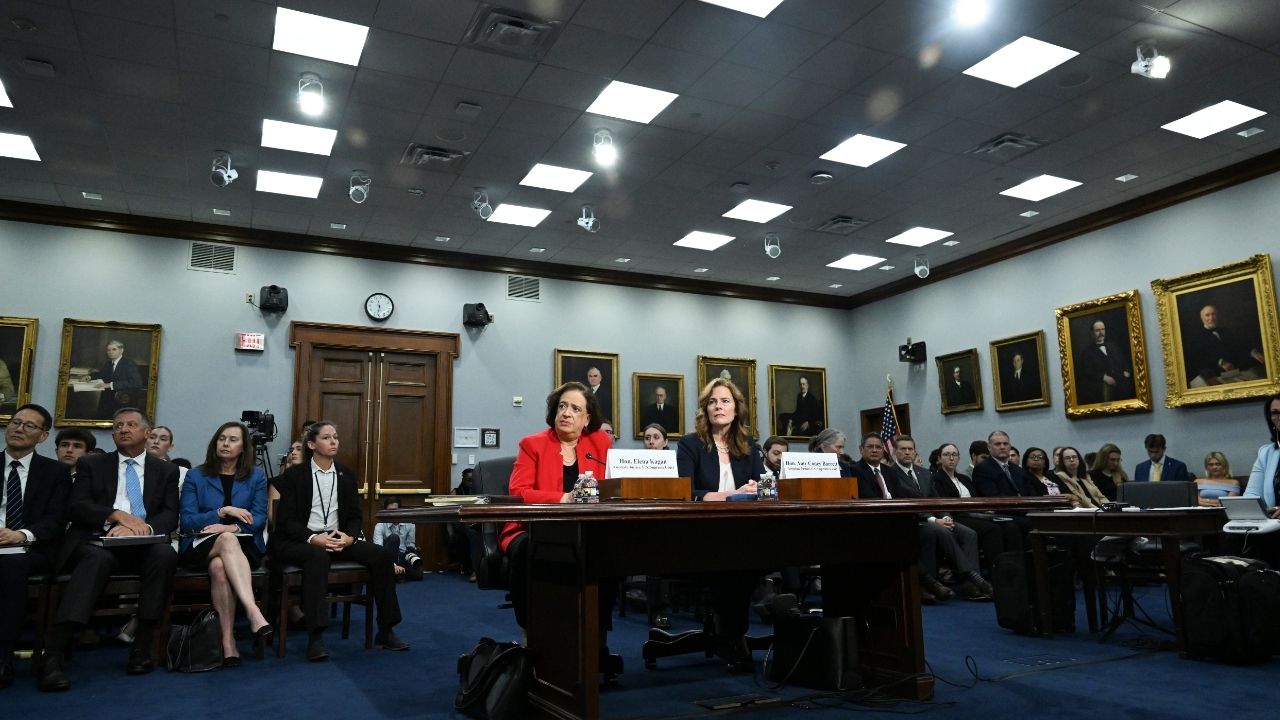
Two Supreme Court justices, Elena Kagan and Amy Coney Barrett, made a rare appearance at the Capitol on Tuesday, ostensibly to answer lawmakers’ questions about the court’s request for millions of dollars to increase security amid rising threats against the justices and their families.
But it was the first time any of the justices answered questions from lawmakers since 2019, and the discussion before House and Senate Appropriations subcommittees quickly moved to other topics, including the court’s emergency docket, ethics rules and harsh rhetoric targeting the justices. Here are some highlights from the testimony.
The Justices Are Still Divided Over Ethics
A rift reemerged between the justices on the question of whether the court should adopt some kind of mechanism to enforce ethics rules it first announced in 2023. At the time, the court was under intense pressure after reports that Justice Clarence Thomas had failed to disclose years of free luxury travel and gifts from a Texas billionaire.

The justices ultimately, for the first time, embraced an ethics code specific to the nine justices, but without any process for policing whether a justice had violated the rules.
Rep. Rosa DeLauro of Connecticut, the top Democrat on the Appropriations Committee, called for more transparency from the court through increased financial disclosure requirements. She characterized the court’s current ethics rules as “woefully insufficient.”
Kagan has previously suggested that the code could be enforced by a committee of respected federal judges — and told lawmakers Tuesday that she continued to support such a system. Barrett, on the other hand, said she was fully committed to following the court’s ethics rules but said she would have concerns about the complexities involved in devising a system of enforcement.
In the past, the justices have described the challenges of making the ethics code binding in part because other branches of government or lower court judges should not be checking the justices, the leaders of the third branch of government.
Lawmakers Denounced Personal Attacks on the Justices, but Only Democrats Mentioned President Donald Trump
In bipartisan fashion, lawmakers decried fiery rhetoric aimed at Supreme Court justices as a serious threat to the institution and the justices’ security. Sen. Susan Collins, R-Maine, said she was appalled by statements from public officials from both parties directed at the justices. Collins recounted, without naming him, how Sen. Chuck Schumer, D-N.Y., had said at a 2020 rally outside the Supreme Court of Trump’s nominees, “You have released the whirlwind, and you will pay the price.”
Sen. Bill Hagerty, R-Tenn., noted the arrest Monday of a Mississippi man who stopped his car near the Capitol to ask a police officer for directions to the Supreme Court. The driver had a handgun in his lap, according to the police, and was charged with carrying a firearm without a license.
But only the Democrats directly took on Trump’s harsh criticism of the justices he nominated who ruled against his tariffs. Sen. Jack Reed of Rhode Island quoted Trump, who referred to those justices, a group that included Barrett, as “fools, lap dogs” and disloyal.
Kagan jumped in to respond. No matter which political party the commentary comes from, she said, those types of statements are unhelpful, dangerous and “not an appropriate way to treat a coordinate branch of government.” Criticism of the court’s decisions is fair game, she added, but “intimidation is a different thing entirely.”
Threats Have Dramatically Altered the Justices’ Daily Lives
Threats to the nine justices have been on the rise — including an assassination attempt on Justice Brett Kavanaugh in 2022.
Barrett spoke in highly personal terms about how rising threats have affected her family. She described one of her sons spotting a bulletproof vest that her security detail had given her after the leak of the draft of the court’s opinion to overturn Roe v. Wade in 2022, a particularly heated time for the court.
The threats against her have required her children “to think about and see things that children should not have to see or think about,” she told the lawmakers.
Kagan talked about the adjustment to round-the-clock security and the imposition on her privacy. Security details for each justice now include four to eight officers, and the justices told the lawmakers that they would like the funding to increase that number.
“It’s easier living life without security than it is living life with security,” Kagan said.
There Are Bipartisan Concerns About the Court’s so-Called Shadow Docket
Members of both parties asked questions about the court’s emergency docket, which the justices use to issue temporary but impactful orders, frequently with little or no reasoning.
In dissenting opinions, Kagan has routinely criticized the court’s conservative majority for issuing such quick-turn decisions. But she offered a brighter view Tuesday, telling the committee that the court has been doing a better job of providing explanations for its emergency rulings.
“I don’t think that’s so much of a problem anymore,” Kagan said.
She also acknowledged that the court itself is partly to blame for the expansion of the emergency docket because it has granted relief more often than in the past to parties that have filed emergency applications. That, in turn, encourages others to file their own applications, she said.
It Was a Surprisingly Collegial Affair for Congress
The justices speak in public only rarely, and even less often respond to unpredictable, direct questions about how the court conducts its business.
Even though public opinion of the court has dropped precipitously in recent years, lawmakers from both parties in the House were cordial, illustrating how ready they have been to increase the court’s security budget — and the deference with which Supreme Court justices are, generally, treated in American life. Their questions were pointed but polite.
Rep. Steny Hoyer of Maryland, the top Democrat on the panel, told the justices that “the very real threats by our judiciary are in our minds.”
“Congress,” he said, “must provide sufficient funding to ensure the safety of all judicial personnel.”
In the Senate, too, lawmakers were respectful even as they questioned the justices about their security needs. They emphasized that justices are not creatures of Congress and that their power derives from their independence from the two other branches of the government.
—
This article originally appeared in The New York Times.
By Ann E. Marimow/Kenny Holston
c. 2026 The New York Times Company