
|
Getting your Trinity Audio player ready...
|
NEW YORK — Twenty-one stories above a midtown Manhattan street early Tuesday morning, construction workers were busy converting an office building into a residential complex when it began falling apart.
“Somebody saw that the concrete was coming down,” said Cliff Johnsen, business agent for the Local 638 steamfitters union, which had workers on-site. “The beams started bending. The windows started busting.”
The building was crumbling fast, he said.

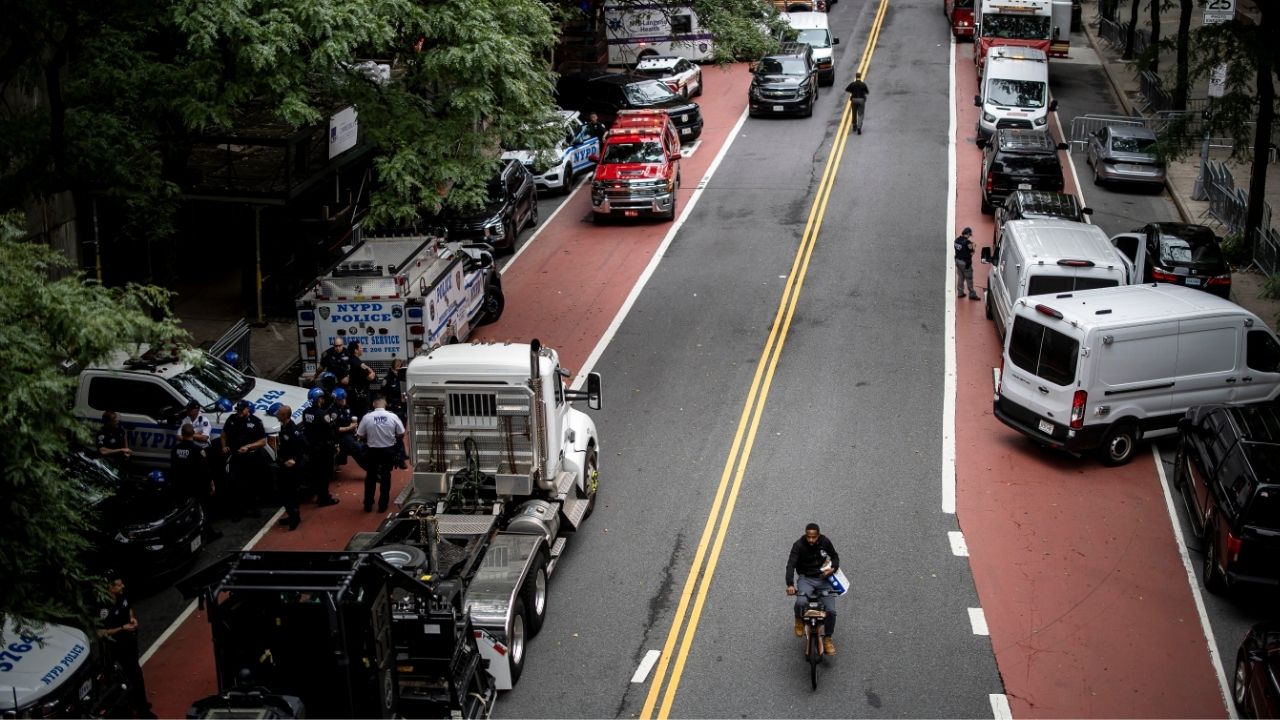
The workers evacuated the building, at 235 East 42nd St., near Grand Central Terminal and the United Nations, and a supervisor called 911, prompting a hurried emergency response as officials worried about a partial collapse. Officials said there were no injuries, but dozens of businesses have been displaced indefinitely after officials established a “frozen zone” spanning several city blocks around the building. The cause of the incident is under investigation.
The episode stalled a project that had come to symbolize the city’s ambitious effort to repurpose Manhattan’s empty office buildings to address the city’s housing shortage. Developers called the project the largest office-to-residential conversion in city history; it had been set for completion next year.
At a news conference in the afternoon, New York City Mayor Zohran Mamdani said that building inspectors using drones to survey the building spotted two columns that had buckled, bent beams, several cracks and sagging floors. The building continued to shift after the authorities arrived, he said.
“The building remains unstable,” he said, urging people to avoid the area until officials deemed it safe.
MetroLoft, the developer on the apartment conversion, thanked city officials for their quick response and said in a statement that the damage was limited to a small area of the building. “The entire building itself is not at risk of collapse,” the company said.
The New York City Fire Department shared photos from the building on social media that showed missing paneling on the building facade and a vertical beam bent like an elbow. Fire officials said there was no risk of a full building collapse.
Officials were awaiting construction materials, including support beams, to stabilize the structure and allow investigators to go inside.
The building is one of two that previously comprised the headquarters of Pfizer, the pharmaceutical company, before it moved west to the other side of Manhattan in the Hudson Yards neighborhood.
In 2024, construction began on the project to convert the offices into an apartment building with more than 1,600 units, a rooftop pool, retail shops and other amenities spanning 100,000 square feet.
The building had 22 violations dating back to 2020, mostly for failing to file elevator inspection and testing reports. Thirteen of the complaints remain active, all from 2025, with the owners owing the city $39,000 in penalties.
A 311 complaint filed against the project on Tuesday accused the developers of conducting excavation that was beyond or contrary to construction plans that had been approved, according to the agency’s online portal. Specifics of the complaint were not yet available, but the city’s buildings department said it was investigating.
Johnsen, the union official, said the incident was highly unusual, and he said the builders had not used enough steel to support the weight of the additional floors. His claim could not be verified.
“That’s not something you see,” he said of the incident, noting the union’s role in building Hudson Yards, the World Trade Center, Yankee Stadium, Madison Square Garden and Barclays Center.
Abi Aghayere, a professor of structural engineering at Drexel University, likened office-to-residential renovations to “structural gymnastics.” Along the way, a lot of work would be happening in the building that could give rise to potential problems.
For example, beams that support columns that bear vertical loads might be moved. Those types of problems could emerge because of a faulty design, or construction workers’ error.
“There’s going to be a lot of cutting of holes and slabs and all that to make room for all the HVAC and the plumbing for each individual residential unit,” he said.
He said photos of the buckling seemed to show that at least one affected column was old, and potentially corroded or rotted.
He said investigators should “strip” the building — look under any superficial exterior surface, like paint, to see what’s actually going on in the “skeleton.” That will help determine both how to stabilize the building temporarily, and also whether it’s viable to continue with the project at all.
”No one knows what stage the structure is in right now,” he said.
—
This article originally appeared in The New York Times.
By Ashley Southall/Dave Sanders
c. 2026 The New York Times Company