

|
Getting your Trinity Audio player ready...
|
For over six years, a Los Angeles-area fiduciary altered bank statements and fudged court reports to steal more than $6 million from his clients, the California Attorney General’s Office claims, setting up what it called a “Ponzi-style” scheme to rob people who can’t take care of themselves.

In May, state prosecutors filed grand theft charges against Gregory Oveross and his accountant, Faranita L. Corvalan, alleging what would be one of the largest fiduciary thefts in California history. Oveross and Corvalan pleaded not guilty and have been released on bond, awaiting trial.
Prosecutors say Oveross misled his clients and the probate court. But court and other public records reviewed by CalMatters show that court officials and the state Professional Fiduciaries Bureau missed red flags years before Oveross was charged, highlighting our ongoing reporting into the state’s weak oversight of fiduciaries, who have the power to control people’s finances and basic aspects of their lives.

This story was originally published by CalMatters. Sign up for their newsletters.
Judge Approved Incomplete Report for $670K
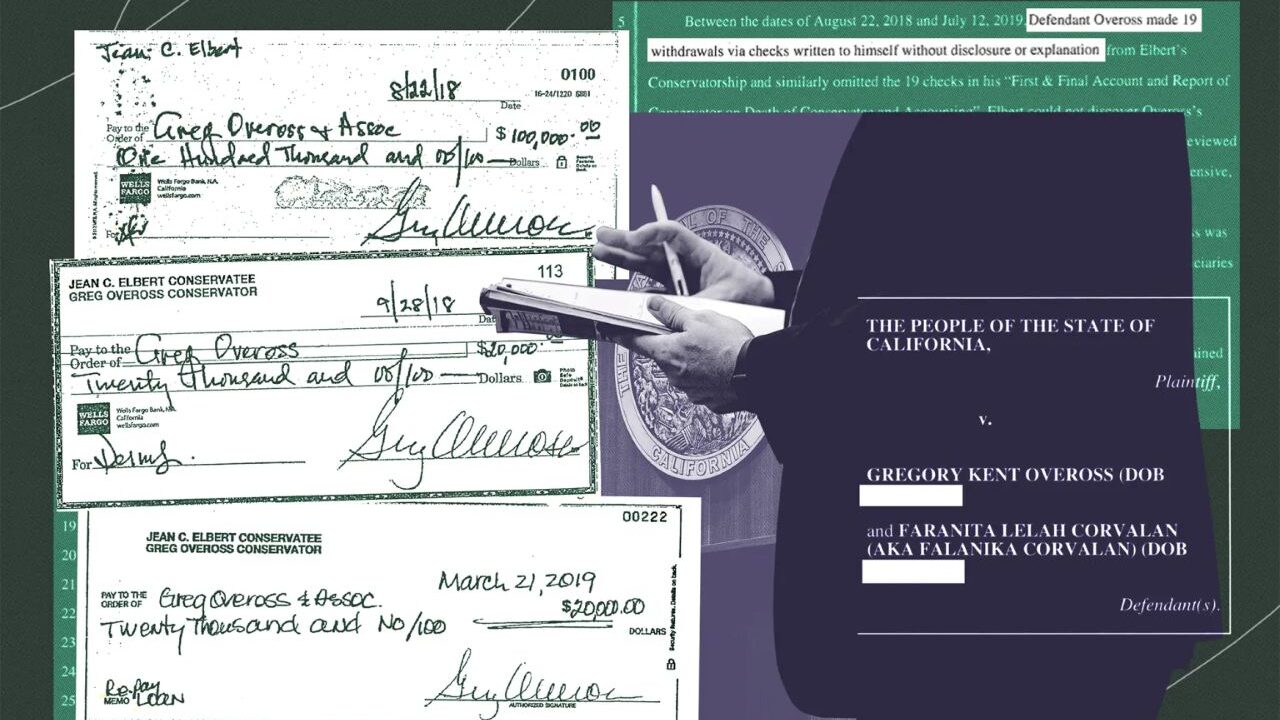
For example, in one case, Oveross allegedly wrote himself 19 checks totaling $670,000 over the course of a year from one client’s accounts. Even though the state accounting form asks for check numbers for every expense, Oveross left that column blank. Still, Judge Deborah L. Christian approved the financial report.
“Not having check numbers would be a big red flag,” said Judge Sandra Bean, the supervising judge for probate court in Alameda County. “It’s all very practical. If something smells bad, it probably is.”
In response to past abuses, lawmakers in 2006 passed a law that required fiduciaries to turn in more detailed documentation to account for how they spent their clients’ money. By forcing fiduciaries to list check numbers, the courts would ostensibly be able to spot if check numbers were missing and stop fiduciaries from writing hidden checks.
In a separate case, the AG’s office said that Oveross never paid a $1.7 million inheritance to beneficiaries after the court appointed him to manage a deceased person’s estate.
Records do not indicate that Los Angeles Superior Court ordered a hearing to ensure the money had been distributed. State law does not require courts to automatically schedule such a review, creating a hodgepodge of rules across California counties.
Some courts automatically set up such a hearing. Other counties, such as Sacramento, San Joaquin and Santa Clara, do not.
During the time of Oveross’s alleged thefts, the Los Angeles court did not automatically schedule such hearings. The court changed its rules in January 2026, automatically scheduling follow-up review dates after approving the final distribution, spokesperson Rob Oftring said.
Fiduciary Concealed Accusations of Wrongdoing
Additionally, public records obtained by CalMatters show that Oveross omitted from his annual statement a case in which he’d been accused of wrongdoing. The statements, which are supposed to give the public and the bureau a window into fiduciaries who’ve been in trouble, are based on the honor system. Fiduciaries sign the statements under penalty of perjury.
Gov. Gavin Newsom signed a 2021 law that would have required courts to notify the bureau if judges punished fiduciaries for abusing their licenses. However, that requirement was to go into effect only if lawmakers funded it. They haven’t.
In 2022 and 2023, Oveross submitted statements to the bureau that didn’t answer a question about whether he had settled any complaints, records show. The bureau still issued Oveross a valid license each year, according to its website. It declined to answer any questions about Oveross, citing the pending criminal case.
The bureau was established two decades ago to protect consumers after a news investigation showed that judges were not preventing abuse and conflicts of interest by fiduciaries. However, CalMatters’ reporting this year has found that some of the same issues remain.
The bureau says it depends on courts to police fiduciaries, and the courts often depend on the bureau, creating a loop of blame and little accountability.
Oftring said an attorney reviews fiduciaries’ accounting and confirms that “all required information and supporting documentation are provided, that financial activity is clearly explained, and that the accounting is accurate and balanced.”
When asked why the court approved Oveross’s accounting, he said that judges and court staff are “prohibited from publicly commenting on any pending or impending proceeding in any court.”
In the arrest declaration, the AG’s office said Oveross had a “systematic and pervasive pattern of asset misappropriation, discrepancies, unauthorized fund diversions and non-compliance with probate court mandates.”
Attorneys for Oveross and Corvalan didn’t respond to requests for comment for this story.
Oveross Kept His License While Under Investigation
Jean C. Elbert had dementia. Her extended family was far away, and her closest relative, her brother, was battling Alzheimer’s. Elbert’s family asked the court to appoint a fiduciary to handle her care and finances. The court appointed Oveross, a longtime fiduciary, in August 2018.
Oveross managed Elbert’s conservatorship for about a year. During his time as her conservator, prosecutors say, Oveross wrote 19 checks to himself and didn’t include any of them on the financial report he filed with the court.
After Elbert died in August 2019, Oveross told the court that he had $1.8 million to distribute to her heirs, and the court ordered him to deliver the money.
Oveross did not send $764,000 owed to Elbert’s brother, according to court filings and state prosecutors.
The brother’s son sued for his father’s share of the inheritance, court records show. The son’s attorney discovered that Oveross had taken money from the conservatorship and estate, according to the court filings, and that he had used money from other clients’ accounts to eventually pay Elbert’s brother his inheritance.
In May 2024, the two sides entered into a settlement agreement, but state records show the fiduciary did not report it on his 2025 annual statement, as is required.
AG Alleges $1.3 Million in Unauthorized Payments
All told, the AG’s office says in court filings, the fiduciary made $1.3 million in unauthorized payments from Elbert’s accounts.
In another case, Oveross was in charge of Guadalupe Rodriguez Diaz’s $2 million estate after she died in 2019.
After paying the bills, Oveross told the court that Diaz’s estate had $1.6 million left for her beneficiaries.
The AG’s office says that Oveross opened “a secondary set of accounts” and made “unauthorized” transfers to himself and Corvalan, and to another trust he managed. In court filings, they say Oveross spent nearly the entire estate on himself and his associates.
Diaz’s heirs, prosecutors say, never got a dime from the accounts.
“Notably, no transactions related to heir distributions were observed within these accounts,” prosecutors wrote in court records.
The criminal case was launched after Elbert’s nephew and one of Oveross’s clients filed complaints to the bureau in 2023, according to court records. Shortly afterward, the bureau investigator forwarded the case to the California Department of Justice.
As the criminal investigation played out, Oveross was allowed to work with a valid fiduciary license for more than two years.
His license was suspended less than two weeks after he was arrested. In its order prohibiting Oveross from practicing, the bureau asked him to give it a complete list of all matters in which he serves as a fiduciary.
Those are details the bureau should have had. The bureau requires its fiduciaries to accurately report them every year on their annual statements.
This article was originally published on CalMatters and was republished under the Creative Commons Attribution-NonCommercial-NoDerivatives license.