
|
Getting your Trinity Audio player ready...
|
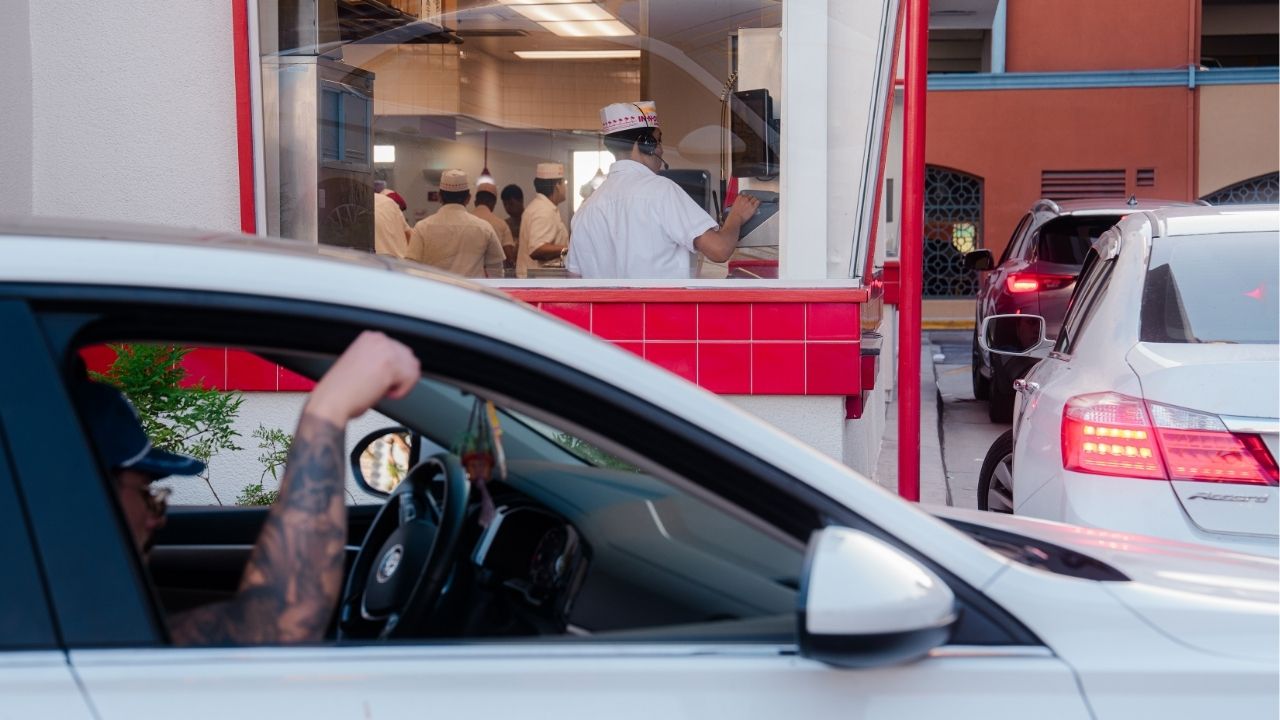
It was lunchtime on Saturday in Southern California and the hunger was 20 cars deep at the In-N-Out Burger drive-thru line. Nose to taillight, the traffic streamed into a jammed parking lot anchored by the Culver City Costco — past seas of parked cars, around families with heaped carts and toward the Costco gas station and 15-minute oil change shop.
The sun glared at the pavement. The air smelled of hot exhaust and onions.
“This traffic is insane,” said Pierre Amoore, a 64-year-old photographer from Santa Monica tucking into a $6.35 Double-Double in the front seat of a Hyundai. “But this is the best burger in the world to me.”

Is such gratification worth the chaos? That has been the sizzling debate lately in parts of California, the car-obsessed state that gave rise to America’s drive-thru culture. Leaders in several cities are calling for drive-thru crackdowns, arguing that they threaten the modern California Dream of clean air, safe streets and walkable communities.
This summer, Culver City, a 5-square-mile community with about 40,000 people on the congested Westside of Los Angeles County, moved to halt what locals complained was an untenable pileup of drive-thrus.
Besides the In-N-Out near the Costco, there are already locations, just minutes away, at either end of Los Angeles International Airport, and another just over the Culver City line that has become a local legend for its meandering queue that routinely stretches for blocks past homes and apartments on a residential side street.
So when the iconic California chain proposed another location with a 26-car queue and 61 parking spaces at the juncture of three major streets — a “mega-drive-thru,” as neighbors called it — it touched off a rebellion. And the city made headlines.
“I have been on the City Council for a year and a half, and nothing we’ve done has caused this much attention,” said Bryan “Bubba” Fish, the vice mayor, who also works as a transportation deputy for a member of the Los Angeles County Board of Supervisors. “Look, I love a burger and fries as much as the next person. But hundreds of people were writing in, worried about traffic, air quality, safety and mobility.”
When the City Council responded with a plan to permanently ban new drive-thrus, however, they were unexpectedly pummeled with right-wing blowback.
The New York Post called it a “war on fast food.” Commentators on Newsmax said the vote was “anti-family.”
Tens of thousands of drive-thrus operate in California, the nation’s most populous state. The founders of In-N-Out, in fact, are credited with inventing the genre when they hung a two-way speaker outside their Los Angeles-area restaurant in 1948.
Drive-thrus spread in the 1960s with the nation’s freeway system and took off in earnest in the 1970s as places like Southern California filled with single-family tract homes and two-car garages. As baby boomers came of age, drive-thrus were a source of family-friendly convenience and cheap eats.
They also were a signature symptom of a landscape that spewed pollution. A ban in the Central Coast college town of San Luis Obispo, California, in 1982 inspired scattered restrictions, mostly in places where the architecture was less suburban and the air quality more challenged — South Pasadena, Sierra Madre, Claremont. As the century turned, new urbanists also inveighed against drive-thrus, saying they undermined everything modern American cities now value: livable neighborhoods, safe and clean streets, space for bicycling and hiking, shopping local.
Then, just as policies were starting to shift, the coronavirus pandemic sent consumers back to drive-thrus. Traffic rose 30% nationally from 2019 to 2022, according to the food service research firm Technomic, as terrified Americans avoided each other. Taco Bell and Chipotle supersized digital pickup lanes. Chick-fil-A developed a two-story, four-lane drive-thru that delivered food on a conveyor belt from the kitchen.
Now, the pendulum has swung again.
Fast food restaurants, which according to industry experts earn about 70% of their revenue through drive-thru windows, have been seriously squeezed. Prices have soared for energy, beef, credit card use, labor and other necessities of operation, while discretionary income has shrunk, especially among poorer consumers.
DoorDash, delivery bots, Ozempic and cyclospora outbreaks haven’t helped.
In California, where the $20 hourly minimum wage for fast-food workers is the nation’s highest state rate, one of the largest Carl’s Jr. franchisees filed for bankruptcy protection this year. Other chains have been more resilient: In-N-Out, which has become a sort of unofficial state tourist attraction, is adding three new California restaurants.
Even the “haves” of the drive-thru world, however, have been facing a tough crowd in California’s more affluent markets. Santa Monica has continued to ban drive-thru restaurants even in the midst of a municipal budget crisis.
In Wine Country, a review of the zoning code in the city of Napa prompted the Planning Commission last month to develop a drive-thru ban that could include not only restaurants but also dry cleaners and car washes.
In Santa Barbara County, planning commissioners debated spillover traffic and “odor abatement” for months before they finally voted in June to let a Chick-fil-A drive-thru open at the site of a shuttered IHOP. The city of Santa Barbara, the county seat, has banned drive-thrus for decades.
A proposed In-N-Out in Palm Springs is still awaiting its shot after two years of city hearings. Concerns include traffic and fears that the architecture isn’t midcentury modern enough.
Drive-thrus offer jobs and low-cost meals, but exacerbate traffic jams, block sidewalks, generate air pollution and endanger pedestrians and bicyclists, said Charles L. Mahron Jr., a land-use planner and president of Strong Towns, a nonprofit based in Minnesota that promotes civic engagement. In recent years, he said, community resistance has tended to correlate most with affluence. Long lines of cars, he said, don’t encourage tourists to window shop at boutiques or linger at sidewalk cafes over croissants and cappuccino.
“Wealthy people enjoy In-N-Out, too,” said Mahron. “But drive-thrus tend to be a more working-class experience.”
A representative for In-N-Out said that “as a private, family-owned company, we generally don’t comment publicly on business matters.” But a senior development manager for the company, Peter Kulmaticki, told the City Council in June that the company was “surprised” by the proposed ban and found it unnecessary.
Local ordinances already allow the city to mitigate traffic, noise, trash and any other issues, he said, and it wasn’t as if Culver City was besieged — 28 uneventful years had passed since the city last approved a drive-thru. That was also an In-N-Out, Kulmaticki noted.
The one at the Costco lot.
–
This article originally appeared in The New York Times.
By Shawn Hubler/Gabriela Bhaskar
c.2026 The New York Times Company