
|
Getting your Trinity Audio player ready...
|
Democrats have a hefty advantage in national polls. President Donald Trump is playing defense, campaigning through deep-red corners of the country that he won by overwhelming margins just two years ago. And assumptions that Democrats will win control of Congress have become conventional wisdom in many quarters, from longtime political observers to social media to the oddsmakers in prediction markets.
But as Democratic dreams of midterm victories grow bigger, some strategists quietly worry that expanding expectations are crowding out signs of a more challenging political reality.
Control of the Senate hinges on victories in red states that favored Trump by significant margins in 2024, including some that Democrats have not won in decades. Republicans are outspending them by eye-popping amounts in key races. And after its performance in 2024, the Democratic Party as a brand still remains unpopular among voters.

All of that has left some in both parties wondering: Could the much-discussed blue wave end up looking more like a splash?
“The election can be summed up in the following sentence: Can huge amounts of Republican money defeat huge Democratic advantages in issues, candidates and political climate,” said Sen. Chuck Schumer, the minority leader from New York.
Strategists in both parties believe it is increasingly unlikely that Republicans will be able to hold on to their House majority. But among Democratic donors, activists and voters, hopes of winning control of both chambers have grown so high that some fear any other result could feel like falling short.
“I am concerned that we have an overheating of expectations,” said Molly Murphy, a pollster who worked on the 2024 campaigns of former President Joe Biden and former Vice President Kamala Harris. “People often assume in a wave you win everything, and what happens in a modern wave is you win far more than normal.”
The kind of broad wins that once defined wave elections are largely a thing of the past, Murphy said, destroyed by gerrymandering that has left relatively few House seats truly competitive.
In 2018, the most recent midterm election considered a landslide election, Democrats won 41 House seats and control of the chamber. But Republicans gained two Senate seats and expanded their majority.
This year, there’s near-universal agreement among politicians, strategists and activists that Republicans face steeper political headwinds than Democrats. Trump’s approval rating hit a new low in the past week, views of the economy are dismal and Democrats lead by 11 points on the generic ballot — a measure often used to gauge a party’s strength.
The sharp deterioration of the national political environment for Republicans has transformed the electoral map, forcing their candidates on the defensive in surprising places. In the past week, Senate Majority PAC, the main super political action committee for Senate Democrats, began airing $1.2 million in television ads in Mississippi — a state that hasn’t elected a Democratic U.S. senator since 1982.
That’s a striking reversal of expectations from two years ago, when Democrats began plotting a midterm strategy and winning control of the Senate seemed nearly impossible. Then, Republicans — and some Democrats — scoffed when Schumer publicly discussed recruiting a Democratic candidate for Senate in Mississippi.
The question is whether the Democrats’ momentum is strong enough to lift their candidates in deep red states to victory. To win control of the Senate, Democrats must flip four Republican-held seats, and keep all of their own.
Of the 10 Senate battleground contests, four feature Republican incumbents: Sens. Dan Sullivan of Alaska, Jon Husted of Ohio, Susan Collins of Maine and Roger Marshall of Kansas. And five are happening in states that Trump won by 11 points or more in 2024.
“Structurally, the Senate is built to be Republican, and the question is whether this wave can breach that levee,” said Liam Donovan, a Republican strategist. “It is incredibly hard.”
Can the Polls Be Trusted?
This year, as in several recent election cycles, Democrats harbor considerable anxiety about the accuracy of polling. Some strategists worry that pollsters are oversampling Democrats, particularly in red states, who may be more likely to respond to questions about the election.
A historical assessment of congressional polls conducted by The Economist in the past week found that the more partisan a state, the more the polls have underestimated the strength of the dominant party.
If that trend held true this year, it would temper Democratic expectations in states like Alaska, Texas, Ohio, Iowa and Kansas.
And even if the polls favoring Democrats turn out to be accurate, many individual Senate races are quite close, in some cases within the margin of error.
“There will be two explanations if the wave is just a ripple,” said Howard Wolfson, a veteran Democratic strategist. “One is there is a massive polling error. The second is that the Democrats didn’t have enough money to put enough races into play and make the races that were in play sufficiently competitive.”
GOP Financial Advantage
Republicans currently have an advantage of about $650 million in general-election advertising, according to a review of past and future ad reservations across federal and state races by AdImpact, a media-tracking firm.
Their edge is most pronounced in the Senate: In the seven races that the Cook Political Report rated as toss-ups, Republicans are outspending Democrats on advertising by more than $320 million, according to a separate tally by AdImpact.
The lack of Democratic funds limits the party’s ability to mount aggressive campaigns in the kind of districts that would fuel a wave, said Wolfson, a political adviser for Mike Bloomberg, the former mayor of New York City, who spent about $80 million bolstering Democrats this fall.
Unpopular With Voters
Some Democrats also worry that their party’s still-battered brand could hurt their support in November. Even as Democratic candidates gain support, polling shows lingering disapproval of their party overall.
Just 28% of voters said they are satisfied with the Democratic Party, in the recent New York Times/Siena poll, eight points lower than satisfaction with the Republican Party and the share of voters who approve of Trump’s job performance.
Republicans have tried to capitalize on that skepticism by casting Democratic candidates as far-left radicals who want to turn the country into “a socialist hellscape.”
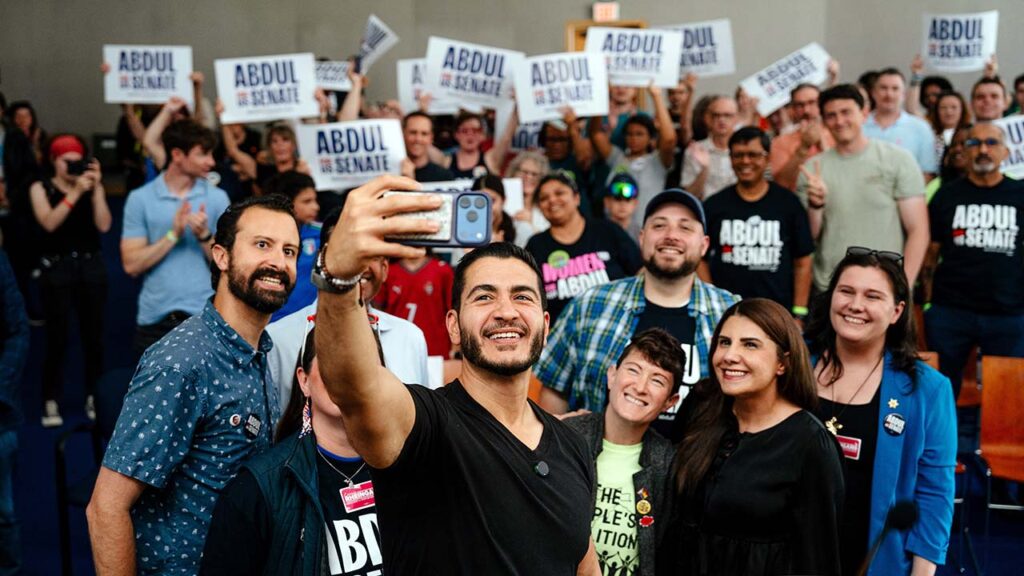
Matt Bennett, a vice president at Third Way, a centrist think tank that presses for a more moderate Democratic approach, worries that some of the party’s more progressive candidates, including Senate nominees Abdul El-Sayed in Michigan and Troy Jackson in Maine, are underperforming Democrats competing in traditional red states.
Is there a scenario in which Democrats win in red states but squeak by in blue ones? Bennett doesn’t rule it out. Midterms, he said, can produce strange results.
“Every single one of the Senate races is on a knife’s edge,” Bennett said. “The results could be super weird.”
—
This article originally appeared in The New York Times.
By Lisa Lerer/Doug Mills
c. 2026 The New York Times Company