


|
Getting your Trinity Audio player ready...
|
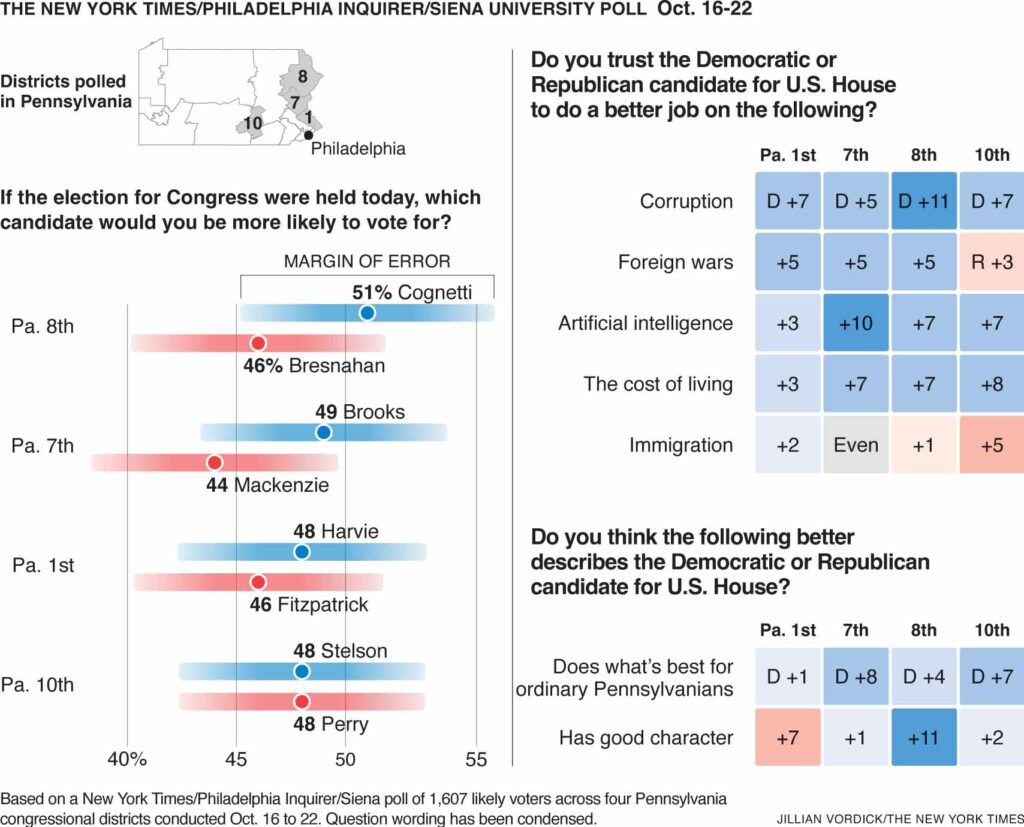
Democrats trying to unseat Republicans in four battleground Pennsylvania House districts are ahead in two of them, hold a narrow edge in a third and are tied in a fourth, according to new polling from The New York Times, The Philadelphia Inquirer and Siena University.
The four seats in Pennsylvania are seen as critical examples of some of the fights playing out nationwide. The districts include working-class communities in the state’s northeastern corner, growing towns with large Hispanic populations, a swing Philadelphia suburb and some more conservative parts of the center of the state.
In the 2024 election, Pennsylvania was one of the country’s biggest battlegrounds, and Republicans romped nearly everywhere. President Donald Trump carried the state en route to being reelected, and it was the only state in the country where Republicans flipped two House seats.

But the new polls show that Democrats are now leading in their bid to flip back both of those districts.
Taken together, the findings in the races for the four seats amount to another warning sign for a Republican Party that is increasingly at risk of losing its narrow House majority.
In Pennsylvania’s 8th District, Rep. Rob Bresnahan, a Republican, trails his Democratic challenger, Paige Cognetti, the Democratic mayor of Scranton, 46% to 51%. Cognetti and her supporters have run numerous ads accusing Bresnahan of profiting from insider stock trading, and voters in Pennsylvania gave her an 11-point edge when asked which candidate they would trust to handle corruption.
In Pennsylvania’s 7th District, Rep. Ryan Mackenzie, a Republican, is behind his Democratic rival, Bob Brooks, the head of a local firefighters union, by 5 points. In 2024, Trump won the swing district by 3 points, and Mackenzie prevailed by 1 point.
The survey in the diverse district also found that Brooks had a wide lead among nonwhite voters, as both candidates court the Hispanic vote in cities such as Allentown.
The other two races are closer.
In Pennsylvania’s 10th District, Rep. Scott Perry, a Republican, is tied at 48% with Janelle Stelson, a Democrat and former news broadcaster, in a rematch of their 2024 race. Stelson is favored on the issue that voters said they cared most about — the cost of living — but it has not so far been enough to pull away from Perry in a district where he is still favored on immigration.
In Pennsylvania’s 1st District, Rep. Brian Fitzpatrick, a Republican, trails his Democratic challenger, Bob Harvie, a local county commissioner in Bucks County, 46% to 48%. This seat is the most Democratic of the four, and Fitzpatrick is one of only three current House Republicans to represent a district that Trump lost in 2024.
Money has poured into the race in recent weeks, as Democrats believe this is the year they will finally be able to defeat Fitzpatrick, who has defied his district’s Democratic lean in presidential elections for a decade.
On the issues, voters repeatedly say they trust Harvie more. Even on immigration, traditionally an area in which Republicans excel, the Democrat has a 2-point advantage.
And voters worry that Fitzpatrick, whose district has voted against Trump for president each time Fitzpatrick has appeared on the ballot, is too cozy with the president. Nearly half of voters said they were worried that Fitzpatrick was too supportive of Trump.
Still, Fitzpatrick is holding his own in the fight for his political life, boosted by the support of 20% of voters who say they plan to support Josh Shapiro, the popular Democratic governor who is running for reelection.
But even as Shapiro is peeling off the support of about 15% of Republicans in these districts, those voters appear poised to split their tickets and back GOP candidates in their home communities.
Perry, who is the former chair of the hard-right House Freedom Caucus, has aggressively defended the war in Iran and backed many of Trump’s signature policies.
Of the four districts polled, Trump appears to be the most popular in Perry’s district. Half of voters there said they approved of the president’s approach on immigration, including 44% of political independents.
Voters also seemed to back Perry’s support for the president. More said they trusted Perry to handle immigration and foreign wars, even as Stelson enjoyed a substantial advantage on cost of living, with more voters saying they would trust her to “do what’s best for ordinary Pennsylvanians.”
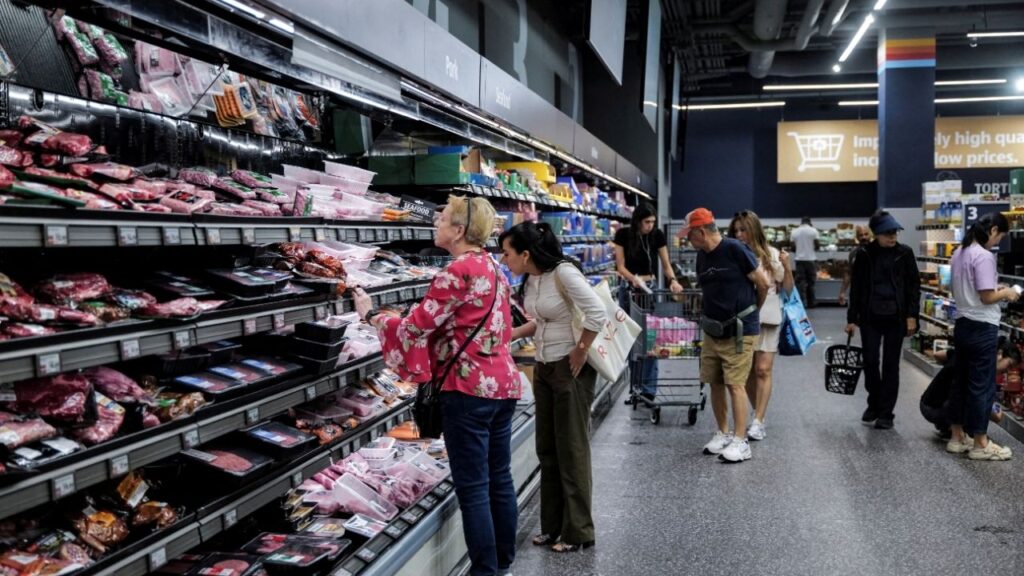
Across the four key battlegrounds, economic issues ranked as the most important: 25% of voters rated the economy as their top issue, and another 13% said that the cost of living or inflation was the most important. No other issue cracked double digits.
Trump had a 32% approval rating when it came to how he was handling the cost of living. Yet the Democratic congressional candidates had only a 6-point edge over the Republican incumbents on the issue.
Voter dissatisfaction with Trump, though, is broadly apparent in the polls.
In the four districts, half of white voters without a college degree — a contingent that is the backbone of Trump’s base and a decisive voting bloc in Pennsylvania — disapproved of Trump’s job performance. Sixty percent disapproved of his handling of cost of living.
That dissatisfaction with Trump’s approach to economic issues among white working-class voters is playing out across the country.
Democratic candidates in Pennsylvania are not winning among white voters without a college degree. But the 40% support they are garnering is a noteworthy incursion into what has typically been the base of the Republican Party during the Trump era.
—
This article originally appeared in The New York Times.
By Shane Goldmacher and Ruth Igielnik/Tierney L. Cross
c. 2026 The New York Times Company