
|
Getting your Trinity Audio player ready...
|
Every Tuesday for the last few months, two dozen of the world’s richest people or their advisers hop onto a conference call and plan for war.
The war is against a proposed tax, but not just any tax. It is against a “wealth tax” on California billionaires, one that Silicon Valley’s most affluent see as an existential threat that could usher in a new way of attacking them. So in confidential memos, WhatsApp and Signal chats and conference calls, they are banding together to battle back.
The calls are organized by Building a Better California, a nonprofit started this year to fight Proposition 40, the ballot measure that would impose a one-time 5% tax on billionaires if voters approve it next week. Each week, the nonprofit’s operatives brief donors or their advisers on polling, advertising and opposition research. Often, the calls include an ask: Would you consider giving a little more?

Eighty or so donors have provided more than $333 million to Building a Better California, state records show, making it among the best-funded political efforts in California history. The donor list is a who’s who of tech celebrities: Google co-founder Sergey Brin; former Google CEO Eric Schmidt; Stripe CEO Patrick Collison; legendary investor John Doerr.
“The effort to beat it is nothing short of an Avenger-level effort,” said Trevor Traina, a Silicon Valley investor who knows many of the billionaires socially but is not involved with the group. “Like the Avengers, this is not a homogenous group of people, but rather heroes of different stripes who share the same goal of protecting California. I, for one, pray they prevail.”
Many are aware of how it looks. Fighting a billionaire tax as populist outrage grows over inequality requires finesse. In a recent memo circulated among donors and viewed by The New York Times, organizers stressed that other supporters — not the billionaires — must be “the ‘face’ of campaigns.”
This account of Building a Better California’s efforts is based on conversations with about two dozen of the group’s donors, people solicited by it or others close to it, most of whom spoke on condition of anonymity because the group’s mechanics are secretive. The Times also reviewed California campaign-finance documents and some of the nonprofit’s confidential presentations and internal documents.
“Our supporters have created companies, entirely new industries and hundreds of thousands of jobs here in California, and they want our state to remain the place where the future is built and where people can still afford to live, dream big and succeed,” said Abby Lunardini, a group spokesperson. She said the wealth tax would “permanently damage the state’s budget, tax base and economy.”
The effort to fight Proposition 40 began with Brin and has swelled to include a wide cross-section of Silicon Valley power brokers. Donors have pressed business peers to consider giving to the organization and joining the Tuesday calls. Sometimes, the ask is for billionaires to consider donating a percentage of their net worth, a cheap commitment if it helps kill a 5% tax.
Doerr and Collison, or people who work on their political operations, have made many of the fundraising calls. They are Building a Better California’s third- and fourth-largest donors, shelling out $40 million and $33 million, respectively. Each declined to comment.
Doerr, 75, is famous for having invested in Google and Amazon and leading the venture firm Kleiner Perkins before becoming its chair in 2016. A longtime Democratic fundraiser, he has a history of political engagement in California, including squashing propositions he viewed as damaging to Silicon Valley’s ecosystem.
Collison, by contrast, is still learning the ropes. The 38-year-old Irish citizen prides himself on a bookish disposition, and has invested money and time into arcane policy topics like housing reform and science funding streams.
The wealth-tax fight is Collison’s most serious campaign engagement to date. The tax could be particularly disruptive to him because most of his net worth consists of stock in Stripe, his privately held payments company valued at $159 billion, which is harder to sell. Collison has occasionally talked of his frustrations with the tax and tried to game out the politics of the ballot measure in private conversations, people who have spoken to him said.
Those dialing-for-dollars are presenting tech entrepreneurs with the option to donate stock that has appreciated in value, according to a donation form seen by the Times. That is appealing because the stockholder can avoid paying a capital-gains tax on donated shares. The strategy has borne fruit: Over two-thirds of the money received by the group over the last six weeks has been in stock.
Backers have included venture capitalists from top firms like Sequoia Capital, Coatue, General Catalyst and Benchmark, as well as founders of tech companies including Robinhood, Rippling, DoorDash, Reddit, Figma and Coinbase.
Brin kicked off the Silicon Valley backlash in late 2025 when he moved his residence and businesses to Nevada to avoid the proposed tax. This year, he began working with the head of his family office, George Pavlov, and two political hands, lawyer Kurt Oneto and ballot expert Ned Wigglesworth, to beat the measure.
Competing efforts against the wealth tax sprouted but quickly petered out partly because of Brin’s credibility. Brin’s team canvassed policy experts and other wealthy Silicon Valley individuals. Another group, organized by crypto billionaire Chris Larsen, joined forces with Brin’s.
Over the group’s first six months, Brin, whose political activity was previously minimal, donated $102 million of his roughly $260 billion net worth. He told the Times in April that he worried about socialism taking root, as it had in his home country of the Soviet Union, which he fled when he was a child.
“I don’t want California to end up in the same place,” Brin said.
He has written seven checks to Building a Better California, but none since July. His advisers have made clear that Brin wanted others to shoulder more of the financial burden this fall. And so his allies have aggressively tried to broaden the fundraising base recently.
“Brin giving $100 million is like a middle-class family splurging on a big night out at Olive Garden. It’s nothing to him,” said Eric Jaye, a San Francisco political consultant close with some tech leaders. “The amount of wealth being created is an order of magnitude above norms. This is what late-stage democracy looks like.”
The group told donors this month that it was about $25 million under its targeted budget, with an unnamed donor willing to give $13 million more if others stepped up with a matching amount.
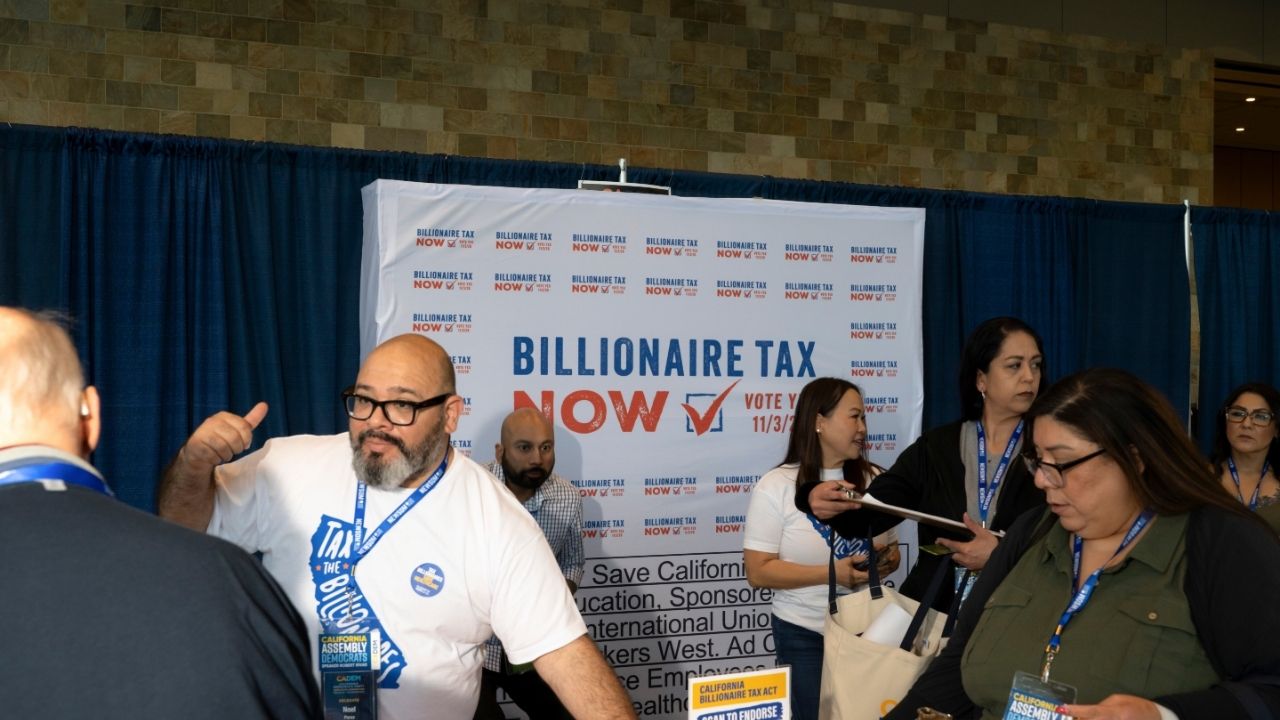
Building a Better California’s polling showed “billionaires are seen as having a net negative impact across issues,” according to a donor presentation obtained by the Times. The tax’s opponents said they have an “understandable deficit on grass roots engagement” compared with its proponents.
The nonprofit has hired a social media agency that specializes in influencer programs to create content that “appears more ‘newsy’ and left-leaning than campaign branding, allowing the content to breakthrough Democratic audiences more easily,” according to the presentation.
Most of its money, though, has gone toward political ads.
This summer, the group bought as much as $97 million of advertising time in California. Over half of that early buy has been transferred to the effort opposing Proposition 40, according to AdImpact, a media-tracking firm.
—
This article originally appeared in The New York Times.
By Theodore Schleifer and Erin Griffith/Mike Kai Chen
c. 2026 The New York Times Company