


|
Getting your Trinity Audio player ready...
|
WASHINGTON — President Donald Trump ran for the White House a second time promising to end the war in Ukraine even before taking office. That has not happened.
Trump is again pushing for a ceasefire and also wants new energy agreements with Russia.
His renewed peace effort, which comes as Russia steps up its attacks in Ukraine, has raised questions about the Trump administration’s commitment to the Ukrainians and the future of U.S. support.

Throughout his presidency, Trump has been deeply skeptical of Ukraine, portraying its president, Volodymyr Zelenskyy, as an obstacle and President Vladimir Putin of Russia as a potential partner.
The Trump administration provides only a fraction of the assistance the Biden administration gave Ukraine.
But the details of U.S. support are complex, and do not simply reflect Trump’s antipathy for Zelenskyy or his fascination with Putin.
There Has Been a Drastic Shift in Military Assistance
Defense Secretary Pete Hegseth abandoned the U.S. leadership role in the Ukraine Defense Contact Group soon after he was sworn in last year. The group helped connect Ukraine to countries that could provide what it needed most on the battlefield.
Trump and Hegseth then began chastising NATO nations for not spending more on defense and became openly hostile to Zelenskyy.
The military relations between the two countries, however, had become close in the Biden administration.
The contact group was created early on in the conflict by Defense Secretary Lloyd Austin and Gen. Mark Milley, the chair of the Joint Chiefs of Staff. It met monthly, with all NATO member states and nearly two dozen other nations supportive of Kyiv, among the more than 50 participating countries.
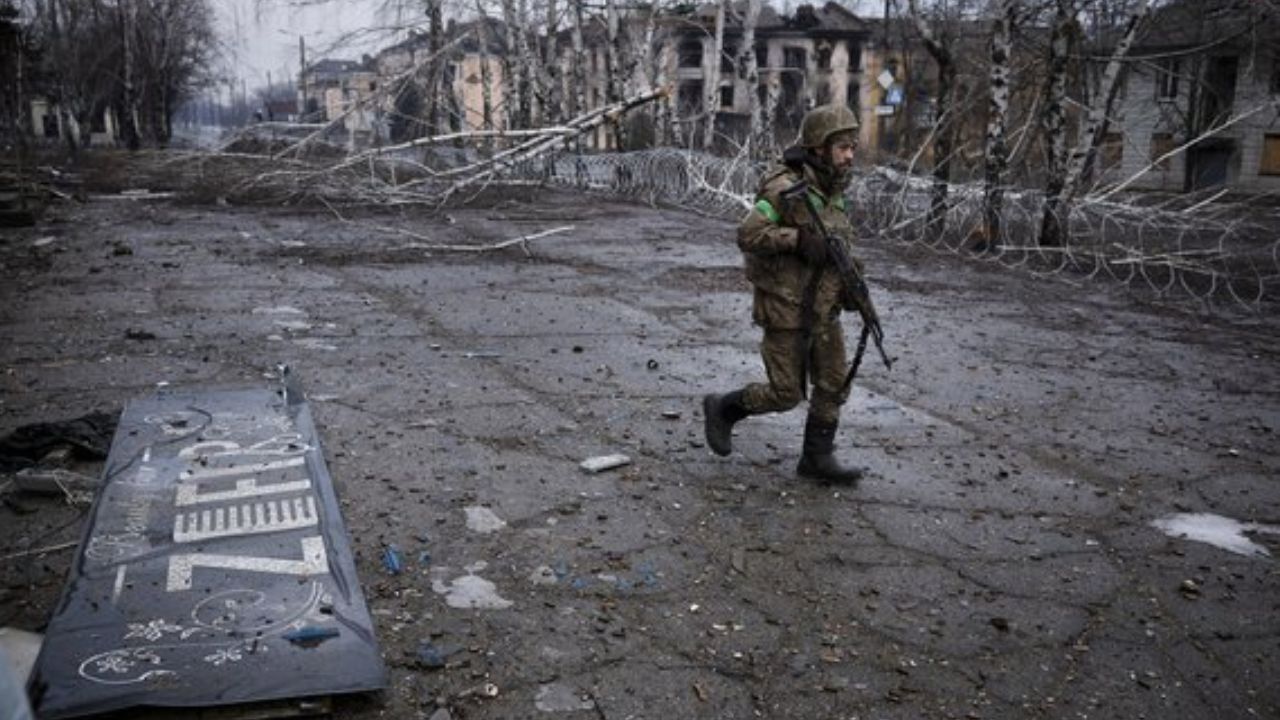
From the time Russia launched the war in 2022 until President Joe Biden left office in early 2025, the United States sent Ukraine $33.8 billion worth of weapons from the Pentagon’s stockpile, and another $33.2 billion in funds to help the country buy additional arms and hardware from the U.S. defense industry.
The grants helped rapidly modernize Ukraine’s military with a flood of NATO-standard weapons to replace those it had inherited from the Soviet Union.
Days after Russian tanks crossed the border, Kyiv began receiving Javelin anti-tank missiles to destroy them and Stinger shoulder-fired missiles to shoot down Russian aircraft. Through the summer of 2022, Kyiv began receiving 155 mm howitzers and the first of more than 3 million shells for them to fire.
As the war stretched into the fall of that year, the Pentagon began sending HIMARS trucks and guided rockets that could reach Russian targets 50 miles away. By the end of that year, Ukraine was operating Patriot anti-aircraft batteries courtesy of the U.S. Army.
Months later, the Pentagon announced it would provide Kyiv with M1 Abrams battle tanks.
Ukraine eventually received U.S.-made F-16 fighter jets from other nations after Biden consented to their transfer.
Those warplanes remain a major part of Ukraine’s defensive efforts against an increasing onslaught of Russian jet-powered drones and ballistic missiles, after Trump cut off supplies of Patriot missiles.
But the Countries Have Continued to Share Intelligence
Intelligence sharing is one area in which the U.S. partnership with Ukraine has arguably deepened in the second Trump administration.
Trump himself has said that intelligence support continues, and it is one of the primary ways the United States continues to help Ukraine.
After a turbulent Oval Office meeting between Trump and Zelenskyy in February 2025, the administration threatened to cut off the flow of information in order to pressure Ukraine to make a deal. Some military intelligence sharing, including targeting data, was temporarily halted, but cooperation with the CIA continued.
The CIA has maintained a robust presence in Ukraine under its current director, John Ratcliffe, and funding for the agency’s work there has increased.
The United States no longer provides intelligence to help Ukraine strike inside Russia with long-range missiles known as ATACMS. But beginning in June 2025, intelligence officials helped Ukraine improve the accuracy of its drone strikes on Russia’s energy infrastructure, particularly oil refineries.
The Trump administration has never given blanket support for Ukraine’s strikes in Russian territory. But the United States has covertly helped — with Trump’s permission.
After a contentious meeting between top U.S. negotiators and Ukrainian officials this month, fears rose again that the administration would cut off intelligence sharing. But that has not happened, officials have said.
US Diplomats Continue to Help Manage Aid to Ukraine
The State Department has kept up a major diplomatic presence in Ukraine during the full-scale Russian invasion. It is an important show of support in the war zone.
The Biden administration evacuated the embassy in Kyiv right before the invasion in February 2022 but reopened it that May.
U.S. diplomats help manage financial and security aid allocated from Washington. The State Department and Treasury Department have worked together to impose sanctions on Russia, but Trump has rolled back or canceled some of those penalties, most recently by announcing that the United States would buy Russian diesel fuel.
Secretary of State Marco Rubio has taken part in some talks about the war in Ukraine. But he has largely left negotiations with Ukraine and Russia to Steve Witkoff, a special envoy for Trump, and Jared Kushner, a businessperson and the president’s son-in-law, who has no government position. They report directly to Trump.
—
This article originally appeared in The New York Times.
By Julian E. Barnes, John Ismay and Edward Wong/Tyler Hicks
c. 2026 The New York Times Company