
|
Getting your Trinity Audio player ready...
|
The Treasury Department took its latest step Wednesday to try to contain rising borrowing costs, doubling the amount of its own debt it is permitted to buy back from investors. Bond yields fell sharply on the move, and stock markets rallied.
The move reflects the unease in the government bond market in recent weeks, as rising deficits, rampant borrowing by artificial intelligence companies and stubborn inflation together have pushed yields on longer-dated Treasurys higher.
That is a worry for policymakers and investors. The Treasury market is the largest bond market in the world, and yields on the government’s debt are used across the world as a benchmark for such things as business loans and mortgages. Higher Treasury yields typically translate into higher interest rates throughout the economy, reducing affordability for households as a time when many are already struggling to make ends meet.

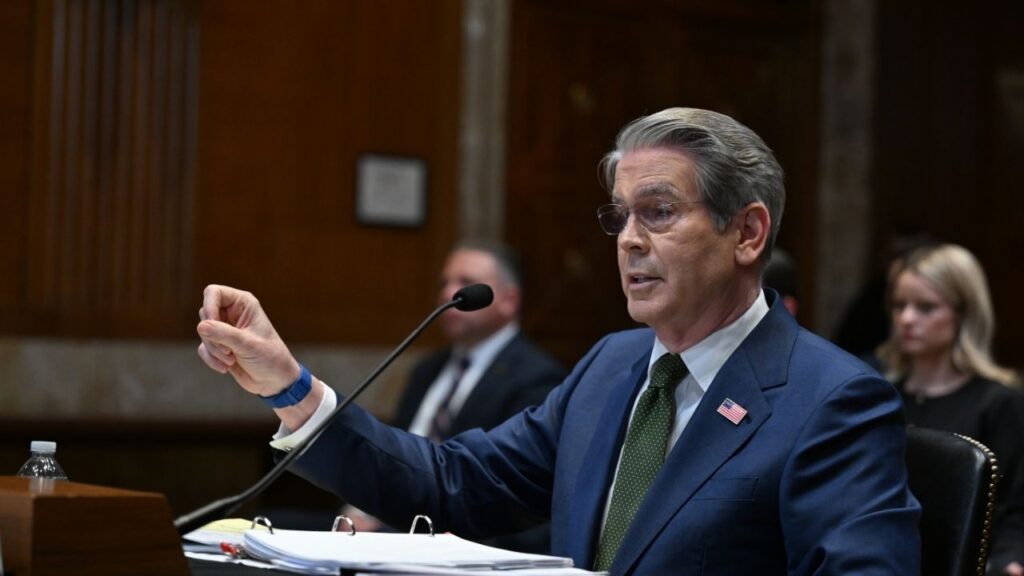
Scott Bessent, the Treasury secretary, has pointed to Treasury yields as a barometer of his success in improving affordability, saying that interest rates play a major role in “whether a young family can afford a home, a college student can buy a car, or an entrepreneur can get a small-business loan.”
The Treasury’s move Wednesday allows it to increase the scale at which it buys back its own debt, to $4 billion per weekly operation from $2 billion, adding demand into the bond market at a time when many investors have been selling.
The 30-year Treasury bond, which this week rose to its highest level since 2007, fell roughly 0.1 percentage point Wednesday, to 5.2%, its largest daily decline in months. The 10-year Treasury yield, which has a major influence over mortgage rates, also fell sharply, to 4.65%. Stocks rose, with the S&P 500 up 0.5%.
Analysts highlighted the relatively small increase in the size of buybacks, compared with the overall size of the Treasury market. There are almost $30 trillion of Treasurys outstanding, and the market consistently trades more than $1 billion per day, according to data from the Securities Industry and Financial Markets Association, a trade group.
“To me, this feels more like a communication strategy than something that will meaningfully stem the rise in long-dated yields,” said Subadra Rajappa, an interest rate strategist at the French bank Société Générale, adding that the increase is not significant enough to cause a lasting move lower in yields.
“It’s hard to get excited about a $2 billion increase in buybacks,” she said, noting that it “feels a little ‘Austin Powers,’” referring to the pittance of a ransom that the once-cryogenically frozen antagonist in the movie demands as part of a plot, not taking into account inflation in the decades while he was asleep.
The Treasury Department’s announcement is the latest in a series of efforts to try to limit the rise of long-term government bond yields.
The government has moved most of its new borrowing needs into short-term bills that mature in less than one year. The Treasury Department also recently stepped in to support the Japanese yen, which analysts suggested was a maneuver to avoid Japanese officials selling a chunk of the country’s large stockpile of U.S. government bonds to support its currency.
The Treasury auctions debt of different maturities at regular intervals. Last week, for example, it sold $42 billion of 10-year notes and $25 billion of 30-year bonds. It plans to issue a new 10-year note and another new 30-year bond every month going forward.
Investors like to own the most recently issued debt, known as “on-the-run” Treasurys. These are more heavily traded, making it easier to buy and sell in large amounts. Once a Treasury is no longer on-the-run, it becomes “off-the-run,” trading less frequently and typically with a slightly lower price — and higher yield — than more recently issued equivalents.
Once a week, the Treasury offers to repurchase some of its old debt, keeping demand strong for new Treasurys sold in auctions, and keeping overall yields slightly lower. The announcement Wednesday will increase the size of these buyback operations.
Analysts also said that as important as the announcement itself is what it signaled to the market, showing the Treasury Department is aware of the recent rise in yields.
“Long-term rates are the focus,” said George Goncalves, head of U.S. macro strategy at MUFG Securities, an investment bank. “That is clearly the case.”
The change in the size of buybacks will be effective next month, through to November, when the Treasury Department is expected to next update the market on its borrowing plans.
—
This article originally appeared in The New York Times.
By Joe Rennison/Kenny Holston
c. 2026 The New York Times Company