


|
Getting your Trinity Audio player ready...
|
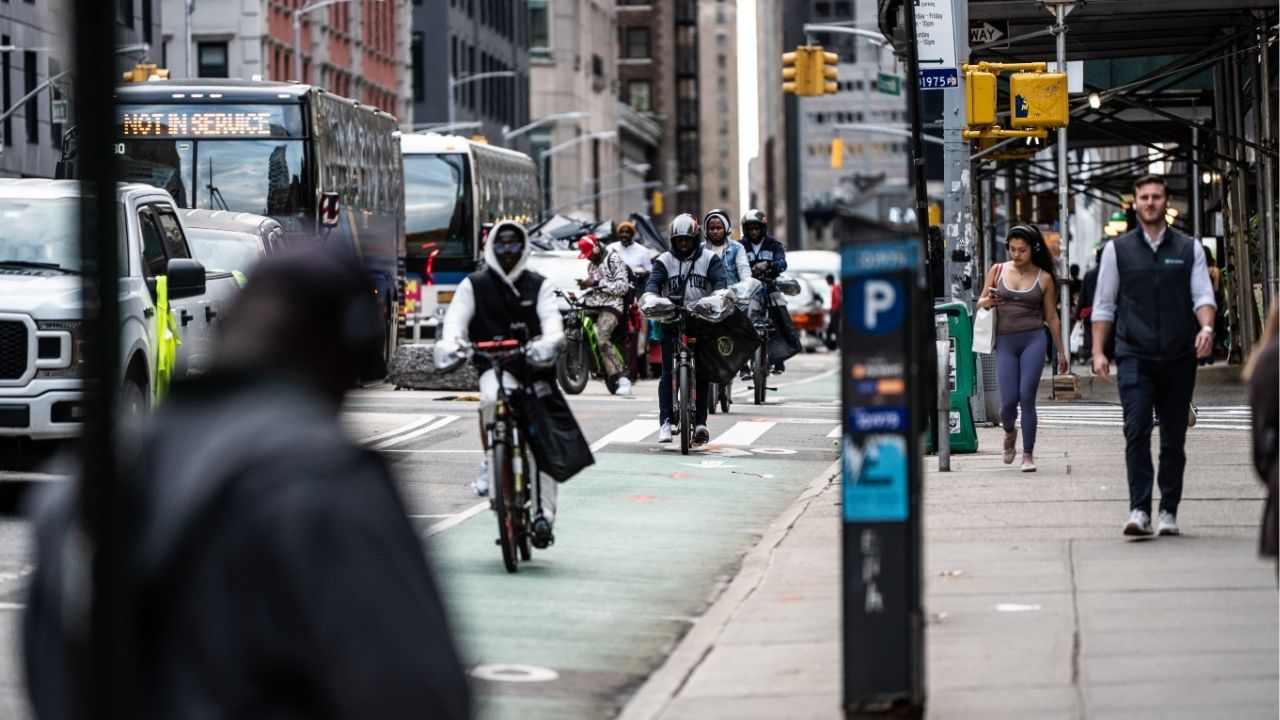
NEW YORK — New York City legislative leaders on Tuesday announced a long list of proposed rules designed to better govern the use of electric bikes and scooters and crack down on illegal vehicles after a series of fatal crashes.
The plan, presented at a news conference outside City Hall, includes 17 bills that the City Council will consider this fall. The announcement begins a long process to shape the proposals, many of which are likely to face opposition from various interest groups, each with its own view of the city’s shared streets.
Some of the bills have already been introduced, including ones that would ban the sale of some faster e-bikes that are currently legal; require delivery companies to register for commercial licenses; compel those companies to share more data about drivers’ trips; curtail the use of unregistered mopeds; and support stricter penalties for riders who flee the scene of a crash.

Other legislation under consideration would mandate additional insurance for food delivery apps; ratchet up enforcement against lawbreakers and users of illegal devices that can far exceed the 15-mph speed limit for e-bikes; and introduce a trade-in program for riders to swap illegal devices with safer ones.
Lawmakers will also consider convening a task force to study street design improvements, as well as consider requiring more detailed enforcement statistics from the Police Department.
“We cannot wait again for tragedy to strike to become advocates for public safety,” Julie Menin, the City Council speaker, said Tuesday, vowing to run a “comprehensive review” of the city’s e-bike regulations. “We owe New Yorkers streets that are safer to bike, safer to walk, safer to drive.”
The council will hold a hearing about the bills on Sept. 30, where it will question officials from the city’s transportation, public safety and consumer protection departments.
Shaun Abreu, the council’s majority leader and transportation committee chair, said the changes would “draw clear lines” that would benefit not only casual e-bike riders but also pedestrians and delivery workers.
Ben Furnas, the executive director of Transportation Alternatives, a safe-streets advocacy group, said he supported banning a category of e-bikes that can exceed safe speeds. He said he also wanted additional oversight of the food delivery industry, which has been accused of creating incentives for delivery workers to flout traffic rules.
“Twenty is plenty for urban streets, whether you’re on a bike or driving an SUV,” he said, referring to the speed limit for cars in much of the city.
The unusually large raft of bills speaks to the complicated web of concerns about pedestrian safety, worker protection and infrastructure that have animated the debate as electric vehicles have proliferated on city streets and crashes have risen.
There were 560 collisions involving e-bikes and 795 involving standup e-scooters through the third week of July, according to police data. Both figures were up 28% from the same period last year.
In a majority of serious crashes, riders were struck by the drivers of cars. At least 20 riders have died in e-bike and e-scooter collisions this year, up from 13 in the same period last year, according to the Department of Transportation.
A 17-year-old boy riding an illegal e-bike died last week in a collision with an SUV in lower Manhattan. A 49-year-old woman riding a stand-up e-scooter on the Upper West Side died last month after a driver struck her. In May, two men — one on an illegal e-scooter, the other on a bicycle — died after colliding in a bike lane on the Queensboro Bridge.
Still, the city is on track to record one of its lowest annual rates of fatal traffic crashes this year, according to the Transportation Department.
While the proposed rules take a variety of approaches to the issue, they are unlikely to please everyone.
Menin stopped short of advancing a version of Priscilla’s Law, a state bill named after Priscilla Loke, an educator who was killed in 2023 by the rider of an electric Citi Bike. The rule would require all electric bikes and scooters to be registered and display license plates.
Janet Schroeder, the director of the NYC E-Vehicle Safety Alliance, which supports the state bill, said its omission from the city’s efforts would be “an absolute shame,” arguing that requiring license plates would deter irresponsible cycling.
“We don’t want a task force and educational program bills,” she said. “It’s time for accountability.”
Critics of the licensing bill say it would be onerous and costly, would do little to curb the worst offenders’ behavior and would have a chilling effect on overall bike ridership.
“Anything that makes it harder to ride an e-bike that goes 15 mph is a huge problem,” said Alex Duncan, a bike advocate who runs a popular online community discussing “micromobility,” including bicycles and scooters.
Duncan said the focus should be on regulating the sale of higher-speed vehicles, sometimes called e-motos, which are already illegal on New York City streets. “We need controls on, basically, the bad forms of every mode,” he said.
—
This article originally appeared in The New York Times.
By Stefanos Chen / Graham Dickie
c. 2026 The New York Times Company