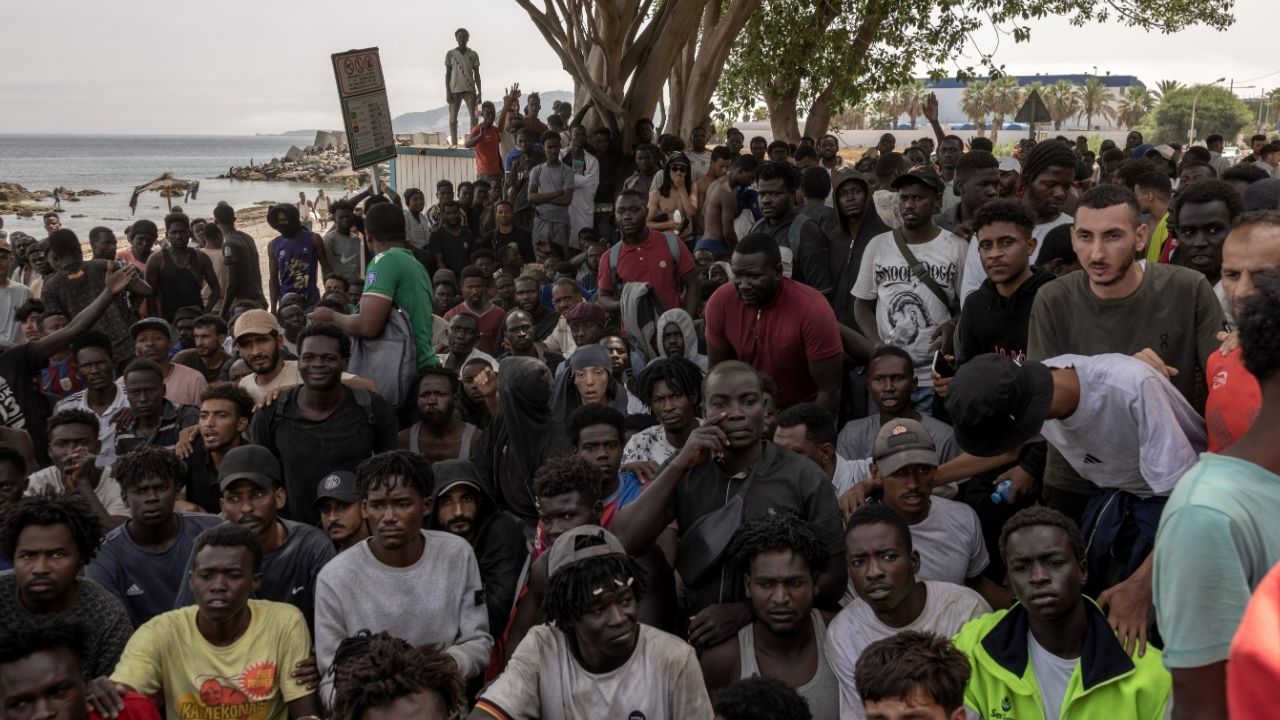

MADRID — The Spanish government Wednesday declassified a document showing that the country’s intelligence service had notified its Moroccan counterpart of calls on social media for migrants to enter the Spanish exclave of Ceuta, a day before 70,000 people surged across the Moroccan border.
Prime Minister Pedro Sánchez of Spain promised the release of documents related to what the government knew before and during the surge in a parliamentary session last week filled with accusations over who bore responsibility for the mass crossing, which began July 30 and killed 141 people.
The episode has caused a crisis in Ceuta, a city of 84,000 people in North Africa, and heaped political pressure on Sánchez and his leftist, pro-immigration government. The conservative opposition has called the migrant crossing an “invasion” that Sánchez failed to stop.

Although more than 90% of the migrants who arrived in Ceuta had returned to Morocco within 72 hours, the government has said that at least 5,000 others remain, with many living in a tent city on a beach.
Many residents of Ceuta have protested what they say is their abandonment by the government, and polls across Spain show that an overwhelming majority of Spaniards blame Morocco.
The declassified documents show that the Spanish intelligence service had also notified an official of the national government in Ceuta. But they didn’t add new information on the most pressing and politically explosive accusations, including whether the Moroccan government had played an active role in the crossing or why its border guards had failed to stop crossings.
The Spanish and Moroccan governments have both blamed human traffickers for organizing the surge. Morocco did not immediately respond to an email seeking comment about the revelations in the declassified documents.
The documents show that Spain’s intelligence agency had warned its Moroccan counterpart that it had detected “the planning of several calls to carry out entries into Ceuta, both by swimming and through the fence,” on July 30. The agency had pointed to WhatsApp groups with names like “Storming the Ceuta fence” and Facebook groups with more than 22,000 followers.
The documents also include a WhatsApp message from a Spanish intelligence agent to a government official in Ceuta, sent the day before the crisis erupted, warning about Moroccan social media messages urging a border crossing on July 30, when Moroccan security forces would be distracted by celebrations commemorating the king’s accession to the throne.
“There are two different groups with a total of 180,000 followers,” an unidentified intelligence official wrote. “Just to give you an idea of the scope of the reach.”
The Spanish government previously said it had not received any serious warnings from the country’s intelligence service. Sánchez also said last week that none of the intelligence reports “went beyond a routine warning, nor did any foresee the scale” of the crisis.
Abdellatif Ouahbi, Morocco’s justice minister, said in a televised interview last month that Moroccan forces had exercised restraint in managing the crowds surging into Ceuta in order to avoid bloodshed.
—
This article originally appeared in The New York Times.
By Carlos Barragán/Finbarr O’Reilly
c. 2026 The New York Times Company