



|
Getting your Trinity Audio player ready...
|
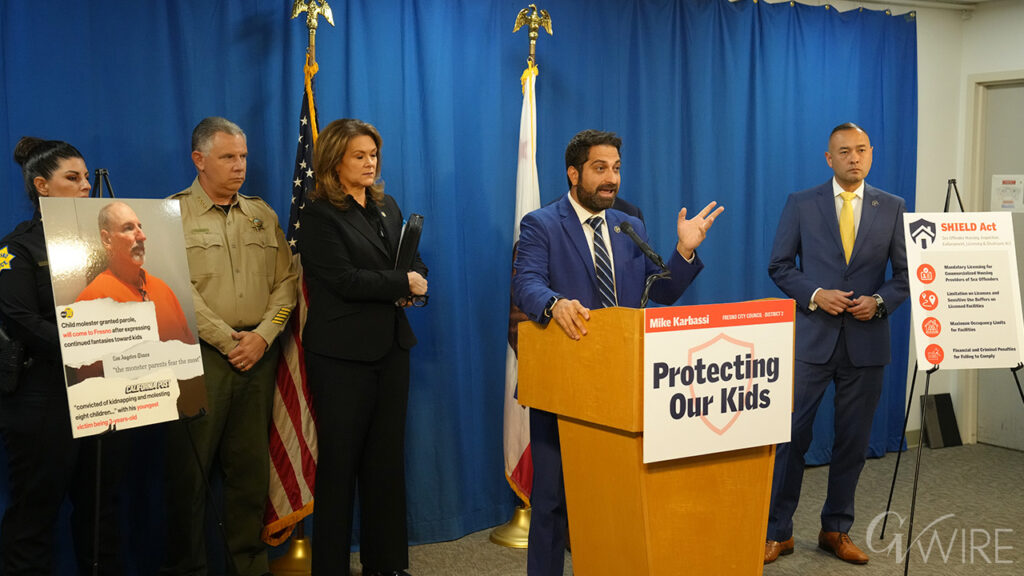
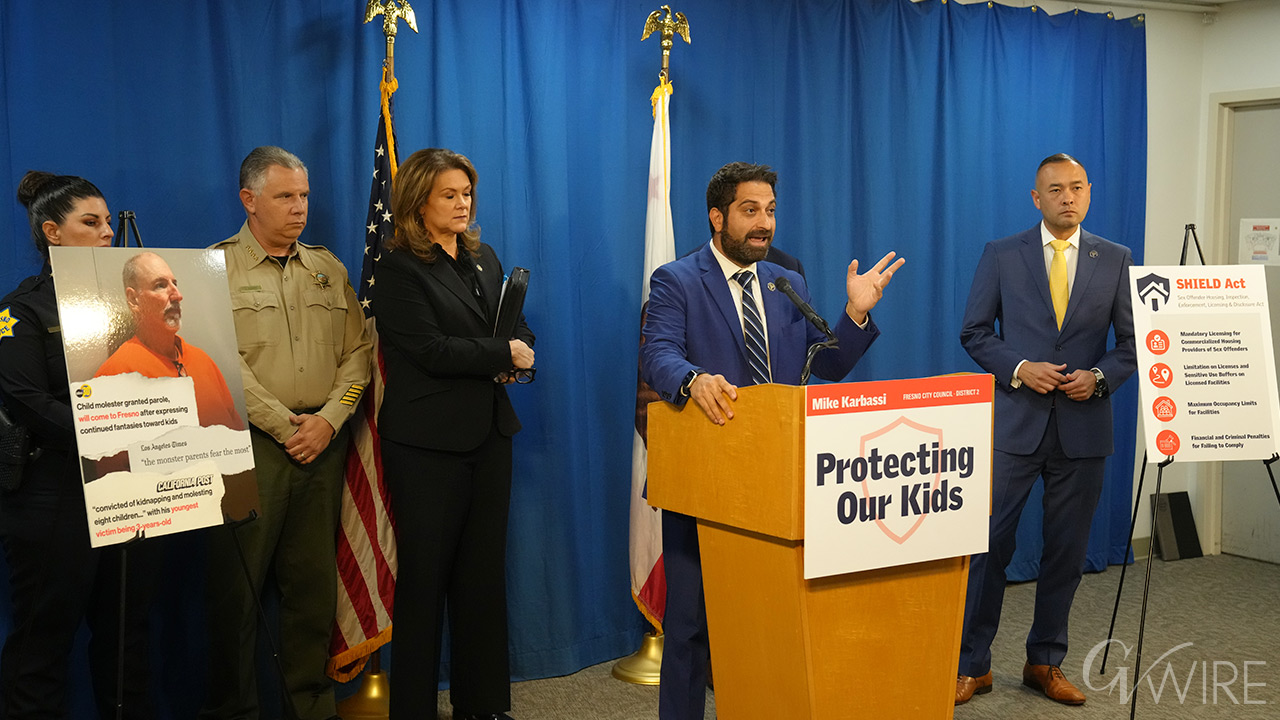
Saying that sex offenders exiting prison often turn to Fresno and unregulated group homes are all too glad to house them, city councilmember Mike Karbassi wants a licensing process to control where the homes are located.
Karbassi said Tuesday at a new conference that he would propose a study developing rules for group homes with sex offenders at the Oct. 22 city council meeting. Joining Karbassi in support were Fresno Mayor Jerry Dyer, Fresno County District Attorney Lisa Smittcamp, Fresno County Sheriff John Zanoni, Fresno Police Chief Mindy Casto, and Fresno City Attorney Andrew Janz.
Karbassi said that group homes can open with little more than a business license. And, while Fresno County in 2025 enacted an ordinance limiting the number of sex offenders living in one home to six, there is no limit to how many homes can be in one neighborhood.

By requiring licenses, the city can control where group homes are situated, Karbassi said.
“Local leaders like myself and the folks behind me became aware of a cottage industry of commercialized providers of housing for sex offenders and sexually violent predators due to our relatively low cost of living in Fresno and low operating costs,” Karbassi said. “Fresno has become a target of these providers who want to gain a foothold in our community and in our neighborhoods.”
Fresno’s Affordability Makes It Attractive for Group Homes: Dyer
If the SHIELD Act — Sex Offender Housing, Inspection, Enforcement, Licensing, and Disclosure — is approved, city staff will create limits and definitions of group homes, as well as permit fees.
“Under the law, Megan’s Law, you can have six sex offenders living in that particular home and we have no way of regulating that in the city of Fresno.” — Fresno Mayor Jerry Dyer
The near-release of convicted child rapist David Funston — who said he wanted to rehabilitate in Fresno — spurred conversations about California’s laws on releasing convicts. Funston was convicted of molesting a child as young as 3 years old.
Changes to parole eligibility in state law allowed Funston to be considered for release through the elderly parole program.
Before his release, however, Placer County district attorneys filed charges against Funston that kept him in prison. Gregory Vogelsang, another high-profile sexual predator, requested to move to Fresno after release. Vogelsang was denied parole.
Dyer said Fresno’s affordability made the city attractive to companies looking to start up group homes, which he described as a “cottage industry.”
“Under the law, Megan’s Law, you can have six sex offenders living in that particular home and we have no way of regulating that in the city of Fresno,” Dyer said.
Megan’s Law Restricts Where Sex Offenders Can Live
Megan’s Law requires sex offenders to register. But regardless of where the group home is, many cannot live near a school or other sensitive areas.
Moreover, police make regular checks on paroled sex offenders. Casto said the city has three detectives and a sergeant assigned to monitoring sex registrants. She estimated that about 1,800 sex offenders live in Fresno.
Smittcamp criticized state policy for being too lax on paroled sex offenders, adding that victims and prosecutors don’t get a say in where offenders locate.
“The old days of every sex offender having lifetime registration are gone,” Smittcamp said.