


|
Getting your Trinity Audio player ready...
|
With the mid-term election behind it, the Fresno City Council on Thursday will, after decades of dispute, attempt to answer a pivotal and controversial proposal: What to do with its Southeast Development Area plan?
And, with election results rapidly painting a picture of what the next city council will look like, Fresno Mayor Jerry Dyer told GV Wire on Wednesday that he wants to get SEDA approvals done before January.
“Tomorrow is the big day,” Dyer said.

Days before the hearing, interests on both sides have released their takes on the plan that would repurpose 2,000 acres in southeast Fresno, turning 1,547 acres into job development land and 467 acres into housing.
Those takes include a study by the Building Industry Association of Fresno Madera Counties on the original plan, not currently under consideration. The BIA concurred with Dyer’s earlier economic analysis showing SEDA can pay for itself. However, that study, done in 2025, goes one step further to show that if the city took on the full 9,000 acres of SEDA, it would also pay for itself.
“Two independent studies, one conclusion: Growth in the southeast Fresno pays its own way,” BIA President Darren Rose told GV Wire.
Dyer has distanced himself from the full SEDA plan, saying he wants to focus on the job-creation portion and about 500 acres of housing nearby. A recent Colliers International market study shows Fresno falling behind its peers for Class A industrial space, the kind Dyer says creates much-needed jobs.
“When I came into office, people told me that we needed housing and jobs,” Dyer said. “That is exactly what South SEDA is all about.”
Council Taking Shape After Election
Last week, however, attorney Patience Milrod released a letter questioning growth models that predict SEDA paying for itself. She said the city’s economic report leaves out serious investment risks that will take years to pay off.
“The 2026 EPS report does not disclose serious risks to the city of Fresno — from prepaid development costs nor from ongoing debt service and operations — for an ill-defined project of dubious feasibility (per EPS’s own 2025 report),” Milrod’s letter states. “Given the missing and/or erroneous data underpinning them, it is likely that at least several of the assumptions on which SEDA’s claimed surplus revenues depend will prove false.”
With SEDA opponents pulling forward in their city council races, the window to get a plan approved may be fast closing.
Early Wednesday morning, Naindeep Singh, running for Fresno City Council District 1, pulled ahead of opponent Rob Fuentes.
Ariana Martinez Lott, running for Fresno City Council District 7, has more than 13 percentage points separating her from her opponent Nav Gurm. Later Wednesday, Gurm conceded the race.
While both Fuentes and Gurm said they opposed SEDA, Singh and Martinez Lott ran on anti-SEDA platforms, appearing at city council meetings to denounce the plan for its costs and claim that it would take away from inner city growth.
Joaquin Arambula and Keshia Thomas, who are vying to succeed the termed-out Miguel Arias, have opposed SEDA. However, Arambula has not taken as strict of an anti-SEDA stance as Singh and Martinez Lott.
That means SEDA opponent Fresno City Councilmember Brandon Vang in District 5 will likely secure an easy three votes to oppose any future SEDA or repeal a plan when the new council is sworn in next year.
Fresno Vacancy Low, Available Space Is Old: Wagner
Dyer has long said that Fresno needs new job creation centers and residential areas to stay competitive with nearby cities.
For example, Fresno has lagged behind Visalia and Madera for business growth.
A market study done by Colliers International in July shows vacancy rates for industrial space at regional lows. Compared to 10.47% in Tulare and Kings counties, and 5.7% in Merced and Madera counties, Fresno’s 3.34% limits availability for job providers.
Building in Fresno has also been minimal, so the vacancy that is available is mostly older spaces, said Buk Wagner, senior vice president with Colliers.
Fresno has the population to support major industrial companies, so companies begin their searches in the city, Wagner said. But limited options and Fresno’s political landscape send them to nearby communities, he said.
“Our vacancy is low, and the inventory in our vacancies is older and nobody who’s looking right now really wants it, so we’re getting passed by,” Wagner said.
Visalia, Madera Attracting Major Names
Wagner said industrial jobs provide living wages and allow a community to grow.
In August, it was reported that Carvana would build a vehicle inspection center in Visalia, creating 700 jobs. Madera has major food processors Kahraman Agro and Gimme Health Foods taking over recently vacated spaces, the Colliers report states.
In Fresno, construction has been slow and major projects don’t occur without very public objections.
One recent example comes from Scannell Properties. Despite being in an industrial zoned area, that developer’s massive 900,000 square-foot project visible from Highway 180 took four years to get approvals and three rounds of environmental reviews.
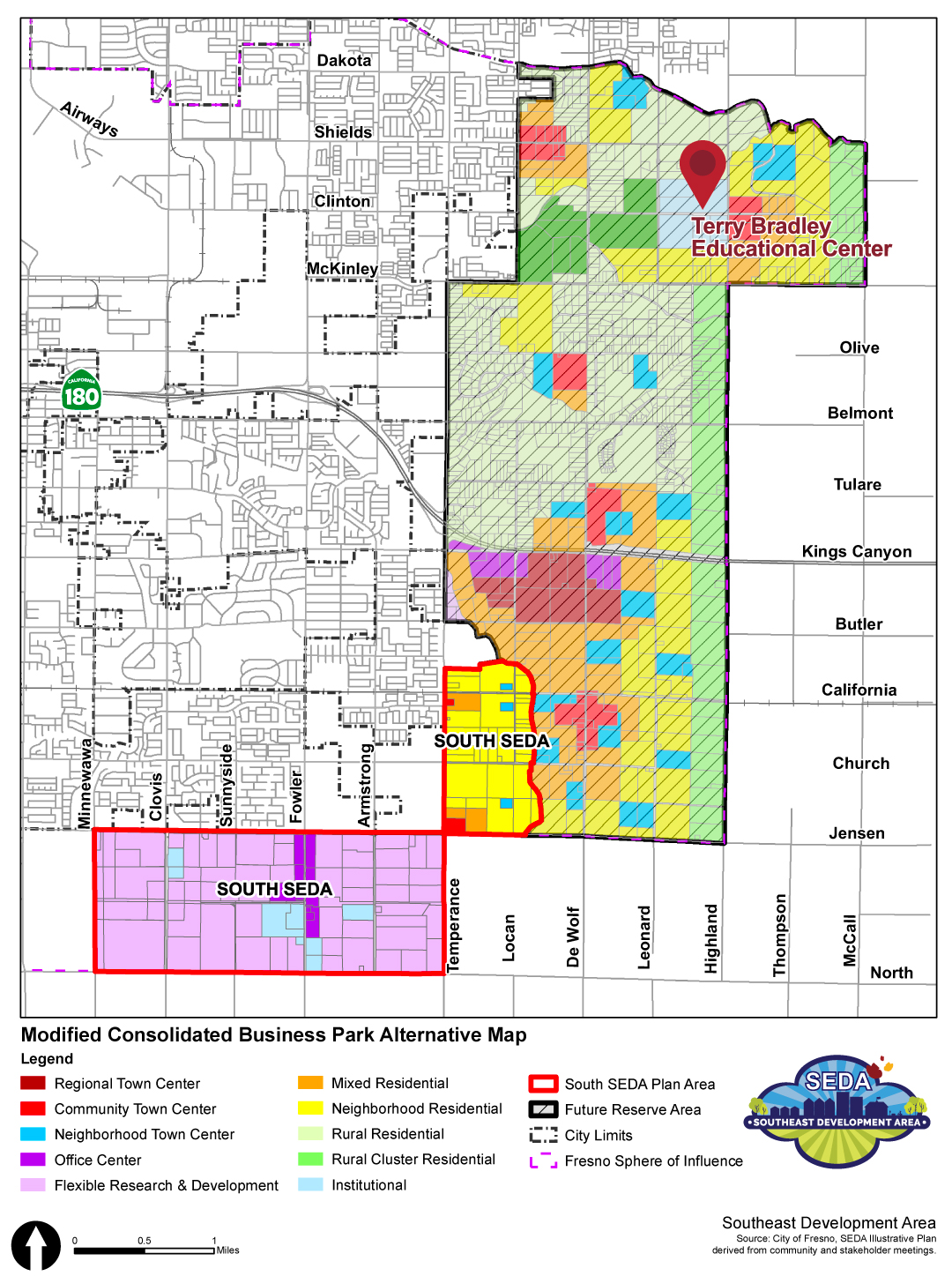
The mayor’s South SEDA plan would centralize what’s being called “research and development” space in ag land. Within plan boundaries is Lone Star Elementary, but Dyer’s administration said buffers and setbacks would provide the protections called for by Vang, who would likely oversee that district.
Years of objections to the plan resulted in additional protections, including a data center moratorium, to overcome problems from SEDA opponents.
South SEDA has far fewer residents than north or central SEDA, and so many of the rural residents who have been most vocally opposed to the plan would be less affected.
Charlie Schuh, senior vice president with Colliers, said it’s important to find a spot that people can generally agree on.
“I know not everyone is going to be in favor of it, but if there is general buy-in, I think that’s important too, that it’s in a spot that generally, people are on the same page with it being acceptable,” Schuh said.
How Fast Can Fresno Absorb New Industrial Space?
While many question whether the juice is worth the squeeze, Dyer says it is.
In September, his administration presented what experts anticipate building in South SEDA would cost. A sewer trunkline would require about $86.1 million if interest costs are included, $72 million without interest.
Even starting to pay down that debt would take between two and nine years for the industrial area and three years for the residential area, depending on demand.
To make the payments until property taxes begin coming in would require a subsidy by the city, totaling $3.2 million over three years for the residential area and between $4.4 million and $21.5 million over three years for the industrial area.
Repayment of the subsidy could take two to six years, according to the study.
Schuh was hesitant to agree with that absorption outlook because of uncertainties around the project, but said that projects currently under construction already have leases signed.
“Barring a major downturn in the economy or event like that, I would expect that if stuff started to get built, I would expect there to be people interested in it,” Schuh said.
Fresno Residents on the Hook for Being Wrong on SEDA: Milrod
Paying for city services would cost about $17.2 million annually — $8 million for the industrial area and $9.2 million for the residential area.
City services won’t be needed until buildout, and the mayor’s study states that tax assessments and general property tax revenue can make up those losses. The economic analysis predicts $26.1 million brought in from the industrial area and $9.7 million from the residential area, leaving $17.2 million in surplus at the end of each year.
Milrod’s letter questions some revenue assumptions, saying estimates to pay back fire service costs don’t take into account how much property tax revenue the city will have to share with the county.
She also called development timelines “untested,” saying a previous housing study cited by the city didn’t analyze industrial demand.
Being wrong about SEDA’s marketability means Fresno utility ratepayers are on the hook for the $86.1 million it could cost for infrastructure.
“The plan promises that ‘the city of Fresno will not subsidize new development,” Milrod said in her letter. “But the city — not developers — will incur and carry the upfront debt for SEDA predevelopment infrastructure.”
Mayor’ Plan Overstates Revenues, Understates Costs: Milrod
Milrod’s letter said overstated revenues and understated costs nullify any possible gains in the mayor’s economic study. She said the mayor’s plan overstates home values.
The city’s economic study uses an estimated average sales price of $525,000 for a single-family home and $335,000 per multifamily unit.
Density assumes 10,000 units across 20 million square feet, averaging out to 2,000 square-feet per lot, which Vang at the last approval said would be smaller than the average lot size in nearby neighborhoods.
Milrod similarly questioned the ability to achieve that sales price and thus bring in that property tax amount.
Dyer, however, said the design of South SEDA is around transit-oriented homes, something clamored for by environmental groups. Despite that, Dyer told GV Wire that regardless of the density, SEDA would still pay for itself at buildout.
“We can do South SEDA with 6,000 square-foot lots, and that would still generate $12 million in surplus revenues,” Dyer said.
BIA Says Full SEDA Commitment Could Be Repaid in 4 Years
The BIA commissioned the National Association of Homebuilders to look at the economics of selling in the area east of Temperance Avenue and south of Dakota Avenue. That study was completed in 2025.
Zoning within the study area has changed since Dyer adapted the plan to favor South SEDA, but BIA President/CEO Darren Rose said the conclusions still ring the same — that SEDA revenue, once building begins, will start collecting revenue to pay for the more than $1 billion required for the full SEDA buildout.
Dyer’s South SEDA plan requires 70% buildout before expanding northward and a new environmental analysis.
The study says that if the city fully committed the $1.4 billion in costs — initial and ongoing — property tax revenues could repay within four years.
Using a model of 700 single-family homes built every year and 800 multifamily units over a construction period of 15 years, it anticipates generating $3.9 billion in revenue annually.
An anticipated 5,900 jobs supported each year during construction would provide $510 million in paychecks and business income, the study states. That adds $110 million in tax and fees for local government.
After construction, the study predicts 1,270 jobs supported annually and $89 million in salaries and business income.
“For years, critics have argued that new growth in southeast Fresno would be a drain on the City’s budget. The numbers say the opposite,” Rose said. “Even when you stack every assumption against development, SEDA pays back its infrastructure in four years and then delivers a growing surplus for decades. That’s money for police, fire, parks, and streets citywide.”
BIA Forecast Assumes Massive Building Spree
Being released a week before the hearing, many at Fresno City Hall have not had a chance to review the BIA numbers.
In 2024, the city issued 1,401 building permits for housing units of all kinds, according to the city’s housing element for that year. That means that the 1,500 units assumed in the BIA’s study for SEDA would surpass totals for that entire year.
Environmental planner Daniel Brannick told GV Wire he questions cost assumptions, saying infrastructure cost estimates come from building within the city sphere and don’t take into account building in the periphery.