


|
Getting your Trinity Audio player ready...
|
After years of waiting, the Fresno public got its first view at how the city can pay for the Southeast Development Area and what benefits it may bring. However, the question looms of whether SEDA can garner enough interest to justify the initial buy-in costs.
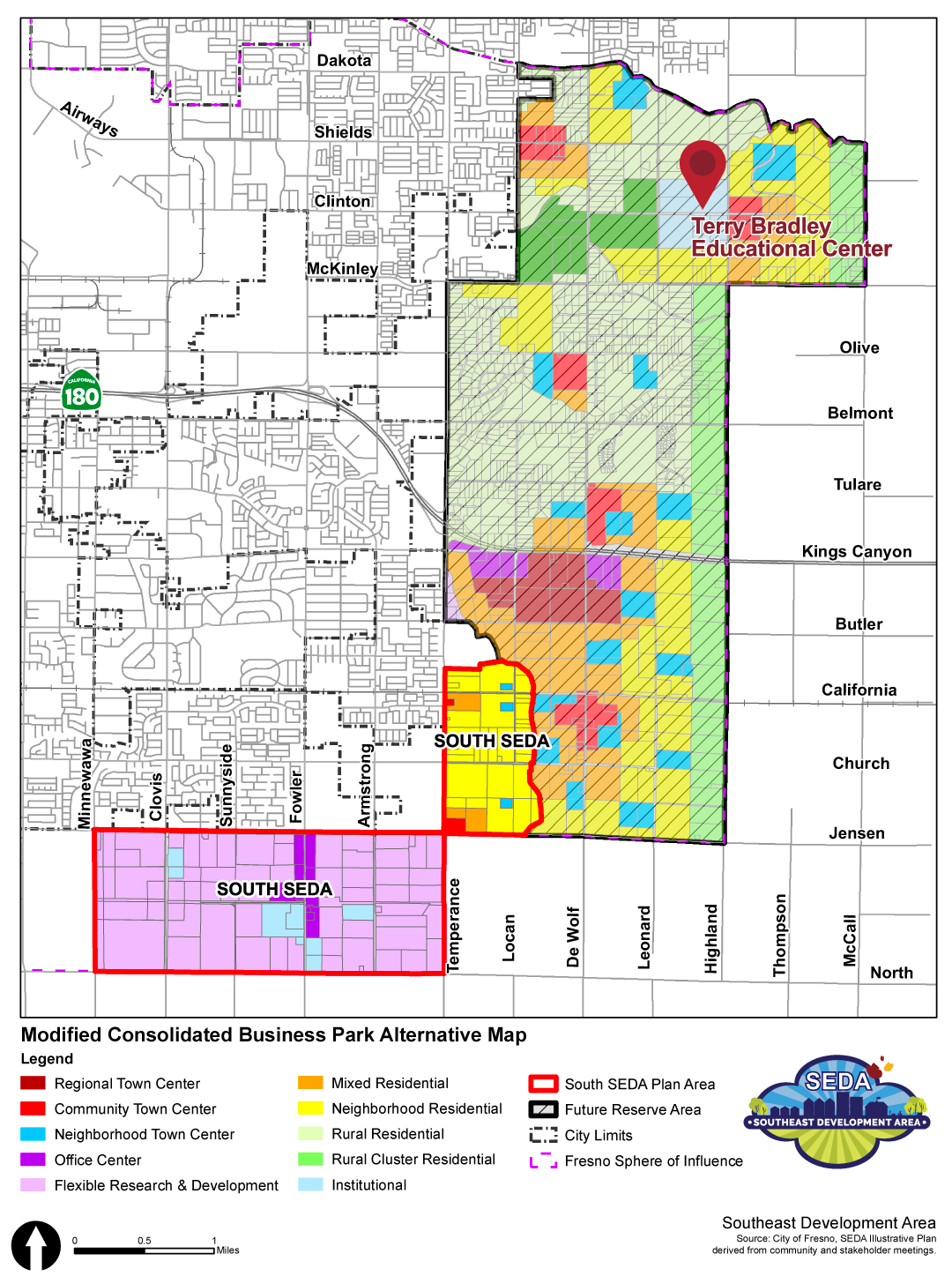
The city of Fresno on Thursday held a financial analysis workshop for South SEDA, which is designated for industrial buildout and 467 acres of adjacent residential homes.
City administration said it would be a revenue generator after it gets fully built out, estimated to be sometime in 2047.

“We have presented a financial picture that not only says South SEDA is going to pay for itself, it’s going to cash flow a fiscal surplus that we can then put back into the infill opportunity zone for housing, for street repair, for sidewalk repair, for tree trimming, for all those things that neighborhoods have not necessarily had for the past several years,” said Mayor Jerry Dyer at the meeting.
But while city administration told councilmembers that the area would bring in more money than it costs, it wouldn’t do so without significant initial municipal investment. That includes bonding against utility rate payments and paying a subsidy for between two and nine years until South SEDA begins generating enough revenue to pay for that bond.
Those conditions have created uncertainty about SEDA’s future among some councilmembers.
For example, councilmembers Brandon Vang, Miguel Arias, and Nick Richardson raised questions about what happens if SEDA doesn’t attract developers and the city can’t pay its bills.
“What we don’t know is what’s going to happen after that,” Vang said.
$86 Million Trunkline
Building the necessary trunk line in South SEDA — in the 1,547-acre portion south of Jensen Avenue and the 467-acre portion east of Temperance Avenue — would cost the city $86.1 million, including interest on the bond.
The only work that the city would undertake on behalf of developers would be the massive sewer trunkline so work can begin. Cities regularly take on that initial work when preparing for expansion and get repaid as property taxes roll in.
Given that it would take several years to transform that ag land into revenue generating properties, city consultant Amy Lapin, with Economic & Planning Systems, said the city’s options to fund are largely limited to bonding.
Arias said given that the Parnagian family owns roughly 1,000 acres in South SEDA, they should undertake the investment on their own. Fresno City Manager Georgeanne White and Lapin countered that a single developer would have difficulty financing the trunk line.
Could SEDA Affect Water Rate Payers?
At full buildout, estimated to be in 2047, the entirety of South SEDA would bring in about $45.1 million annually, $19 million for the “flexible research and development portion” and $26.1 million for the residential portion.
Counted against about $27.9 million in expenditures — police, fire, but not road repair — the area would net the city $17.2 million. The city calculated road repair separately as money from California’s gas tax or the countywide Measure S transportation tax, if approved by voters, could pay for those repairs.
Dyer said a portion of that surplus would go into a Community Benefit Fund to pay for needs in other parts of the city.
“These numbers look great. They pencil,” said Council President Nelson Esparza.
Other councilmembers weren’t as sure.
Water and sewer rates could go up if SEDA doesn’t pay for itself, White said. Annual payments on the bond would equal about $6.5 million.
For the first several years, a subsidy would be needed to make that payment. The city has a reserve of roughly $32 million, but Arias in the meeting said that reserve goes toward emergency situations.
Financial analysts for the city said the plan would be cost neutral between three and six years with private development paying back the subsidy another two to five years after that.
White, however, said in the past 30 years, even with the ups and downs of the economy, the city has not had to raise rates because of inability to pay a bond.
“We have not been confronted with that issue,” White said.
Can City Sell Industrial South SEDA?
The marketability of SEDA was a recurrent theme among councilmembers and members of the public. Until recently, the plan had been for homes in the SEDA area. In the last couple years, the focus changed to a job center.
Dyer said he didn’t support SEDA until the current smaller version was envisioned.
What exactly “flexible research and development” is remains unclear. The city likened it to the industrial area near Ingram and Nees avenues, with family-owned small businesses occupying those areas.
Speculation circulated in social media that data centers were planned for the area. However, Councilmember Nick Richardson and Dyer got a plan approved to begin the process of banning data centers.
Richardson said by eliminating the possibility of data centers would make the SEDA discussion “more emotion free and more fact based.”
Planning and development director Jennifer Clark said the city may be able to bring the text amendment ban before council before the end of the year.
Even without data centers, staff estimated between 500,000 and 2 million square feet of industrial businesses could come to the area. Another Valley city, Visalia, has eclipsed those numbers time and again with its focus on industrial development on its north end.
Jobs in the industrial area could equal 8,600 construction jobs and 23,700 permanent jobs at full buildout, according to city documents.
10,000 Units on 467 Acres
In the 467-acre residential area, the city said that developers could build 10,000 units, 80% of them single-family homes. With 20 million square feet to divide up, that leaves an average of 2,000 square feet per lot, something Vang said would be a stark contrast to the average lot size in his nearby district equaling twice that.
Clark said that not all lots would be equal and they would vary from apartments to larger homes.
Dyer said even if the city reduces lot sizes, it would still net revenue.