
|
Getting your Trinity Audio player ready...
|
LOS ANGELES — Graphic footage showing the deaths of two men in the custody of the Los Angeles Police Department prompted calls this week for additional oversight of the department. Experts raised questions about how officers had responded to two recent encounters, both of which appeared to involve mental health crises, and Mayor Karen Bass said she had doubts about how officers had been prepared for such challenges.
“What is the training?” Bass said in an interview Tuesday. “My impression is that it does not seem to be adequate.”
Video footage of the two deaths, which was captured by law enforcement cameras, jarred the nation’s second-largest city when authorities released it late last week. Police accountability laws in California are among the more stringent in the United States, a response dating to riots in 1992 that were sparked by the beating of Rodney King.

Videos from July 15 show detention officers in a city jail converging on a man brought there after family members had called the police, saying he was brandishing a knife at them.
After an hourslong standoff with crisis negotiators and SWAT officers, the man, Jose Carlos Hoyos-Munoz, 58, had been arrested. At the holding facility in the San Fernando Valley, however, police said he resisted their efforts to fingerprint him. In the video, officers can be seen moving him to a fingerprinting area, where they hold him down while they cover his head with a “spit sock” — an effort, officials said later, to stop him from biting and spitting on them.
Later footage from a cell shows officers swarming him as he stands on top of a toilet with his hands cuffed behind his back. Several officers wrestle him onto a cot, face down, the video shows, then back away from his prone body several minutes later.
Hoyos-Munoz was pronounced dead a short time later. Authorities have yet to release a cause of death.
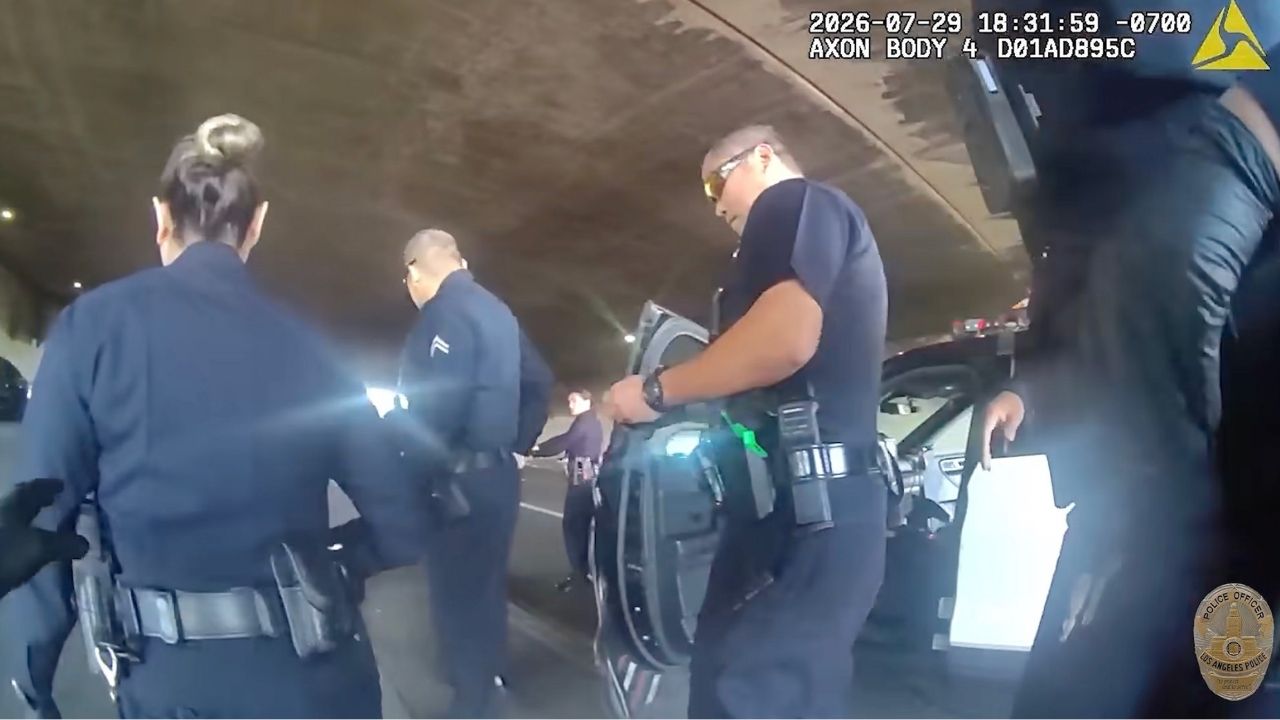
In a second video, officers can be seen shooting a man who was reported to be swinging an aluminum baseball bat at pedestrians and cars along a Los Angeles sidewalk on July 29. The man, Alejandro Luis Garcia, 33, died in the shooting.
In the footage, officers shout at the man to drop the bat. Seconds later, an officer opens fire.
Los Angeles police officials said both deaths were under review by internal investigators and outside agencies, including Los Angeles County prosecutors. No criminal charges have been filed or disciplinary actions taken against the officers.
“Our officers are committed to protecting the public, preventing violent crime, and responding with compassion to individuals experiencing a mental health crisis or severe emotional distress, often in rapidly evolving and complex situations,” a statement from the department said. “In these moments, officers must make split-second decisions to safeguard innocent lives.”
Law enforcement officers are allowed to use deadly force if they reasonably perceive an imminent threat of death or great bodily harm to themselves or someone else.
In Los Angeles, detention officers at city jails are not sworn officers, but civilians who receive some training in handling people with mental illness, according to department officials. Los Angeles police officers receive at least 40 hours of mental health intervention training, and mental health professionals are deployed with every SWAT call, according to the department’s policy.
Jeff Wenninger, a retired Los Angeles police lieutenant who consults on use-of-force issues, said footage of the jail death raised concerns. At several points, he said, officers appeared to have pinned Hoyos-Munoz down in a way that might have restricted his breathing. A spokesperson for the police department declined to comment, citing an ongoing investigation.
In 2021, after the death of George Floyd led to a national reckoning on police abuses, California made it illegal for law enforcement officers to use any restraint or transport method that puts people at substantial risk of so-called “positional asphyxia.” City policy requires that officers be trained to restrain people without restricting their breathing.
Nithya Raman, a City Council member who is challenging Bass in the mayoral race, has sparred with the mayor over police funding and the police union’s support for Bass.
On Tuesday, Raman said that she would strengthen oversight of the police.
“What happened to Jose Carlos Hoyos-Munoz and Alejandro Garcia is disturbing and demands justice,” she said. “Both cases need a full, independent investigation with real accountability.”
A woman who identified herself as Garcia’s sister declined to speak with a reporter.
Hoyos-Munoz’s brother described him as a kind man who took particular care of their mother after their father’s death several years ago. The brother, Jorge Hoyos, said Hoyos-Munoz had moved from Peru roughly two decades ago and worked in the dental field.
He struggled with his mental health, his brother said, requiring medications that he had stopped taking last year after complaining that they were affecting his sleep.
On the day Hoyos and his mother called the police, the family had hoped that officers would take Hoyos-Munoz to the hospital.
“He was not taking the medicine by himself, and he refused to take it from me,” Hoyos said. “What he did was very small, but the police considered him like a criminal.”
Hoyos said he told officers he didn’t want to press charges, only to get help for his brother, whom the family called Pepe.
“We’re missing him,” he said.
—
This article originally appeared in The New York Times.
By Jill Cowan and Shawn Hubler/LAPD
c. 2026 The New York Times Company