

|
Getting your Trinity Audio player ready...
|
More than 3,000 miles of railways crisscross the Swiss countryside, linking Alpine villages to big cities like Zurich and Geneva. It’s the most dense rail network in Europe.
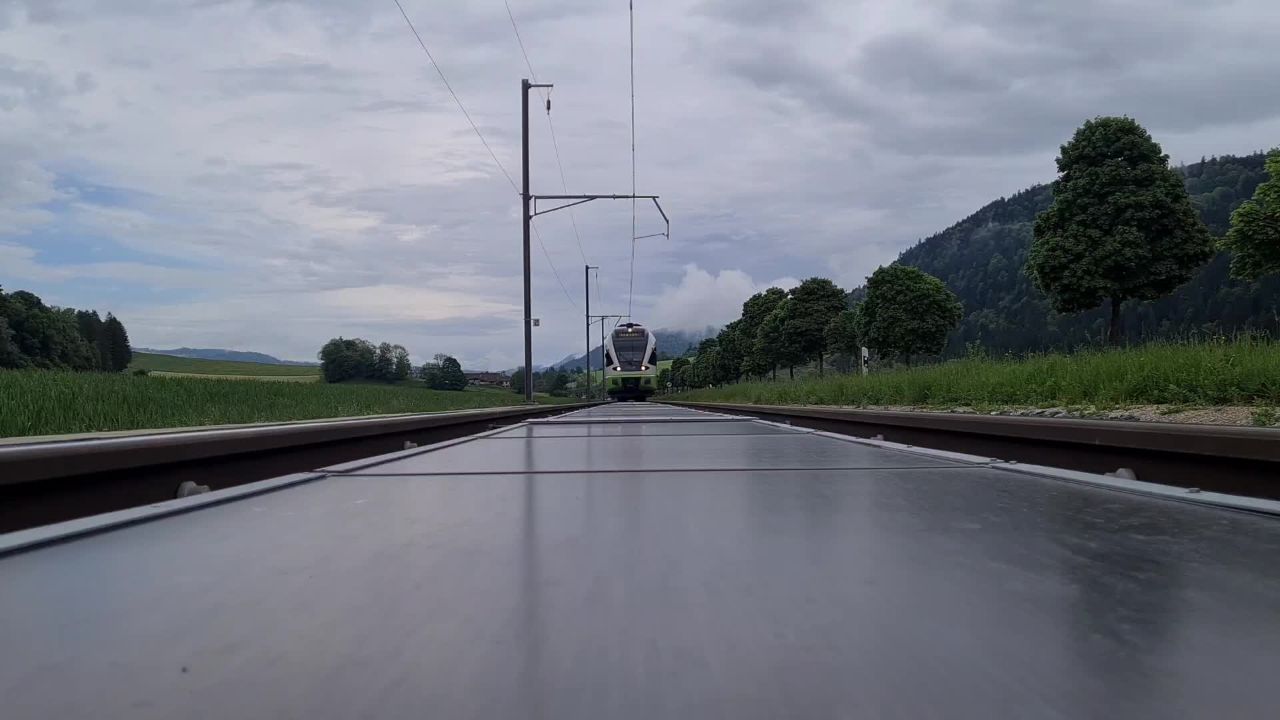
Now, a startup company and a local rail operator have found a way to use that land to generate clean electricity: Lay solar panels between the rails.
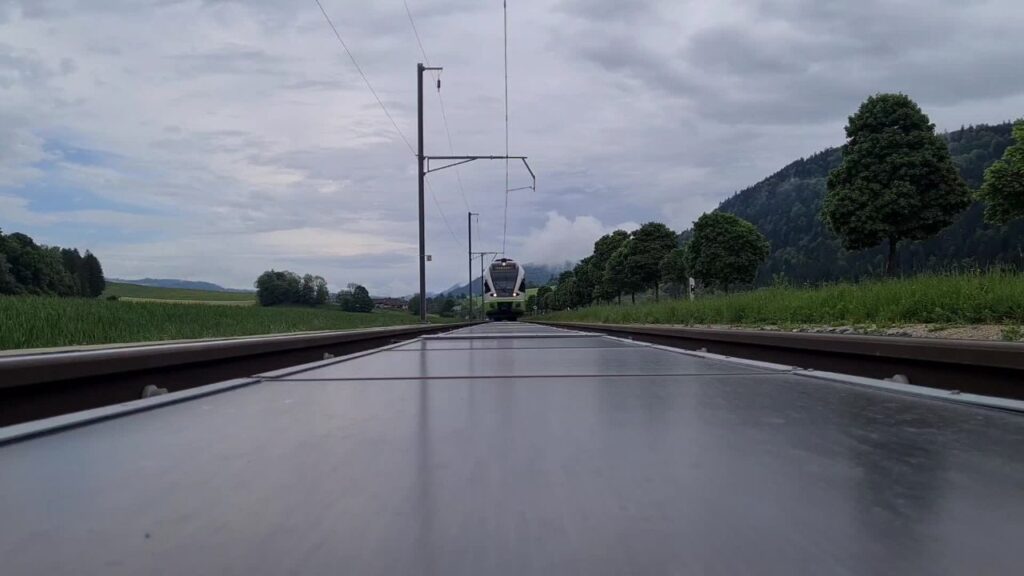
Starting last April, in the shadow of a craggy mountaintop in the village of Buttes, the company, Sun-Ways, began running a test project on a short stretch of track that proved the idea can work. Similar projects are now expanding to France, Italy and South Korea.

“This technology is rock solid,” said Valerio Tamellini, project manager at TransN, the Swiss public transit company that hosted the initial pilot project in Buttes.
A Variety of Designs Being Tested
TransN’s test covered only about the length of a football field of track. But if the technology were to be adopted across Switzerland’s national rail network, Sun-Ways projects it could power as much as 30% of the country’s energy needs for public transportation.
In February, the French national railway company SNCF signed a partnership with Sun-Ways to evaluate the technology for its own tracks, which cover about 18,000 miles. “We want to become a big, big solar energy producer,” said Nicolas Phan-Trong, who leads energy and decarbonization projects for the company, which is France’s largest landowner and consumer of electricity.
SNCF is testing at least 10 different solar designs and planning a “much bigger installation,” Phan-Trong said. Another potential benefit, he said, is that placing solar panels between the rails prevents weeds from growing between the tracks, reducing maintenance and potentially offsetting part of the cost of the solar installations.
The Sun-Ways design has also been picked up in South Korea, where the government approved a two-year pilot at the Korea Railroad Research Institute’s test track last September to evaluate the technology.
In Buttes, the Sun-Ways design uses solar panels that are pinned in place by pistons that press against the steel rails. The concept of installing solar on railbeds isn’t entirely novel, according to Joseph Scuderi, the company’s founder, and had been explored in more than a dozen earlier patents. But the current design uses pistons to hold the panels in place, enabling them to be moved out of the way for maintenance by a single worker in about 10 minutes.
Solar Needs Space to Absorb the Sun’s Energy
Increasingly, decisions to expand solar generation aren’t constrained by technology or cost, but rather by space. Traditional, ground-mounted solar farms can require 2 1/2 acres of land to generate a single megawatt of power. But building between rails and on top of existing infrastructure solves part of that problem, said Giuseppe Fulco, an Italian engineer and energy consultant.
Fulco said he has negotiated a license with Sun-Ways to launch a test project in Italy in the next year. Fulco estimated that if 20% of Italy’s railways, or roughly 2,500 miles of track, were used for solar installations like these it would add up to a gigawatt of generating capacity, enough to power up to 1 million homes.
Switzerland and other countries across Europe are pushing to add renewables not only to meet new demand from the electrification of vehicles and to reduce their greenhouse gas emissions, but also to bolster energy independence after the continent weathered an energy crisis wrought by the war in Ukraine in 2022.
Most of the energy could be used by electric trains, Scuderi said. But one complication of the technology is how to move excess electricity to other places where it could be used or fed into the grid. A significant amount of energy could be lost during that transmission process, said Julien Pouget, who studies electrical systems at the University of Applied Sciences Western Switzerland Valais.
What About the Costs?
Pouget and his colleagues said they are working on a specialized electrical architecture to try to minimize those losses, which could make scaling solar-producing railways far more viable. His research was presented at a summit of power systems in Paris this month, he said.
Another question is cost. Fulco said that could be partially offset because rail companies already own the land, which would otherwise be a major expense. Tamellini expects the economics will be further explored as the Buttes pilot concludes in 2028, and as other projects spring up in other countries. If the price works, he said, “why not deploy it everywhere?”
This article originally appeared in The New York Times.
c.2026 The New York Times Company