


|
Getting your Trinity Audio player ready...
|
DAKAR, Senegal — Five of the 20 U.S. deportees who arrived in Liberia on Thursday as part of a deportation deal with the Trump administration refused to deplane and had to be restrained for several minutes by U.S. federal agents, according to two people with knowledge of the situation.
The 20 deportees arrived at Roberts International Airport on Thursday afternoon in the Liberian capital, Monrovia, according to Liberia’s foreign minister, Sara Beysolow Nyanti.
U.S. federal agents escorting the deportees forced the five resisting men off the plane, but eventually all five were returned to the aircraft, according to three people who spoke on the condition of anonymity because they were not authorized to discuss the operation.

The Liberian government has not clarified the status of the five individuals. The State Department referred questions about the operation to the Department of Homeland Security, which did not respond to requests for comment. A video verified by The New York Times shows some of the deportees sitting on the airport tarmac next to the plane, surrounded by roughly 20 agents.
The deportees arrived in Liberia amid a growing backlash in Africa, with critics saying the Liberian government’s deal with the Trump administration to accept 1,200 U.S. deportees is too large and too opaque. And the resistance among some of the deportees underscored how the Trump administration’s efforts to expel migrants to countries where they have no ties have caused fear and uncertainty, rights groups say.
The deal with Liberia, in West Africa, is one of the largest struck by the Trump administration so far for so-called third-country deportations, in which U.S. deportees are not sent to their home countries.
It is unclear if any of the deportees have criminal records in the United States. But the agreement has raised questions among Liberians about a lack of transparency.
“The issue of deportations is raising many concerns that can’t be left unanswered,” said Adama Dempster, a human rights lawyer and activist in Liberia. “What conditions will they be held in? And how does Liberia benefit?” he said. “Liberians, we are hospitable people, we love strangers. But the government should explain this.”
The deportees will initially be held in a government facility and be allowed to seek asylum in Liberia or return to their home countries, said Jerolinmek Matthew Piah, Liberia’s information minister.
“They are being received as guests,” he said in a statement. He highlighted Liberia’s history of welcoming refugees and migrants, often deported to countries where they have no ties, as an explanation for the deal.
Liberia’s government has said it did not demand or receive any compensation as part of the deportation deal with the Trump administration. Dempster said this was hard to believe, considering the economic challenges in a country where more than half of the 6 million people live in poverty.
“What is more concerning is that the U.S. is sending 1,200, a high number. Liberia has a struggling economy where unemployment is high. What conditions will be put in place to help?”
Thirty countries have made third-country deportation deals with the Trump administration, according to Human Rights First, a nonprofit group that tracks deportations. The majority of the countries making such agreements have been in Africa, including Congo, Ghana and South Sudan.
For several months, the administration pushed to send to Liberia a Salvadoran immigrant, Kilmar Abrego Garcia, whose deportation case has become a symbol of President Donald Trump’s crackdown on illegal immigration.
Abrego Garcia spent months in a notorious prison built for terrorists after being deported to El Salvador last year. He was later returned to the United States, then faced human smuggling charges that were later thrown out by a federal judge in Nashville, Tennessee, as an abuse of prosecutorial powers.
No information about the deportees’ records has been made public, fueling anxiety in Liberia, where crime centered on the drug trade has exploded in recent years. A crackdown by law enforcement has resulted in hundreds of millions of dollars of cocaine seized by officials.
Piah said the deportees were not “criminals” and “not being prosecuted in any manner under United States or Liberian law.” But his denials have been met with skepticism among rights groups that say his statement does not adequately address whether the deportees had criminal records or were awaiting trial.
The deal with the Trump administration has also raised questions about whether diplomatic pressure was applied on Liberia, a country with deep ties to the United States. Liberian history is rooted in America’s “Back to Africa” movement and the American Colonization Society, a group formed in 1816 by philanthropists, abolitionists as well as some slave owners.
The group helped resettle free Black Americans in what would become Liberia. At Liberia’s independence, its constitution and flag were modeled on those of the United States. English is the country’s official language.
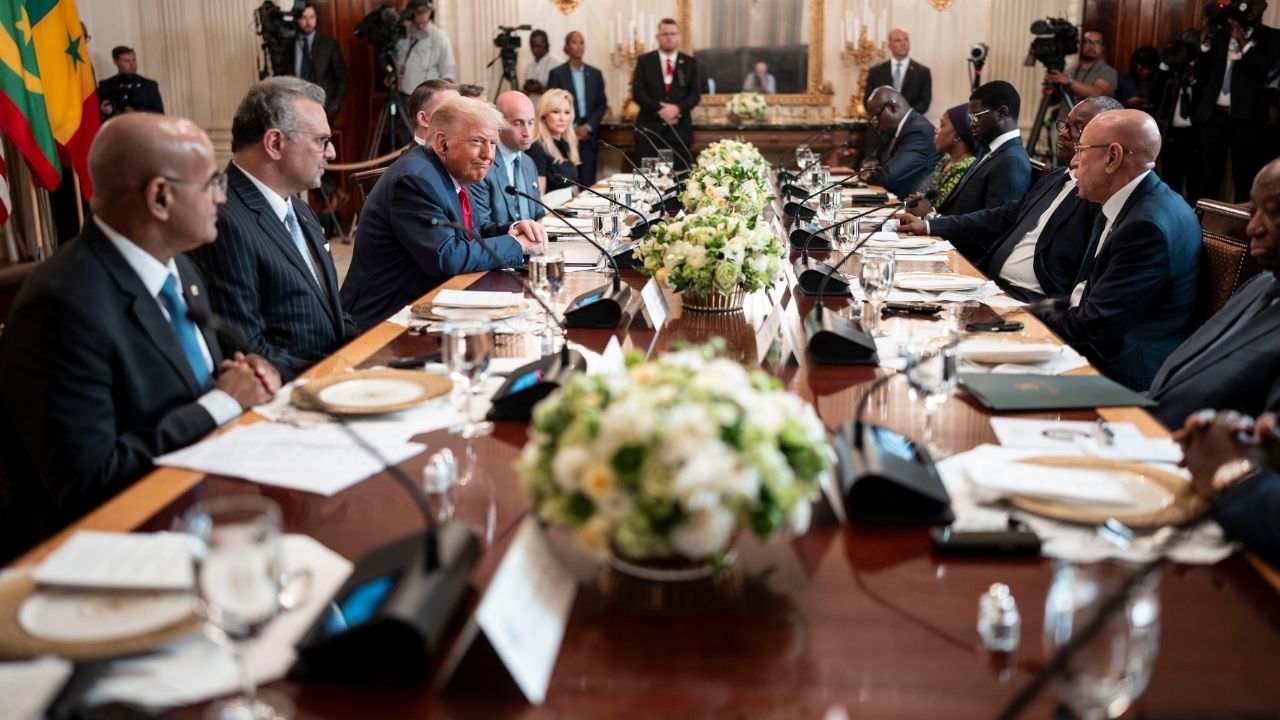
Last year, Joseph Boakai, Liberia’s president, was one of five African leaders to meet with Trump at the White House. The meeting caused a stir when Trump complimented Boakai on his English, asking him “Where did you learn to speak so beautifully?”
Liberia’s economy and health system have been hit hard by cuts in U.S. foreign aid, damaging perceptions of the United States and fueling suspicions that Liberia was forced to negotiate from a position of weakness.
“As a sovereign country, was it possible for President Joseph Boakai to have refused President Donald Trump’s offer of accepting those individuals?” asked Clara Mallah, a program officer at the Center for Transparency and Accountability in Liberia, a civil society group based in the capital.
“Why can’t America keep them? Why Liberia?”
—
This article originally appeared in The New York Times.
By Emmanuel Akinwotu, Helene Cooper and Hamed Aleaziz/Doug Mills
c. 2026 The New York Times Company