


|
Getting your Trinity Audio player ready...
|
A new proposal limiting city spending in the city’s southeast development area from Fresno City Council President Nelson Esparza would put before voters technical land-use decisions typically reserved for councilmembers.
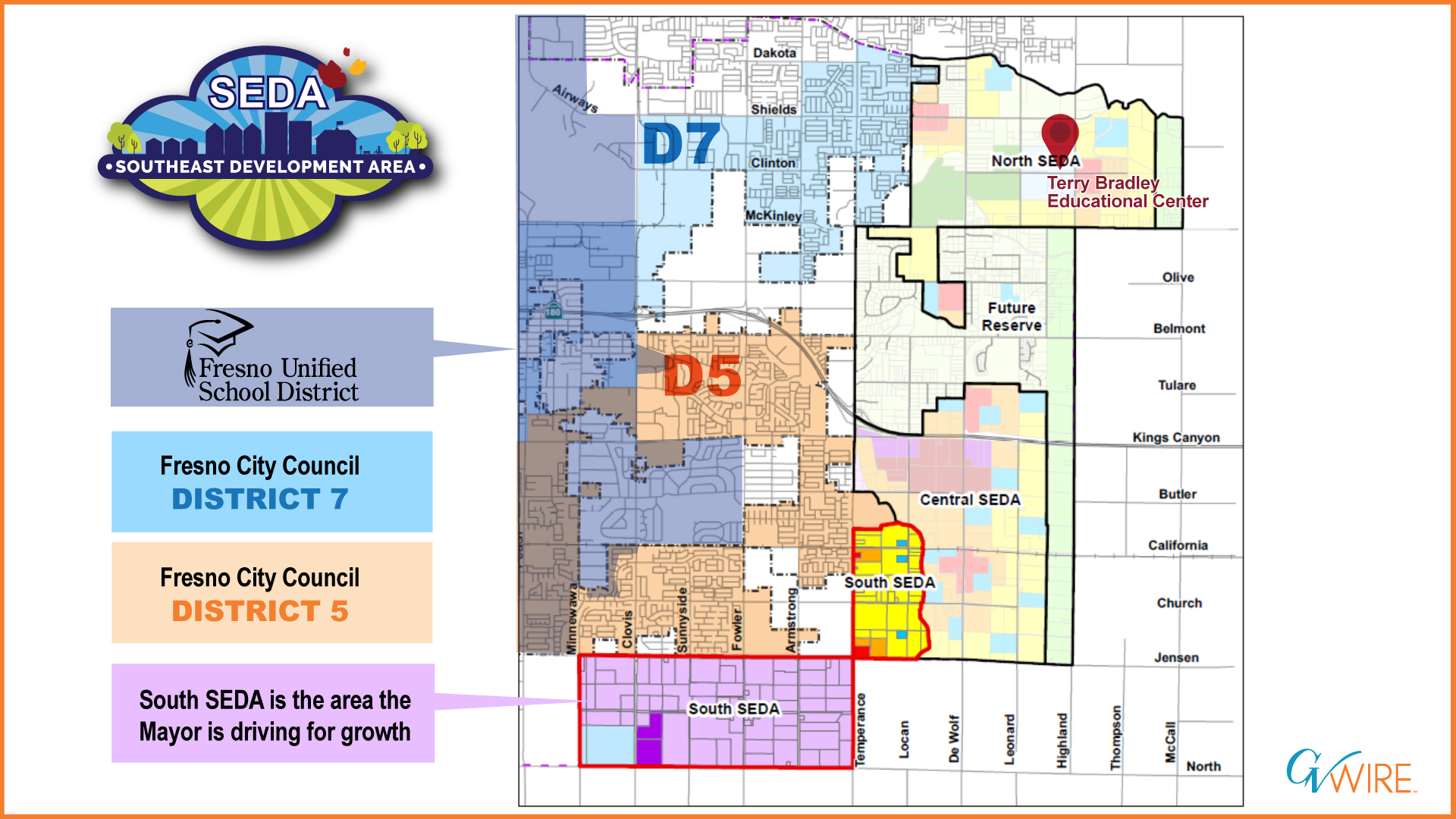
The “No Debt on Development Act” would do three things: Prohibit the city from using general funds for infrastructure in the 9,000-acre Southeast Development Area, bonding out city resources for it, or subsidizing development to pay for infrastructure for the plan that has been circulating in some form since the early 2000s.
The plan excludes the South SEDA portion advocated for by Fresno Mayor Jerry Dyer. That area is reserved for 10,000 homes and a research and tech hub.

Esparza will propose the plan next Thursday, a week before the Aug. 7 deadline to get measures on the November ballot. Fresno City Attorney Andrew Janz confirmed that Dyer can veto the plan, putting it past the ballot deadline.
“The No Debt on Development Act will provide clear financial safeguards to ensure that residents in our established neighborhoods get the return on taxes that they pay to the city of Fresno, and requires that development at the city limit pays for itself,” Esparza said.
Related Story: Progressives Opposed to SEDA Talk From Both Sides of Their Mouths
Nelson Plan Effectively Kills SEDA: Rose
The decision by the outgoing councilmember, however, would effectively shelf the plan indefinitely as development requires upfront investment to build homes and job centers, said Darren Rose, president of the Building Industry Association of Fresno Madera Counties.
Dyer has long said that the city needs additional homes and jobs to compete with neighboring cities as the city has more and more had to rely on property tax revenue to keep its coffers funded.
Building in north SEDA, however, requires significant investment for the sewer, water, and road capacity absent in the area. Figures of $2.2 billion for initial investment have been floated by the city.
Dyer has also said that development can pay for itself in SEDA. Dyer said he didn’t want to comment until he had studied the proposed ordinance.
Rose told GV Wire that options exist for development to fund the project, including reimbursement agreements, special tax districts, or fee credit structures. Those require an initial city buy-in as “no individual builder can carry that alone.”
“The specific tool is negotiable. The principle isn’t: Someone has to fund the first phase, and the private market can’t do it unilaterally,” Rose said. “The alternative is a plan on a shelf. Fresno has plenty of those already.”
That means the only funding for road maintenance, police or fire services will come from additional property tax assessments known as Community Facilities Districts.
“The city hasn’t done a new development in a while without implementing a a CFD that maintains that infrastructure,” Esparza told GV Wire. “This would be no exception, since that has been the standard now for a while.”
New development areas in other parts of town with CFD assessments still qualify for general fund dollars.
Ballot Measure Gives Plan Time to Prove Itself: Dyer
Dyer told GV Wire on Friday that while the plan is not ideal for development, it will address many public concerns about the plan area.
An early financial plan shows building out South SEDA would cost less than building out North or Central SEDA.
The city builds about 1,500 homes a year, Dyer said. With the capacity for 10,000 homes and 2,000 acres of advanced manufacturing in South SEDA, it will be many years before that area gets fully built out.
He said given the time it will take to build out SEDA, it will prove to the public that SEDA will be profitable for the city. Then, another measure can go before voters to undo Esparza’s.
“It will give us time as a city to prove the financial viability of South SEDA, and the fact that opening up South SEDA which does not hinder development in the core, which has been claimed by opponents,” Dyer said. “It will actually show South SEDA benefits development in the core financially.
‘If This Is An Effort to Placate Naysayers, It Won’t Work’: Karbassi
Last year, the city council tasked Dyer’s administration with developing an in-depth financing study on required investment and potential returns on SEDA.
At that meeting, councilmembers expressed concerns about the project’s feasibility. That came after vocal opposition from community groups and some residents within the SEDA area opposing the potential environmental impacts, the financial commitment, and outward growth.
Fresno City Councilmember Mike Karbassi said he liked the idea of restricting funding for SEDA, but said “if this is an effort to placate the naysayers, that won’t work.”
“They have an agenda that has nothing to do with lowering the price of housing for working families or creating good-paying local jobs for the next generation of workers,” Karbassi said.
Before the SEDA vote in December 2025, city councilmembers, including Karbassi, Tyler Maxwell, and Annalisa Perea, agreed with the county on a tax-sharing agreement for the SEDA area favoring the city.
Karbassi said the 51%/49% split would help make SEDA feasible.
“Even that didn’t convince (opponents),” Karbassi said.
Land Use, Financial Decisions Under Council’s Purview
A hard copy of the proposal was not available by the publication of this story. Esparza told media it would not be available until late Friday or Monday.
Technical land-use and financing decisions typically fall on the city council to weigh.
During the December 2025 meeting, city councilmembers voiced many of the same restrictions proposed by Esparza on Friday.
In Clovis, the city council there said that before development could occur in the north Heritage Grove area, the eastern Loma Vista area had to reach specified development thresholds.
The city has neared that threshold and now, Heritage Grove is slated to begin in earnest in the coming years.
This comes as the San Francisco Chronicle has named Clovis one of the most desirable and fastest growing cities in the state.
Fresno City Manager Georgeanne White has said construction on SEDA would likely not begin until after Dyer’s term as mayor ends.
Esparza said having a ballot measure would lock in current sentiments about SEDA.
“I think here at City Hall, anything can be changed any given Thursday that we’re in session,” Esparza said. “And I think residents are looking for a bit more of a tighter safeguard against fiscal insolvency that could potentially occur if we ever got a future council that was reckless or a future mayor that was reckless.”