
|
Getting your Trinity Audio player ready...
|
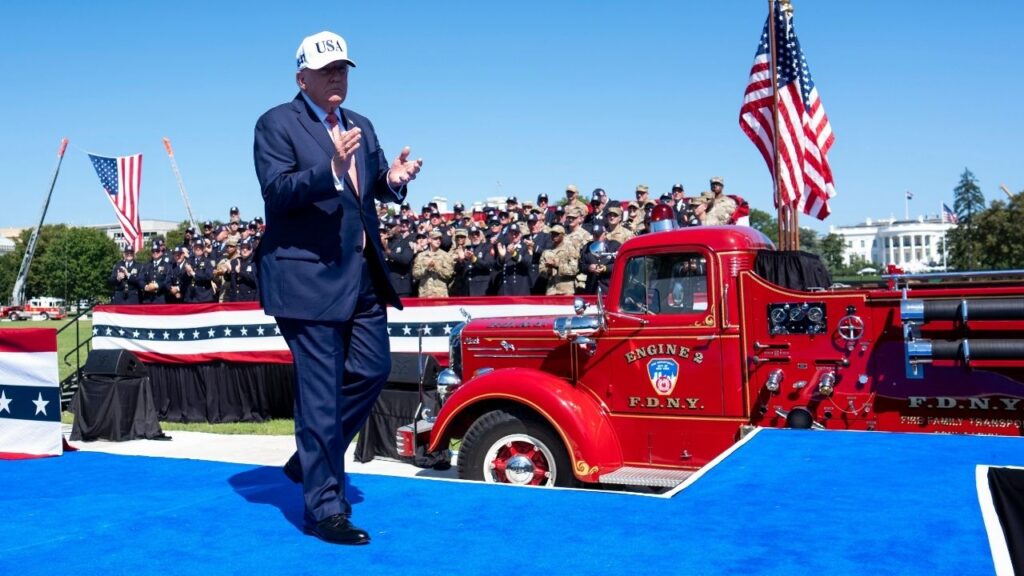
President Donald Trump is poised to become far more visible outside the White House than he has been for most of his term, starting with a Republican midterms convention in Texas and continuing with travel to boost candidates, according to his aides.
If the president expands his domestic travel after the two-day mini-convention in Dallas that begins Wednesday, it will be a test of whether he still has the ability to connect to the concerns of voters, something that helped him win the 2016 and 2024 presidential elections.
Trump’s ability to harness voter anger over an eroded manufacturing base, or a lack of accountability after the 2008 fiscal crisis, or the toll of the so-called “forever wars” in the Middle East after the Sept. 11 terrorist attacks, was part of how he was able to succeed. He loved the adulation he got at rallies in his 2016 campaign in particular, and threw himself into them again in the final stretch of the 2024 race that began against President Joe Biden and ended up with Vice President Kamala Harris as the Democratic nominee.

But early in 2025, Trump made clear to several advisers that he did not want to keep holding rallies. The campaign portion of his political career was over, he suggested, as he settled back into the West Wing and worked day by day to remake it in a hue of gold.
His domestic travel in 2026 has included roughly two dozen events that were strictly about policy or a particular activity his administration had worked on. Some of those trips were tacked onto visits he was making to Florida or Sterling, Virginia, or Bedminster, New Jersey, to be at his private clubs and play golf. And so Trump has been living an unusually isolated existence, with an extremely small group of advisers and officials helping him arrive at decisions, and a small group of aides providing him with constant positive feedback.
That information ecosystem tends to override what the president absorbs from polling and focus groups conducted by his own team, reactions that show voters frustrated by ongoing inflation, a spike in gas prices after a war he helped start in Iran, and a mistrust among some who cast ballots for him over how he handled the release of investigative material related to sex offender Jeffrey Epstein.
Since earlier this year, the president’s advisers have been forecasting a more aggressive schedule that will take him out into the country every week. They have assured reporters that it will finally come to pass after this week.
When Trump has made appearances outside the White House, his scripts tend to stay the same, regardless of the event or the setting. He rails against the “fake news,” casts his memory back to the 2016 campaign, and talks about “hoaxes” he claims have been perpetrated against him.
And Trump seems to be making a similar case about the economy than Biden did in 2024 — essentially insisting the economy is doing well even though voters are not feeling it in their daily lives. Trump has repeatedly mocked the word “affordability” as a contrivance by Democrats, made up to attack him.
That mockery has been less present in the past two weeks, as the midterms drawing near appears to have gotten his attention. (Still, Republicans have expressed frustration that Trump has only begun to dole out portions of the nearly $1 billion he says his political action committee has raised, to help them in their races.)
Now, the goal for Republicans is to win in a cycle in which the president has given them no room to separate from him, and in which they hope he can push his party’s base to match the Democrats’ energy, and to appeal to the voters who have only turned out during his presidential elections to do so again. His Cabinet members are expected to attend the convention in large numbers, and to spread out across the country in key states in the coming weeks.
“The name of the game” is “turnout,” said Natalie Baldassarre, a spokesperson for the Republican National Committee.
Olivia Wales, a White House spokesperson, described Trump as “the unequivocal leader and unmatched motivator for the Republican Party, who is committed to maintaining Republican majorities in Congress,” and said he will “draw a sharp contrast between his common sense agenda” and what she called “radical Democrats” in Congress.
“Much of the 2026 playing field is on states and districts where Trump won,” said Jim Hobart, a Republican pollster with Public Opinion Strategies, pointing to states like Iowa and Ohio, both of which Trump has won by double digits. “That means candidates are likely to welcome Trump’s presence on the trail as they work to turn out Trump 2024 voters in a midterm election.”
Liam Donovan, a Republican strategist and former National Republican Senatorial Committee aide, said that every GOP candidate will be tied to Trump, and that running away from him “plays into an asymmetry that only benefits Dems.”
“The challenge for the GOP is capitalizing on his appeal among voters they can’t otherwise access,” he said.
—
This article originally appeared in The New York Times.
By Maggie Haberman/Doug Mills
c. 2026 The New York Times Company