
|
Getting your Trinity Audio player ready...
|
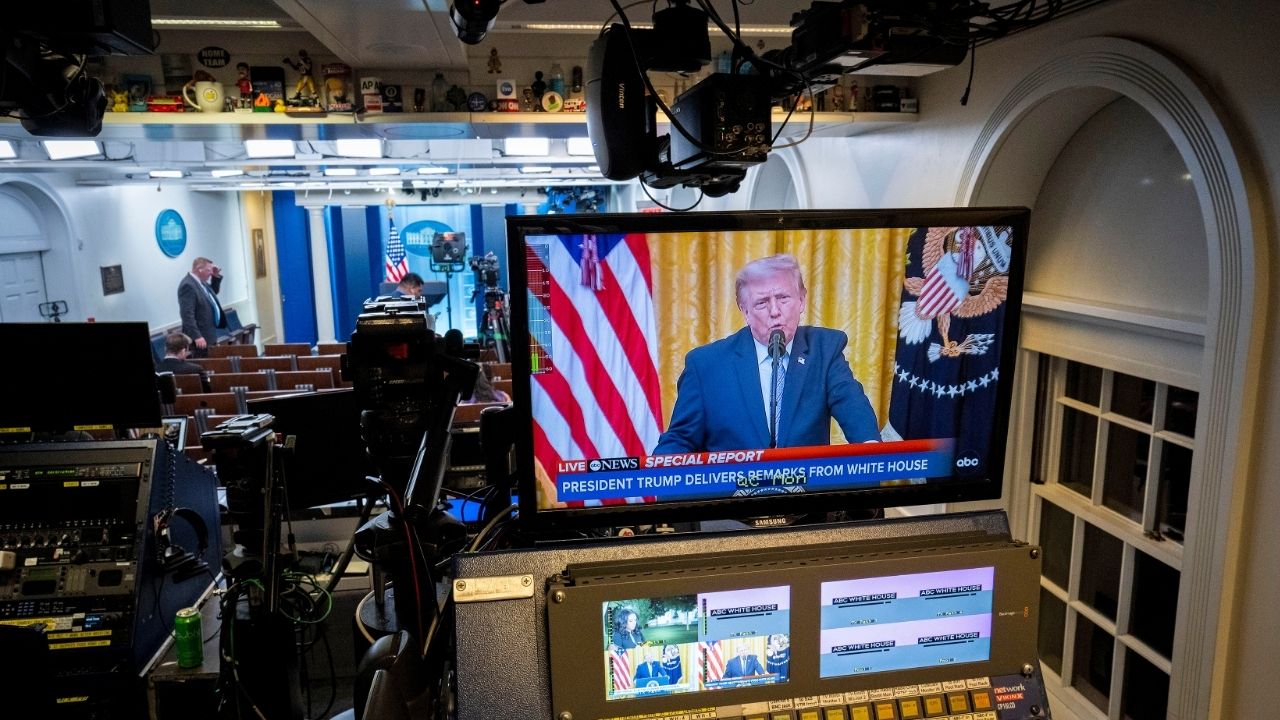
President Donald Trump started his speech Thursday evening by outlining a series of claims about China’s attempts to acquire U.S. voter data, portraying the alleged activity as a historic scandal.
But China’s efforts to collect that data have been broadly known for years. Voter data is in many cases freely available to download on the internet, and in other cases can be purchased. Possessing such data could reveal insights about U.S. voters, but would not allow votes to be manipulated.
Trump asserted that China had carried out “the largest compromise of election data in history” starting with the 2020 cycle, illicitly collecting 220 million voter files “over a period of years.”

It was unclear precisely how the president arrived at that number, which could include names, addresses and phone numbers, though the heavily redacted documents include a table that lists volumes of acquired records, including some 204 million records from 2016. China has hacked far more sensitive information, such as government personnel records, than what voter files would offer.
The claim was one of several Trump made that was either overstated or untethered from reality as his administration published hundreds of pages of documents that were far more measured and reserved in their judgments about China and other election security issues.
During the 2020 election, the mainstream view inside U.S. intelligence agencies was that China was not seeking to influence the outcome of the presidential contest, but there was a dissenting view that China wanted Trump to lose his reelection bid.
Newly declassified documents released Thursday by the Trump administration present a more detailed account of that dissenting view, although its main aspects were already public.
A senior cyber intelligence official, Chris Porter, who was not identified in the documents, wrote a series of classified memos on the matter. He made the case that “Beijing has taken at least some low-level, exploratory steps” to undermine Trump’s chances of being reelected in his 2020 race against Joe Biden.
In broad strokes, Porter’s dissent was made public after the election, first in a note released Jan. 7, 2021, by John Ratcliffe, who was then the outgoing director of national intelligence, and later in a declassified intelligence community assessment on foreign influence operations that was released in March 2021.
That document noted Porter agreed with the overall view of the intelligence community that “there was no information suggesting China tried to interfere with election processes.”
The documents made public Thursday were heavily redacted but give a closer look into the intelligence Porter and a colleague used to draw their conclusions that China was at least taking some steps to undermine Trump’s reelection.
In his first declassified memo, from Oct. 16, 2020, Porter said that he and the other intelligence official assessed China’s efforts at influence “probably included overt messaging, nascent online covert influence capabilities” as well as diplomatic and economic leverage.
The memo notes that the national intelligence officer for East Asia as well as other officers from the Office of the Director of National Intelligence disagreed. They assessed that China had not deployed influence efforts, in large measure because its leadership sought stability in relations with the United States.
Key sections of the October 2020 document are redacted, making it difficult to assess fully what intelligence caused Porter and the other intelligence officer to have doubts over their colleagues’ conclusions. Porter and the colleague gave their assessment a low-to-medium confidence level, suggesting that they did not have robust evidence for the conclusions.
But in parts of the memo, Porter and the other officer cite increasing planning discussions among Chinese officials about how to respond to U.S. pressure and worries about the damage Trump’s reelection would do to China’s semiconductor industry.
In a partially redacted sentence, Porter wrote about a recommendation that China collect “black materials” about Trump and “sensationalize” them at the appropriate time.
There is no evidence that recommendation was acted on. But that did not seem to matter to Trump in his remarks.
“In mid-2019, the Chinese government strategy against the United States was focused on undermining domestic confidence in the U.S. president,” Trump said. “They wanted to just make you sound like your president was not so hot. When actually your president has done a great job.”
In another section, the file says China was experimenting with creating deepfakes — manipulated images and videos — to denigrate Trump. Due to redactions, it is unclear whether China did anything more than experiment.
But the dissenting intelligence officers noted that Chinese government had used Chinese organizations to incite protests in the U.S. to undermine Trump’s reelection chances and that pro-China influence network had posted messaging denigrating the administration.
Trump referred to those intelligence findings in his remarks, but exaggerated what the declassified documents said, portraying them as a far broader effort.
In another memo, Porter wrote that key adversarial countries — Russia, China, Iran and North Korea — all had the capability to access and manipulate data in some election-related computer systems. They found that voter registration databases and election websites were most vulnerable. While systems that tabulate voters could be “vulnerable to localized exploitation,” they found it would be difficult to manipulate on a big enough scale to change the election outcome.
The intelligence community assessment conducted on the 2020 vote made much the same points. It said while adversarial powers had the capability of hacking local election systems, any effort to change votes would be detected.
One file reveals that in January 2022, actors aligned with the Chinese government obtained public voter registration data from Colorado, Connecticut, Florida, Michigan, Oklahoma and Rhode Island and unsuccessfully tried to download a voter registration application from Ohio.
Such information, the report said, could be useful in hacking efforts against those voters or election influence operations. But the report conceded: “The actual motivations for collecting this information is unknown.”
—
This article originally appeared in The New York Times.
By Dustin Volz and Julian E. Barnes/Doug Mills
c. 2026 The New York Times Company