
|
Getting your Trinity Audio player ready...
|
WASHINGTON — The House on Wednesday rejected a measure to eliminate U.S. aid to Israel, but almost half of Democrats supported the move, reflecting a rapid and dramatic shift within the party away from decades of unequivocal support for the Jewish state.
The measure, which sought to cut all $3.3 billion in military and humanitarian aid to Israel from a foreign affairs spending bill, failed by a vote of 104-314, with 10 voting “present,” and all but one Republican, Rep. Thomas Massie of Kentucky, a sponsor, voting no.
But more Democrats supported it than opposed it, including many who said they voted in favor despite their opposition to the cuts to humanitarian aid. It was the latest and starkest evidence of a major divide over supporting Israel within the Democratic Party, which is grappling with a groundswell of hostility in its ranks toward Israel and its conduct of the war in the Gaza Strip.

Supporters said the measure was their only way to register their opposition to the actions of the Israeli government in Gaza, the West Bank and Lebanon, and their desire for a fundamental change in course in the U.S. relationship with Israel.
“While I wish we could vote on an amendment targeted just to military aid, and of course support humanitarian programs, we do not have that option,” Rep. Greg Casar, D-Texas, and the chair of the Congressional Progressive Caucus, wrote in a letter to his members, in which he urged all 98 of them to follow his lead in backing the proposal. “The American people are crying out for an end to U.S. tax dollars subsidizing Israel’s military.”
The vote even split Democratic leaders.
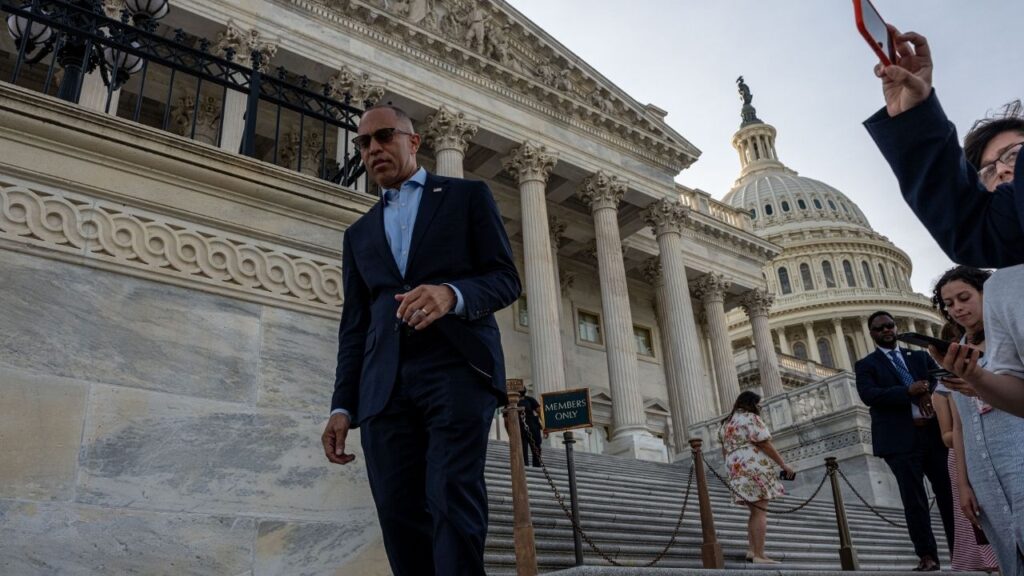
Reps. Hakeem Jeffries of New York, the minority leader, and Pete Aguilar of California, the No. 3 Democrat, voted against the measure, while Rep. Katherine Clark of Massachusetts, the minority whip, voted in favor.
Clark said she supported the measure “not because I agree with the entirety of the amendment, or the GOP’s cynical motivations for its consideration, but because I believe we must change course.”
In a statement shortly before the vote, Rep. Nancy Pelosi, D-Calif., the former speaker, called the amendment an “unfortunate choice” but said she would support it “for the message that it sends.”
In the final tally, 103 Democrats voted to cut off aid while 98 opposed doing so, with another 10 voting “present,” declining to register a position. That amounts to more than half of the Democratic Caucus unwilling to reject a measure that would terminate U.S. assistance to Israel.
For weeks leading up to the vote, Democrats had struggled with how to respond to the measure proposed by Massie, who opposes foreign intervention, which they viewed as a tactic to put them in a political bind.
Jeffries, a longtime staunch supporter of Israel, hosted two caucus meetings to discuss the amendment, a highly unusual move that underscored how fraught the politics around Israel have become for Democrats.
And in a letter on Tuesday announcing his opposition to the amendment, Jeffries called for the first time for a “major reset” in U.S.-Israel relations. He also hinted that Democrats, should they win the majority in Congress, would insist that any security aid to Israel be contingent on barring human rights abuses against Palestinians.
Even in opposing the measure, Jeffries, who is in line to be elected speaker next year if Democrats win back the House, acknowledged that there were “good-faith reasons that will result in members voting in a variety of different ways.”
But scores of Democrats swallowed their concerns about the measure and backed it.
“Self-defense does not include indiscriminately bombing homes,” Rep. Joaquin Castro, D-Texas, said on the House floor, criticizing the response by Prime Minister Benjamin Netanyahu’s government to the terror attacks of Oct. 7, 2023.
Even a onetime Israel stalwart, Rep. Seth Moulton, D-Mass., said he supported cutting all aid, asserting that “we simply cannot continue to condone Netanyahu’s actions that are against our moral conscience and our own national security interests by perpetuating the status quo.”
Moulton, who is running for Senate, has also said he would no longer accept donations from AIPAC, the hard-right pro-Israel lobbying group that has recently become a toxic brand among Democrats.
Only a few Democratic voices spoke on the House floor on Wednesday in opposition to the measure.
Rep. Brad Sherman, D-Calif., said the sole purpose of the bill was “driving a wedge in the middle of the Democratic Party, to put our party on the side of those that say that Israel has no right to exist.”
And Rep. Steny Hoyer, D-Md., and a longtime ally of AIPAC’s, encouraged his colleagues to “vote no,” arguing that a vote for the measure was “a vote against American security and against American safety.”
The vote was difficult for some Democrats to navigate in part because of timing: It came as the United States and Iran had restarted their war, which President Donald Trump entered at Israel’s urging, and weeks after three incumbent Democrats lost primaries to far-left challengers who made their records of supporting Israel a major line of attack.
“The shifting dynamics are not lost on the members of Congress,” said Jeremy Ben-Ami, the president of J Street, the center-left lobbying group. “Navigating this moment and trying to find solid ground where you feel comfortable is a challenge.”
Support for the Jewish state has quickly become a major liability with young and left-leaning voters who are important constituencies in the party. But there are indications that the hostility is much broader. A New York Times/Siena National poll conducted in May found that 74% of Democratic voters opposed providing additional economic and military support to Israel, including large majorities in all age groups.
Ben-Ami said the final vote was emblematic of the dramatic change that has already taken place — perhaps the quickest 180-degree shift in public opinion on a policy issue since the legalization of same-sex marriage.
“The days of ‘Israel, right or wrong’ being the mainstream of American politics are over,” he said. “We’re defining the new normal.”
—
This article originally appeared in The New York Times.
By Annie Karni/Alex Kent
c. 2026 The New York Times Company