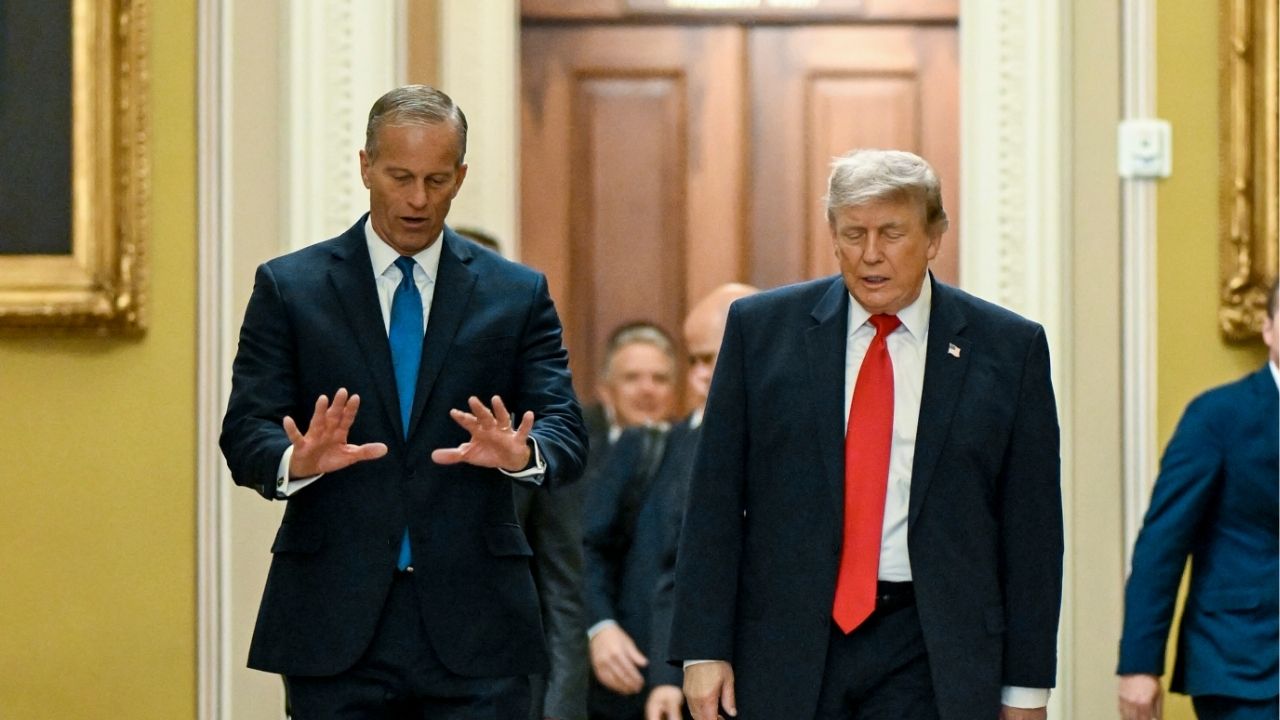

President Donald Trump allowed a bipartisan housing bill to become law without his signature oSaturday, hours after he said he would refuse to sign it because Republicans had failed to pass an unrelated voting restriction bill that does not have enough support to clear the Senate.
“I will not sign the Housing Bill, which has been fully approved by Congress and sent to the White House, in PROTEST over the fact that the United States Senate is not capable of passing THE SAVE AMERICA ACT,” Trump wrote on social media, referring to the elections bill.
Trump’s inaction was symbolic. The measure, the first major legislative effort to address the nation’s housing crisis in more than three decades, became law at midnight after a constitutionally mandated period without the president vetoing the measure.

But Trump’s pronouncement is still a remarkable dismissal by a president of efforts by his own party to address a major political vulnerability. And it reflected the growing rift between the president and Senate Republicans over the elections bill, which contains strict voter identification requirements and a raft of other measures the president has demanded.
The housing measure adjusts a host of federal regulations to make it easier and cheaper to build housing. That approach won broad support from economists and policy experts, and the bill passed Congress last month with overwhelming bipartisan support, an increasingly rare accomplishment in a starkly polarized legislature.
The bill, known as the 21st Century ROAD to Housing Act, was poised to deliver congressional Republicans a significant victory before November’s midterm elections as they try to blunt Democrats’ attacks over rising costs.
But Trump clouded the achievement. Hours before a planned signing ceremony at the Capitol last month that he abruptly canceled, he dismissed the bill as “of minor importance” and said he would sign it only if Congress passed the voting measure.
Trump’s focus on the elections bill has already derailed Republicans’ congressional agenda. House leaders were forced to scrap votes twice last month after a group of far-right lawmakers refused to let legislation come to the floor unless the Senate took action on the voting measure.
Most Republicans back voter identification requirements, though Trump’s restrictions are far greater. The bill would require Americans to show proof of citizenship to register to vote and would severely curtail voting by mail, a popular practice in many Republican-held states and districts.
Senate Republicans, including the majority leader, Sen. John Thune of South Dakota, have repeatedly said they do not have the 60 votes needed to overcome a Democratic filibuster against the bill. They have also acknowledged that there is not enough support in their caucus to overhaul the filibuster and find a way to push the bill through over Democratic opposition.
Republican leaders did not expect Trump to block the housing bill, and Speaker Mike Johnson sent it to his desk on June 29, starting a 10-day clock for the president to sign the bill, veto it or allow it to automatically become law.
Still, the president’s approach, in which the bill effectively limps across the finish line, robbed congressional Republicans of the fanfare they had sought to help make their case to voters that they were addressing affordability. Polls show that it is a top concern and that Americans increasingly blame them for economic woes.
Though Republicans are expected to trumpet the housing legislation on the campaign trail, they will do so after weeks in which Trump — who last month issued a proclamation calling the bill “comprehensive and consequential” — publicly downplayed it as a “yawn” compared with his elections measure.
Democrats have seized on Trump’s remarks to bolster their arguments that the president is unresponsive to, if not outright dismissive of, Americans’ concerns about affordability. Trump has described the issue as a “hoax” or a “con job.”
They quickly returned to the theme after Trump’s pronouncement on Friday.
“His priorities couldn’t be clearer: higher costs for families and more power for himself,” Sen. Chuck Schumer, D-N.Y., the minority leader, said in a social media post.
The bill aims to expand the housing supply to eventually drive down prices for buying a home or renting. It would relax federal regulations, including environmental reviews, to make construction faster and cheaper. It would also ease lending rules and include incentives for state and local governments to build new homes.
Though Trump at times weighs in publicly on legislative negotiations, he had been relatively hushed on the housing package. Still, the final bill included a provision intended to win support from the president: a limit on some large investors that snap up single-family homes.
That policy, something Trump tried to address in an executive order this year, proved to be one of the biggest flash points in negotiations between the House and the Senate.
Yet Trump has not discussed the provision much since the legislation passed. Instead, he has diminished its importance by arguing that the most effective way to lower housing costs would be a reduction in interest rates that could help to push down mortgage bills. The new chair of the Federal Reserve, Kevin Warsh, has expressed optimism about taming inflation but has not committed to quickly lowering interest rates.
–
This article originally appeared in The New York Times.
By Michael Gold/Kenny Holston
c.2026 The New York Times Company