
|
Getting your Trinity Audio player ready...
|
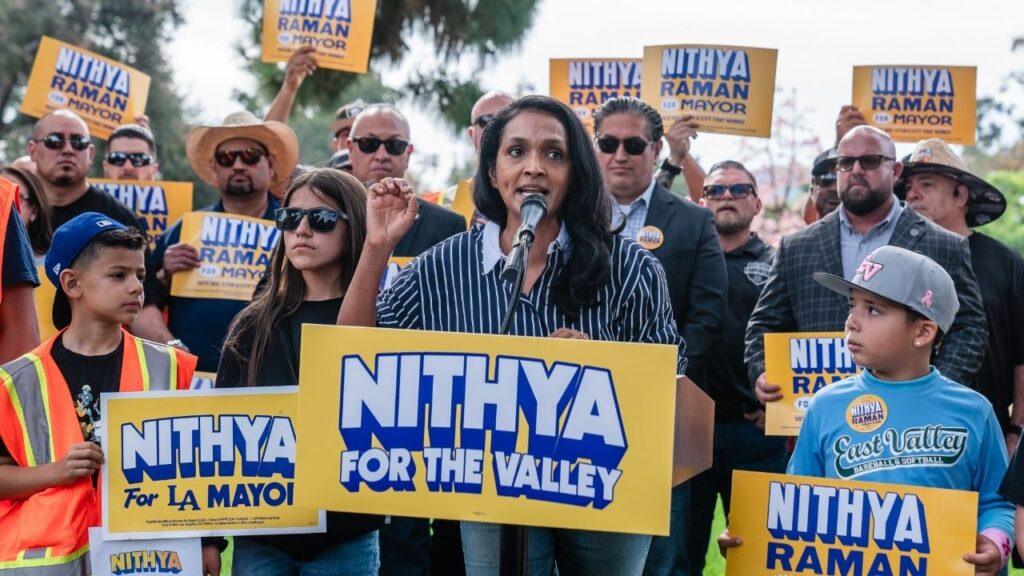
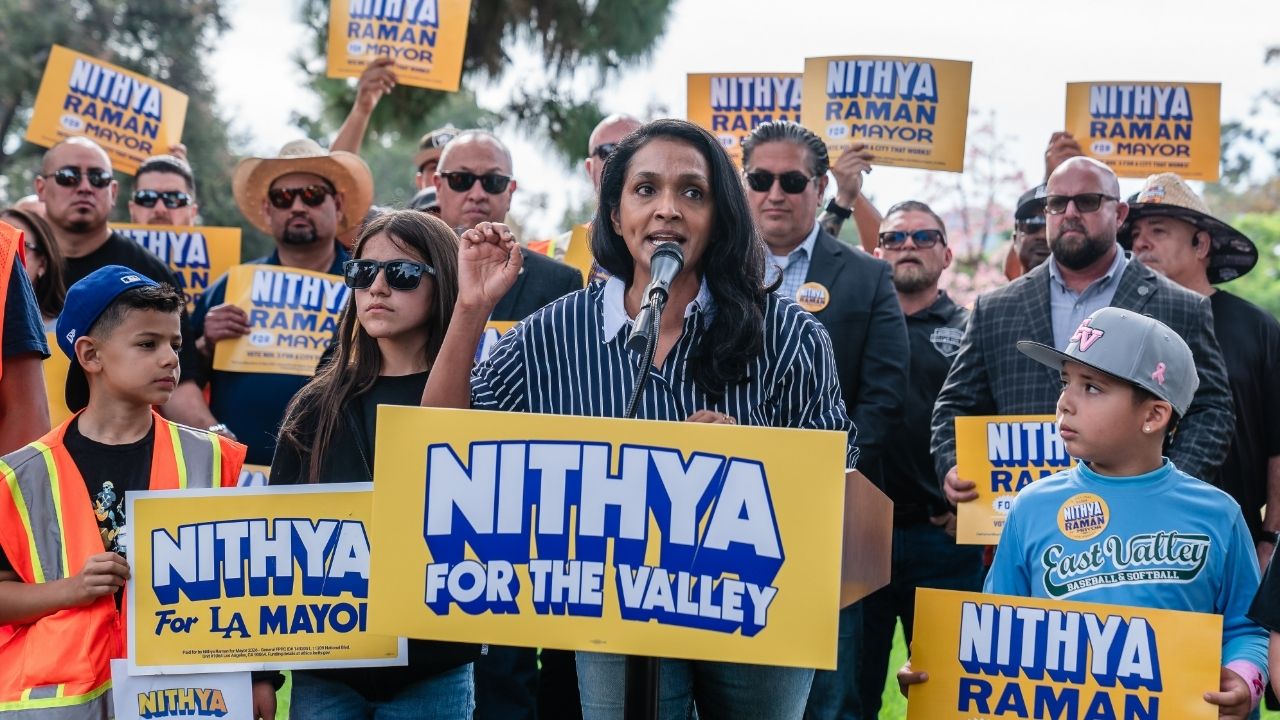
LOS ANGELES — The crowd of supporters was almost artfully diverse: union members in neon orange construction vests, democratic socialists in Dodger blue “DSA LA” ball caps, a group of banner-toting South Asian American workers.
“Look around,” said Nithya Raman, the front-runner to become Los Angeles’ next leader in the Nov. 3 election. “This is the coalition that is going to take us to the mayor’s seat.” The crowd cheered and waved yellow and blue campaign signs.
It was a scene few would have predicted at the beginning of the year, when Raman, 45, was a little known member of the Los Angeles City Council. But at every step of her rise, Raman has vaulted past expectations.

In 2020, as a political newcomer, she unseated an incumbent council member — the first time that had happened in more than a decade. In 2024, she fended off a well-funded challenge from a former prosecutor. Her council seat, in one of the city’s most liberal and highly educated districts, was where she expected to stay for the next four years.
Then came a chain of unlikely events: The most viable challenger to Mayor Karen Bass dropped out because of a family tragedy, leaving her virtually unopposed. Spencer Pratt, a Republican former reality TV star, joined the race, attracting disaffected Angelenos and scrambling the deeply blue city’s electoral math. And a wave of other democratic socialists ascended in cities across the country.
Now, buoyed by the same forces that catapulted New York City Mayor Zohran Mamdani to national prominence — seething frustration with the Democratic establishment chief among them — Raman is leading in polls to oust Bass.
The prospect of a Raman victory is particularly tantalizing for the small but polarizing Democratic Socialist movement whose members backed both her and Mamdani as they seek to turn big U.S. cities into a laboratory for progressive policies.
For Raman, the comparisons with the New York mayor were inevitable. Aside from their DSA membership, both are millennials born abroad to South Asian parents, and their campaigns shrewdly deployed social media.
But political experts in Los Angeles say Raman’s savvy and charisma pale next to that of Mamdani, a preternaturally skilled politician. And they say her rise probably has less to do with the DSA agenda than with a generalized disenchantment with incumbents in this election.
If Raman wins, they say, it will not be because she is the West Coast Mamdani. It will be because she is not Bass.
Indeed, Raman has argued that Los Angeles is leaderless, with a broken government that struggles even to repair streetlights, fill potholes and respond to 911 calls in a timely fashion.
“Every single one of my campaigns has been about trying to get people to pay attention to the city,” she said in an interview. “You know, look at what’s happening and here’s how it can be better.”
Bass, in turn, has portrayed her opponent as too inexperienced to run the nation’s second largest city, especially with the Olympics coming in 2028. The mayor’s supporters have noted that none of her colleagues on the City Council have endorsed Raman — not even the other three DSA-aligned members.
Raman’s embrace of the DSA has waxed and waned during her time in office, and she has carefully separated her campaign from Mamdani’s, framing it as a natural extension of her nuts-and-bolts work to promote affordable housing in pricey Los Angeles.
“He was a very special candidate who captured so much enthusiasm at that moment,” she said.
Born in Kerala, India, Raman was raised in a suburb of Boston and graduated from Harvard University before getting a master’s degree in urban planning from the Massachusetts Institute of Technology. She moved with her husband, a successful television writer and producer, to Los Angeles in 2013, and the couple had twins, who are now 10.
She has worked at a series of nonprofits, including in the slums of India and in Hollywood, where she served as executive director of Times Up, an advocacy group for women in entertainment.
Raman also helped found a nonprofit aimed at helping homeless people in her neighborhood. In 2020, frustrated that her City Council representative wasn’t responding to a push for more shelter space and more housing, she decided to run against him.
With outrage over the killing of George Floyd as a backdrop, drawing millions of Americans into the streets to protest racism and inequality, she harnessed a national moment.
A young mother with Ivy League polish and policy chops, she was the subject of a Vogue feature in which she was compared to Rep. Alexandria Ocasio-Cortez. Raman’s face, rendered in a style reminiscent of Shepard Fairey’s portrait of Barack Obama, adorned shop windows alongside “Black Lives Matter” posters.
Mike Bonin, who at the time was the most outspoken progressive on the City Council, recalled meeting her back then and thinking: “If she gets elected, I’m totally going to be overshadowed.”
But since taking office, some of her relationships have been tenuous, both with DSA members and other local leaders.
Homeowners and landlords, arguing that she was radical and naive, tried unsuccessfully to recall her. Some fellow council members describe her as hard to work with. Still, Bass had become an ally, and Raman initially endorsed the mayor for reelection as a fellow progressive.
But just two weeks later, Austin Beutner, a civic leader running against Bass, abruptly withdrew following the death of his daughter. Raman announced, on the last day possible, that she would challenge the mayor. After a bruising primary, she edged out Pratt to face Bass.
Raman’s proposed policy measures range from more audits of homelessness programs to improved performance measures for city department heads. She has promised to create an office of tenant protection and develop a long-term plan to improve infrastructure.
Her proposals are less catchy and more incremental than Mamdani’s, but her supporters note that Los Angeles mayors have less unilateral power than New York mayors. And, they add, the public appetite for change has been apparent in her rise despite significant establishment opposition, including from the powerful police union and major business interests.
Recently, she sought changes to a voter-approved “mansion tax” that she helped create, because it had the unintended consequence of squashing apartment construction. While some on the left saw it as capitulating to developers, pro-housing advocates applauded the move. It nearly cost her the backing of the Los Angeles DSA chapter, which debated its formal endorsement for months before finally backing her, arguing over whether she had sufficiently ideological priorities.
Bass’ supporters slammed Raman as a flip-flopper, both for that shift and for her evolving stances on the police chief. Raman, who initially voted to confirm the chief, has lately said she would fire him because of the department’s use of force last year during immigration protests. Bass has said that would be irresponsible, given the security issues that will unfold before the 2028 Olympics. Later, Raman said that she would replace him only if she could martial support to do so.
Opponents have also seized on moments where Raman has seemed to stumble in avoidable ways as evidence that she is “not ready for primetime,” as the mayor has said.
Her staff had to work overtime to dispel suggestions that she had called Bass and the police chief “fascist liars” in a social media video, saying she was instead referring to federal immigration agents.
And she was forced to apologize for invoking in a positive way the tenure of Daryl Gates, the police chief who presided over an era of notoriously harsh policing in the 1990s.
Those challenges didn’t deter a couple dozen DSA volunteers and union members gathered at a park one recent weekend in the Eagle Rock neighborhood, a rapidly gentrifying enclave on the city’s east side.
Leslie Chang, one of the DSA’s Los Angeles chapter leaders, wound her way through apartment buildings canvassing for Raman.
Most doors remained shut. But she said that talking to voters face-to-face has been a core part of the DSA’s strategy. It’s one that Raman has used effectively in years past and Mamdani’s campaign managed to scale up.
“People are hungry to have positive engagement with their communities,” Raman said, “and any time you can give them that opportunity, I think you can find support.”
—
This article originally appeared in The New York Times.
By Jill Cowan/Ariana Dreshsler
c. 2026 The New York Times Company