
|
Getting your Trinity Audio player ready...
|
BERLIN — Last October, President Donald Trump imposed significant sanctions on Russia’s two largest oil companies, complaining that negotiations with President Vladimir Putin over ending the war in Ukraine “just don’t go anywhere.”
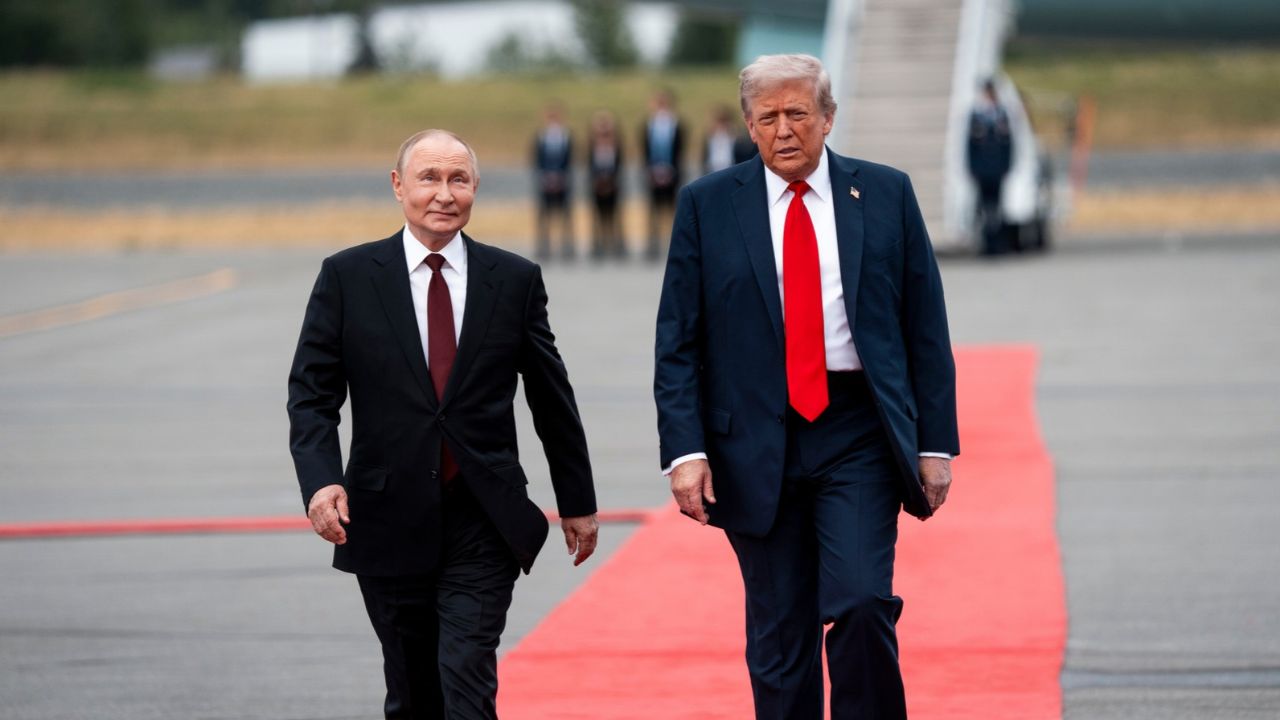
A red-carpet welcome for the Russian leader in Alaska had done nothing to bring peace. A planned summit in Budapest, Hungary, had fallen apart. Trump had started to acknowledge that Putin might just be playing him, with no intention of making peace. Faint Ukrainian hopes glimmered of a Trump-Putin break.
But the Russian president was playing a longer game.

Now, exactly a year after the oil sanctions, Putin has never been so close to his goal of normalizing relations with Washington without having to make any compromises on Ukraine.
Over the past week and a half, Trump has set aside years of U.S. foreign policy by openly embracing Putin and easing the economic pressure on the Kremlin. At the same time, Trump has vilified President Volodymyr Zelenskyy of Ukraine, the putative American ally trying to defend his nation against a Russian invasion.
On Oct. 9, Trump announced that the United States would buy Russian diesel, asking for no concessions from Putin in return. The Trump administration went on to pressure Ukraine to stop striking oil refineries — Ukraine’s most powerful lever — and suspended Russia sanctions that Trump had just signed into law. Trump declared that “Russia, frankly, has been fine on Ukraine.”
The diesel deal was in part a political calculation by Trump before the midterm elections, as he tries to lower fuel prices. But that action and others that followed also reflect the president’s long-evident affinity for Putin, which the Russian leader has assiduously cultivated even while continuing the war and denying Trump a coveted prize.
Ever since Trump returned to office, Russia has sought to separate the conflict in Ukraine from potential business agreements and closer diplomatic ties with the United States. The Trump administration held back, even as it slashed aid to Ukraine, largely continuing a Biden administration policy of refraining from economic deals with Russia until Putin stopped the war.
The White House now says such deals will help Russia see the benefits of peace. The Kremlin said Wednesday that Putin, meeting with Trump’s special envoy, Steve Witkoff, had agreed to talks with Ukraine and the United States next month. But they would involve relatively low-level representatives, and a Russian official played down the Kremlin’s openness to forging a comprehensive agreement now.
Newly emboldened, Moscow is moving to assert itself as a global power equal to the United States and China, promoting a trilateral summit among them in November.
“In my personal view, victory has already been achieved,” pro-Putin journalist Marina Akhmedova wrote on social media Wednesday. “It is not just a matter of the 20 to 25% of territory we have liberated,” she added, referring Russian-occupied land in Ukraine. “It is also about how the United States now engages with Russia.”
Many analysts call the economic incentives offered by Trump the wrong solution to a war being waged over political and security questions. Still, during his visit to St. Petersburg, Russia, on Wednesday, Witkoff said the diesel deal was “another example of what we can achieve by working together.” Putin, in turn, suggested a deal on Russian fertilizer.
Other potential agreements are on the horizon. Russia and the United States have discussed the sale of the international assets of the Russian energy giant Lukoil to an investor group that includes the U.S. government, The New York Times reported. The Times also reported that American negotiators have pitched the idea of Europe resuming purchases of large quantities of Russian gas piped through Ukraine.
After the St. Petersburg meeting, Putin’s economic envoy, Kirill Dmitriev, said that there was “no question” that Russian-U.S. economic cooperation “will strengthen.” He said that Putin had talked not only about a potential fertilizer deal with Witkoff, but also about “different projects such as data centers, many projects in energy and energy cooperation.”
Playing to Trump’s style of personal diplomacy, Putin has portrayed actions that benefit Russia — like selling diesel to the United States — as favors to the American leader. That includes the release Wednesday of Stephen James Hubbard, 74, a Michigan teacher whom the State Department called “wrongfully detained” by Russia.
Trump described the release — which was not part of any prisoner swap — as a sign of Putin’s high regard for him. Referring to himself in the third person, Trump wrote on social media that “the United States, out of respect for President Trump, was not required to give anything in return.”
But later on Wednesday, Trump told reporters that Russia would not have let Hubbard go if sanctions had remained in place. The stage was also set, analysts said, by the diesel agreement and the potential for other business deals, giving Putin the sort of diplomatic victory he is craving after Western nations piled sanctions on Russia over its invasion of Ukraine.
Russia “tried all of last year to establish the idea that you can do stuff bilaterally with the U.S. short of settling the war in Ukraine,” said Hanna Notte, the author of “We Shall Outlast Them,” a book about Russia’s wartime foreign policy.
“It wasn’t just the economic deals,” she added. “They also wanted to talk about the Middle East. They wanted to talk about the Arctic. They wanted to talk about nuclear arms control.”
Russia’s goal, she said, was to advance “this whole idea that you can compartmentalize the relationship with the United States and do stuff together even while you’re still prosecuting the war.”
The Trump administration’s offering of carrots to end the war is likely to fail, Notte predicted.
Sam Charap, a Russia analyst at the Rand Corp., and other analysts noted that an irony of Russia’s rapprochement with Washington was that it may no longer be a silver bullet to a settlement of the war on Moscow’s terms.
Europe has taken on a bigger role in providing Ukraine with economic and political support, and relations between Putin and many European leaders have completely broken down.
“Winning the Americans isn’t the prize it once was,” said Jeremy Shapiro, research director at the European Council on Foreign Relations. “It was the whole game two years ago. Now it’s a much smaller piece.”
The Kremlin is also aware that Trump could change tack again after the midterms, Shapiro said. Russian decision-makers, he said, see the U.S. president as “very inconsistent” and feel little security about his approach to Russia.
—
This article originally appeared in The New York Times.
By Valerie Hopkins/Doug Mills
c. 2026 The New York Times Company