

|
Getting your Trinity Audio player ready...
|
At a team meeting at Silas Bartsch School in Reedley last year, math teachers noted that many fifth graders missed a multistep multiplication problem, which required them to multiply, regroup, then add.
The teachers spent the hour reviewing students’ work and noticed the same mistake: students were multiplying at each step when they should have been adding at the end.
The teachers decided to change how they taught the algorithm. Students didn’t understand why addition was part of a multiplication problem, so teachers needed to explain the reasoning behind the process.

“That’s an example of how teachers use data that leads to solid long-term instructional practice changes,” said principal Reggie Wagner. One educator had been teaching 25 years, he said, and “she changed the way she taught because of this.”
This story was originally published by EdSource. Sign up for their daily newsletter.
A Top-Performing District
The results are reflected in student performance at Silas Bartsch and across its district, Kings Canyon Joint Unified. Students throughout the district have made consistent academic gains over the past five years, surpassing their prepandemic scores and outperforming Fresno County as well as the state.
In the latest state assessment, Kings Canyon students outpaced the state’s modest improvements in English and math. More than 57% of Kings Canyon students met or exceeded standards in English language arts compared with 49% statewide. In math, nearly 46% met or exceeded standards, compared with 38% statewide.
Educators in the district say the gains reflect its culture of continuous learning in which teachers use data to identify students’ needs, work together to develop instructional strategies and assess whether those methods are working.
The rural district of 9,700 students, nestled in the mountain foothills, may offer lessons for improving student performance elsewhere.
‘Districts Should Pay Attention to Kings Canyon’
“Districts should be paying attention to Kings Canyon Unified,” said Babatunde Ilori, the CEO of Parsec Education, an education technology consulting firm that provides tools to compare similar districts using publicly available data. Kings Canyon is a Parsec client.
Among unified school districts where at least 15% of students are English learners and more than 80% are socioeconomically disadvantaged, Kings Canyon ranks first in the state in English language arts and second only to Compton Unified in math, according to Parsec.
“They’re not doing a silver bullet approach,” Ilori said. “There’s not some magic after-school program that’s the reason why they have the results they have. Frankly, it’s high-quality instructional practices.”
Statewide, improvements in English and math have been slow, and scores remain below 2019 levels. But Kings Canyon has made gains three times the state’s and reached its highest scores since the current testing system began in 2015.
From the superintendent, John Campbell, to classroom teachers, educators examine districtwide, school, teacher and student data, ask hard questions and find solutions to support student learning, leaders say.
“Our superintendent says all of the time that ‘it’s people, not programs,’ ” said Eddie Nolen, assistant superintendent for secondary education. “It’s always about what the teachers are doing.”
Teachers Are Refining Their Teaching Strategies
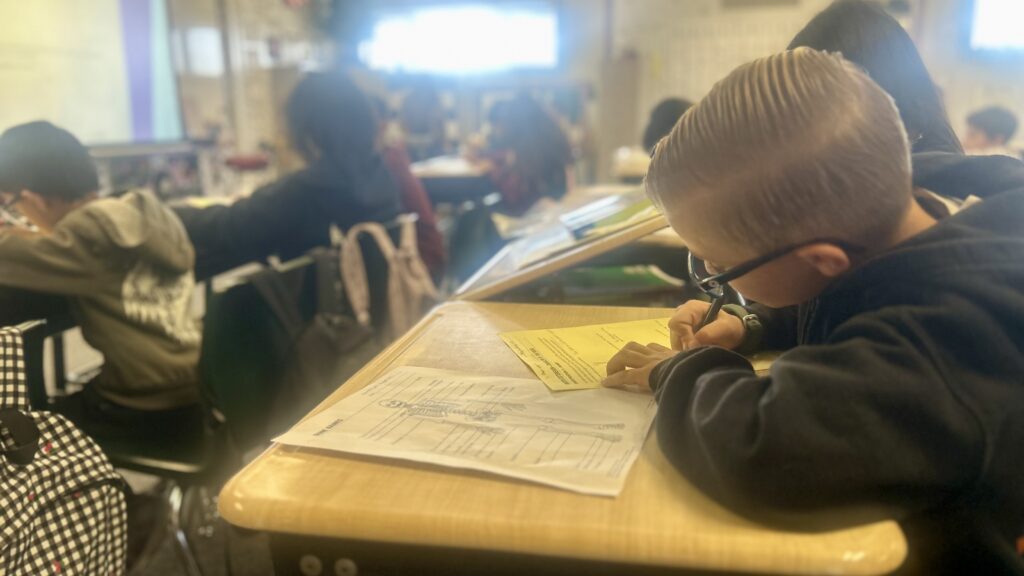
Kings Canyon educators draw on decades of classroom experience, research-based approaches learned from professional development or colleagues. Every Wednesday afternoon, they participate in team meetings to refine instruction.
Some teachers say they challenge students to take control of their learning.
Cheyenne Gomez, a sixth grade social studies and English teacher, instructs her students on how to do informational and narrative writing. But 11-year old Alexa Mendez said she didn’t quite understand the process for narratives. Gomez questioned her, asking about ways to introduce the story and make it flow with transitions. That frustrated Alexa at the time, she said.
Despite her frustration, Alexa said her teacher’s approach helped her. She tries to mostly question us, “so we can understand more,” Alexa says.
Still, it takes assessments to ensure students are grasping the concepts. Teams of teachers develop grade-level or subject-area assessments, which helps tell them how well their instruction is working. Educators teach, test, respond and reteach, as necessary.
“It’s not about evaluating students at that point,” Wagner, the principal, said. “It’s reflecting on our own practices.”
‘We Do, You Explore, You Do’
For example, sixth graders recently struggled to master figuring out the missing edges of a three-dimensional figure. Ulysses Mendoza, their math teacher, gave students tangible 3-D shapes to feel, so they’d realize which sides are always equal.
“These kids need(ed) to actually hold the shape,” Mendoza said.
Across math classes at Silas Bartsch, teachers utilize different ways for students to make sense of problems. They often use “we do, you explore, you do” approaches.
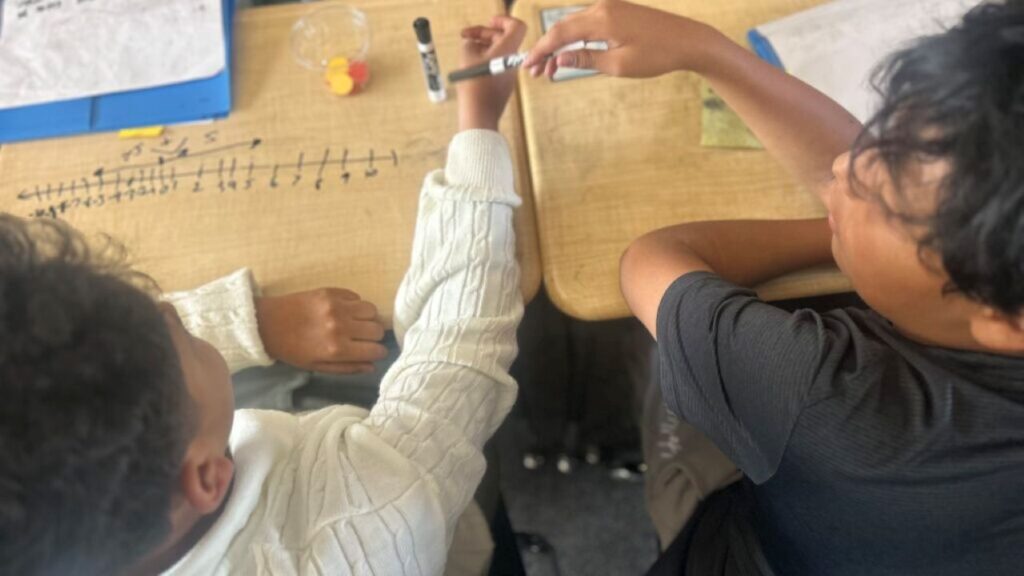
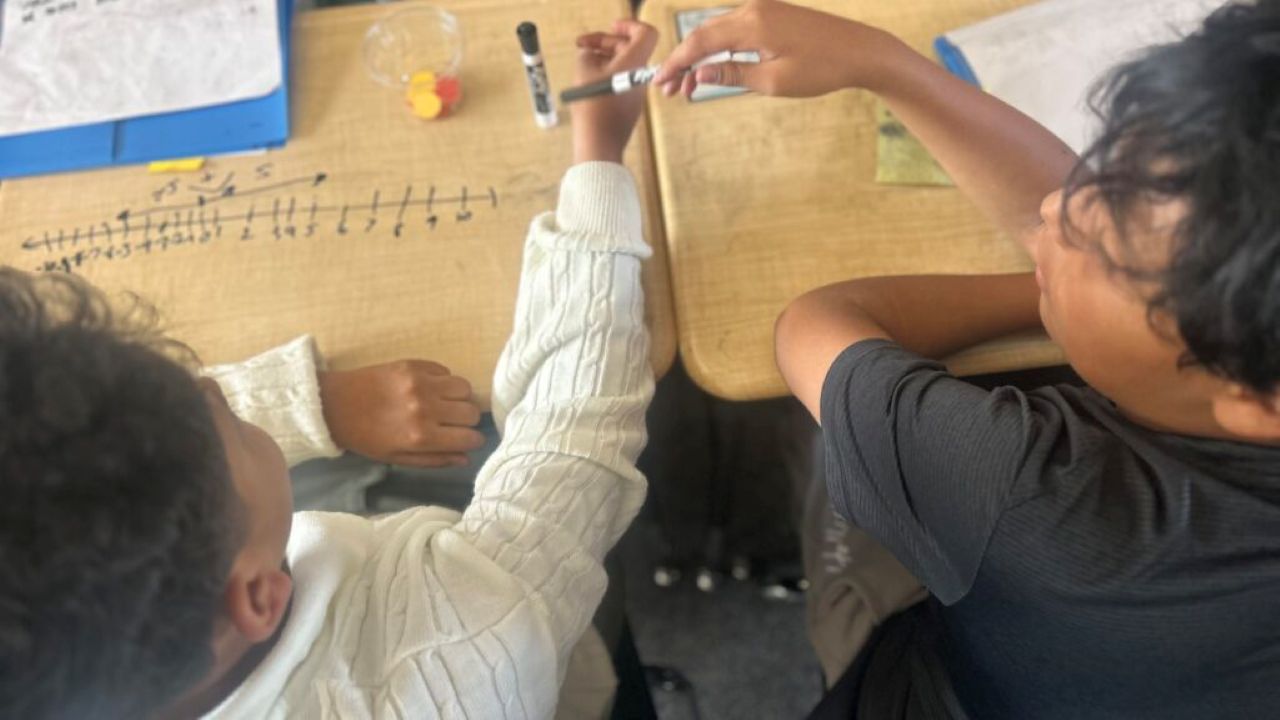
Using a dry-erase marker, seventh graders recently drew on their desks to show where figures should be on a number line. Sometimes using chips, and other times using arrows, students solved and depicted whether the number should be negative or positive. “No wrong answers,” teacher Savanah Alvarez said as students explored and discussed the problem.
Groups compared and justified their work with each other, eliciting feedback from their peers.
Such experiences have had an impact at Silas Bartsch, which scored above the district’s averages. Nearly 55% of Silas Bartsch students reached proficiency in math — a 7 percentage point increase from the prior year. Up by over 2 percentage points, 60% reached proficiency or better in English.
A District to Learn From
Fifth graders in Vanessa Frias’ class identify the main idea and supporting details of a text on Oct. 13, 2026. Credit: Lasherica Thornton/ EdSource
In May, Kings Canyon was recognized as one of California’s 11 “Districts on the Rise” for making significant improvement in both math and English, according to a Harvard, Stanford and Dartmouth report.
The Learning Policy Institute said it is also studying the district’s practices to understand what has helped English language learners make academic gains.
Students who are still learning English tend to struggle on standardized tests. But English learners in Kings Canyon Unified outperform their peers statewide. Nearly 20% met English language arts standards, compared with over 10% statewide.
Students often do better after they are reclassified as fluent in English. Statewide, 60.9% of former English learners met English language arts standards, compared with 53.5% of native English speakers. In Kings Canyon, 76.1% met proficiency.
“We are studying Kings Canyon Unified to better understand the practices behind these results and what other school systems can learn from its success,” said Amaya Garcia, a consultant with the Learning Policy Institute, in a media release shared with EdSource.
Though still working toward getting all students to proficiency, the district’s educators are learning in order to help students learn, they say.
According to fifth grade teacher, Vanessa Frias, “We’re always trying to come up with how we can do better.”