
|
Getting your Trinity Audio player ready...
|
Yayoi Kusama, a Japanese artist whose polka-dot-covered paintings, phallic sculptures and public performances caused a stir in New York City and Europe in the 1960s, and whose mirrored “Infinity Room” installations became selfie sensations and blockbuster museum and gallery attractions in recent decades, died Aug. 14 in Tokyo. She was 97.
The Yayoi Kusama Museum and the Yayoi Kusama Foundation announced her death, at a hospital, on Thursday.
Kusama first gained attention in the late 1950s and early 1960s with her immense abstract paintings that she called “Infinity Nets.” These were composed of countless small, curving strokes of white paint on all-white or all-black surfaces, suggesting giant, swirling meshes pierced with pinprick holes.

Far larger in scale than the Abstract Expressionist works that still dominated New York galleries, her pieces quickly attracted the notice of young artists who were trying to take American art in new directions. One was Donald Judd, who was working at the time as an art critic and formulating what would become Minimalism. He began championing her work, bought a painting of hers and helped out in her studio.
Creating art incrementally from repeated components became Kusama’s fixed working mode, and she applied it to sculpture. In the early 1960s she began sewing thousands of stuffed fabric phalluses, painting them white or gold, and gluing them onto the surface of everyday objects — tables, armchairs, coats, shoes, a baby carriage, a rowboat — to create bristling room-filling installations.
These “Accumulation Sculptures” made their debut, along with work by Claes Oldenburg, James Rosenquist and Andy Warhol, in a 1962 group show at Green Gallery that was among the first exhibitions of pop art. With that, Kusama became a pioneer in the two major avant-garde styles of the day, pop and minimalism.
Yayoi Kusama was born March 22, 1929, into a prosperous middle-class family with deep roots in the city of Matsumoto, northwest of Tokyo. She was the youngest of four children. Her father, Kamon Kusama, and mother, Shigeru Kusama, helped oversee the family’s wholesale seed business.
Kusama took steps to be a professional artist as a teenager, an extremely unusual move for a woman in conservative postwar Japan. In 1948, over the objections of her parents, she enrolled in art school in Kyoto and studied Nihonga painting, a style that merged Japanese and Western traditions.
But chafing at academic discipline and the style’s association with wartime nationalism, she soon went her own way. Immersing herself in reports of surrealist-inspired art in Paris and New York, and keeping a close eye on avant-garde developments in Japan itself, Kusama produced hundreds of semiabstract paintings that set floral, astronomical and sexual forms against fields of dots and spiky lines.
Kusama began exhibiting, and gaining attention while in her teens. In 1955, three of her paintings were sent to New York for inclusion in an international watercolor exhibition at the Brooklyn Museum, and she began to make plans to move to the United States.
Needing advice on how to establish a career there, she wrote to Georgia O’Keeffe — the only American woman artist she knew of — having tracked down her New Mexico address through the American Embassy.
O’Keeffe replied with encouragement, and in 1957 Kusama flew to Seattle, where she lived for about six months before moving on to New York City.
From her base there, the allure of her personal presence increasingly became a component of her art. She was very aware that as an Asian woman she projected an exotic outsider presence in the city’s art world, an identity that had useful potential for marketing her career. Calibrated orientalism became the substance of some of the public performance work she developed in the mid- to late 1960s, when she aligned herself with rising hippie culture.
In a series of anti-authoritarian and specifically anti-Vietnam War happenings starting in 1966, Kusama made guerrilla appearances in strategic locations throughout New York City — Wall Street, the Statue of Liberty and the Museum of Modern Art Sculpture Garden — leading a group of male and female volunteers. At her cue, they would strip down and pose as she painted their nude bodies with polka dots, to which she sometimes attributed magical properties.
“With those polka dots the people will self-obliterate and return to the nature of the universe,” she said.
Wearing dot-covered costumes, she remained fully clothed.
These events, which she called Body Festivals and Anatomic Explosions, had pragmatic dimensions. The display of bare flesh was calculated to grab public attention; if the police showed up, all the better. Scandal was valuable for promoting Kusama’s extra-aesthetic activities, which included a pop-up boutique, “Kusama’s Korner,” in Bloomingdale’s and a gay bar called “Kusama’s Omophile Klub.”
All of this was a success for a while. But trends were fleeting in that chaotic time, and as the Flower Child 1960s turned into the grimmer 1970s, her art spectacles began to look old. Sensing that Americans had lost interest in her, she returned to Japan in 1973.
In Tokyo, to support herself, Kusama sold modern and contemporary Western art until the mid-1970s oil crisis ended the Japanese economic boom and forced her to seek other means of income. She began making collages inspired by American artist Joseph Cornell, with whom she had earlier formed an intense but platonic relationship.
She also began writing fiction, publishing more than a dozen novels, some of them, like “Manhattan Suicide Addict,” autobiographical. She wrote several volumes of poetry. All the activity was not enough to stave off panic attacks and hallucinations, which became acute. In 1977 she admitted herself to the Seiwa mental hospital in Tokyo. She would make it her permanent home and build a studio nearby.
With the emotional security that the hospital environment afforded, she continued to work at high volume, creating a virtual industry in bright-color paintings, some with patterns suggesting capillary webs or swarms of spermatozoa, some incorporating figures and flowers and recalling her Surrealist-tinged work of the 1950s.
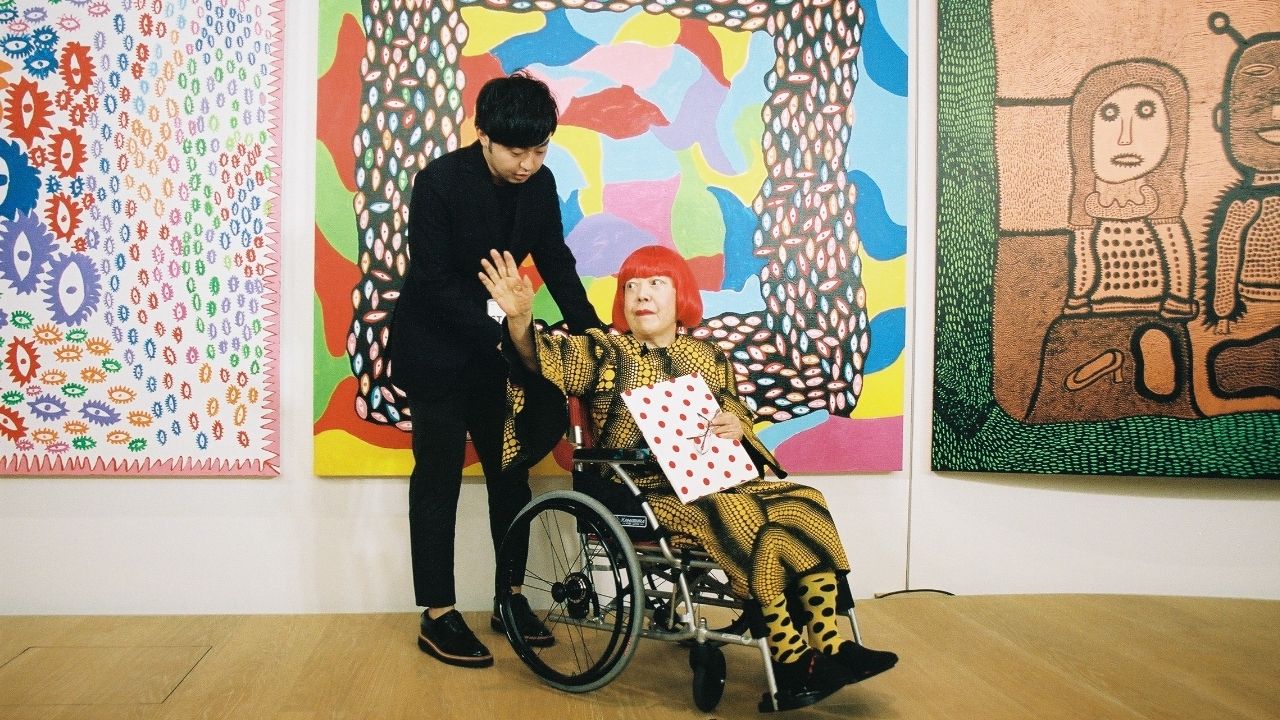
In the late 1990s and early 2000s, she returned to creating encompassing installations for the first time in three decades: rooms covered entirely in polka-dots and endlessly reflective mirrored “Infinity Rooms.”
Her persistent effort to establish herself and her art as an international brand paid off. In the 21st century, as Japanese contemporary art and popular culture gained global attention, interest in her work soared, as did prices for it. She herself referred to the phenomenon as “Kusamania.”
When one of her 1960 “Infinity Net” paintings sold for $7.1 million at Christie’s in 2014, it was the most expensive work by a living female artist ever bought at auction. She was represented by David Zwirner Gallery in New York.
In recent years, Kusama made lucrative arrangements to endorse commercial products, from cosmetics to cars. With her dot-patterned wardrobe and fluorescent page-boy-cut wigs, she was an instantly recognizable pop star, invited to contribute to international art shows and awarded shows of her own, often of new work produced with a platoon of assistants.
One museum show, “Love Forever: Yayoi Kusama 1958-1968,” which was organized by the Los Angeles County Museum of Art and the Japan Foundation in 1998, and which traveled to the Museum of Modern Art, celebrated her early years. In 2011-12, a larger retrospective appeared at the Tate Modern in Britain, the Whitney Museum of American Art in New York, the Centre Pompidou in Paris and the Reina Sofía in Madrid. In 2017, a major survey of her work was organized by the Hirshhorn Museum in Washington, D.C. In the same year, a Yayoi Kusama Museum opened in Tokyo.
Also in 2017, an article in Vice magazine pointed out repeated anti-Black comments — specifically, racist descriptions of Black people — that Kusama had made in her 2002 autobiography. In 2023, on the occasion of a solo exhibition at the San Francisco Museum of Modern Art, when the accusations resurfaced, the artist publicly apologized for those comments.
Iterations of the poetic, endlessly reflective “Infinity Room” — a mirror-lined chamber housing an intricately twinkling LED light display — have been box office gold for museums and galleries, either as part of larger exhibitions or on their own. They’ve drawn enormous crowds, with visitors lining up for hours and entering one at a time for 45 seconds each, basically long enough to take a selfie, an exercise in aestheticized narcissism that the artist understood and endorsed.
Japan, though slow in coming to appreciate her, has also honored Kusama with exhibitions. She represented her home country at the 1993 Venice Biennale. (She had appeared in the 1966 Biennale representing herself, showing up in a gold kimono and passing out clips of her reviews.) In 2006, she was awarded the Praemium Imperiale for painting, an international prize sponsored by Japan’s imperial family on behalf of the Japan Art Association.
Information on her survivors was not immediately available.
—
This article originally appeared in The New York Times.
By Holland Cotter/Motohiko Hasui
c. 2026 The New York Times Company