
|
Getting your Trinity Audio player ready...
|
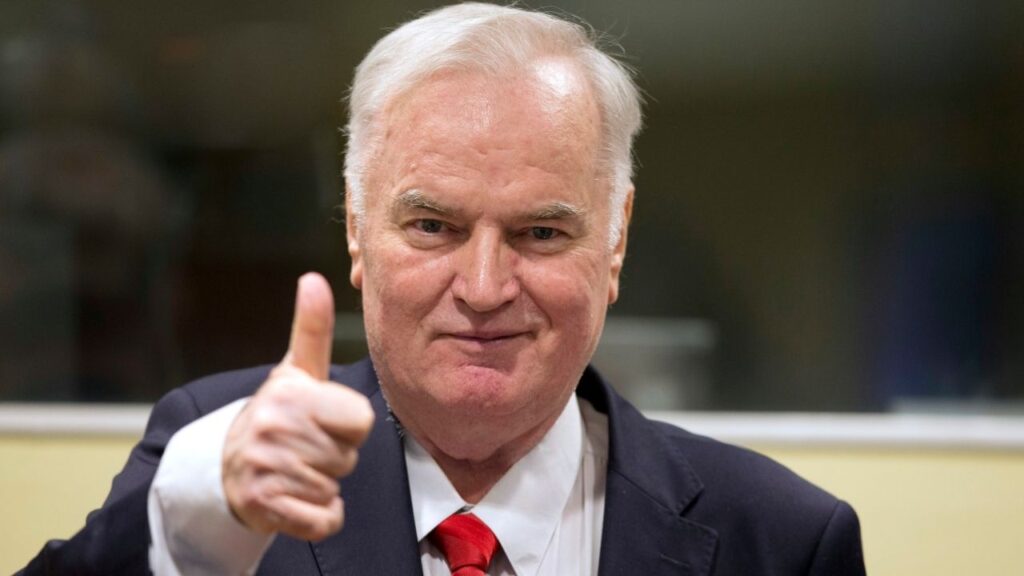
Ratko Mladic, the former Bosnian Serb general whose actions during the Balkan wars of the 1990s led to him being called the “Butcher of Bosnia” and who was held responsible for Europe’s deadliest massacre since World War II, the killing of some 8,000 Muslim men and boys at Srebrenica in 1995, has died in detention at The Hague. He was 83.
His death was announced Thursday by Serbian state media.
Mladic was captured May 26, 2011, in a farming village north of Belgrade, Serbia’s capital, after almost 16 years as a fugitive, ending one of the longest searches in modern history. His 2017 conviction by an international tribunal on charges of genocide, crimes against humanity and war crimes marked the end of a dark and bloody chapter.

In pronouncing a life sentence, the presiding judge, Alphons Orie, said Mladic’s crimes ranked “among the most heinous known to humankind.” Mladic appealed the verdict, which was upheld in 2021.
The Balkan wars erupted as Yugoslavia was breaking up into independent states. Slobodan Milosevic, the nationalist president of Serbia, one of those states, was intent on creating a Greater Serbia. He reawakened old ethnic and religious enmities and started wars pitting Serbs against Slovenes, Croats, Bosniaks and the Albanians of Kosovo.
Roughly 100,000 people died during the conflict, and more than 2.5 million were displaced.
A ruddy-faced and intimidating man with a bellowing voice, piercing blue eyes and a grandiose sense of himself, Mladic, an officer in the Yugoslav People’s Army, led the army of the Bosnian Serbs in the early 1990s.
On the eve of the Srebrenica massacre, he promised to avenge the conquest of Serbia centuries before by the Ottoman Muslim Turks. Over 10 days, his soldiers hunted down, captured and summarily executed thousands of Bosniaks, lining them up with hands tied behind their backs and shooting them. Women were raped. International pleas for restraint were ignored.
Serb forces buried the remains, dug them up again and scattered them in distant mass graves in an organized effort to hide damning evidence of war crimes.
Mladic’s trial was among the last high-profile ones at the International Criminal Tribunal for the former Yugoslavia in The Hague. The tribunal wound down after trying nearly 100 of those responsible for the atrocities of the Balkan wars, including Mladic’s boss, Radovan Karadzic, the political leader of the Bosnian Serbs.
Arrested in 2008, Karadzic was convicted in 2016 on charges almost identical to Mladic’s, and his sentence was extended to life in prison three years later.
Mladic’s arrest was a signal moment in Serbia’s long effort to shed its status as a pariah nation. It removed a major obstacle to the country’s still-pending accession to the European Union, which had grown weary of the refusal of successive Serbian governments to capture him.
When he was finally tracked down, he was hiding in the house of a cousin and was so desperate for money that one of his repeated demands was the restoration of his frozen military pension.
In addition to masterminding the massacre at Srebrenica, Mladic was eventually also convicted of multiple crimes tied to the nearly four-year siege of Sarajevo, Bosnia’s capital, in which 10,000 people died, including 1,500 children.
During the siege, the longest in the history of modern warfare, Mladic’s men shelled the city from surrounding mountains and terrorized civilians with sniper bullets. Judges also found him guilty of the persecution and extermination of non-Serbs living in large swaths of Bosnia.
Within Serbia, Mladic’s military prowess was legendary. Ljiljana Bulatovic, who wrote a biography of him, said he remained a hero to many Serbs, who would always regard him as “the mythical protector of the Serbian people.”
Ratko Mladic was born into poverty in the remote village of Bozanovici on March 12, 1943, when the area was part of the Independent State of Croatia, a Nazi puppet state dominated by fanatical Croat nationalists.
His father, Neda Mladic, an ethnic Serb member of the communist-led partisan resistance, was killed when Ratko was a toddler, and his mother, Stana (Lalovic) Mladic, raised him and his two siblings. His family’s experience planted in Mladic a deep fear that ethnic Serbs, unless they held the upper hand, would always face persecution by Croats and other ethnic groups.
He was a metalworker as a young man but soon turned toward the military for his schooling. With his sharp mind, physical strength and a charisma that inspired deep loyalty, Mladic rose swiftly in the Yugoslav People’s Army.
He was said to have adhered early in his military career to Josip Broz Tito’s brand of communism, which rejected nationalism and called instead for Yugoslav brotherhood as a way of holding together Yugoslavia’s fragile assemblage of multiethnic, multireligious republics.
Tito died in 1980, and after Milosevic stirred up nationalist grudges and Yugoslavia had begun to disintegrate in the early 1990s, Mladic took up Milosevic’s cause: halting separatism and assuring the dominance of the Serbs, the largest ethnic group. In 1992, a month after the Bosnian Republic’s declaration of independence, Mladic’s forces began the siege of Sarajevo.
In 1994, his daughter, Ana, a medical student in her early 20s, killed herself with his prized military pistol, apparently distraught by her father’s actions in the war.
In July 1995, with video cameras rolling, Mladic’s bodyguards handed out candies to Bosniak children. “No one will be harmed,” Mladic told terrified women and children July 12, patting a young boy on the head. At the time, his soldiers were preparing to conduct the mass killings.
After the massacre, the outrage in Washington and Europe prompted a NATO bombing campaign that overcame Bosnian Serb forces and led to the Dayton Accords that ended the Balkan wars in December 1995, though conflict in the former Yugoslavia erupted again in 1998 over Kosovo.
In 1995, the international tribunal in The Hague, which had been created two years earlier, indicted Mladic on war crimes and genocide charges related to the Sarajevo siege and the Srebrenica massacre.
—
This article originally appeared in The New York Times.
By Dan Bilefsky/Peter Dejong
c. 2026 The New York Times Company