

|
Getting your Trinity Audio player ready...
|
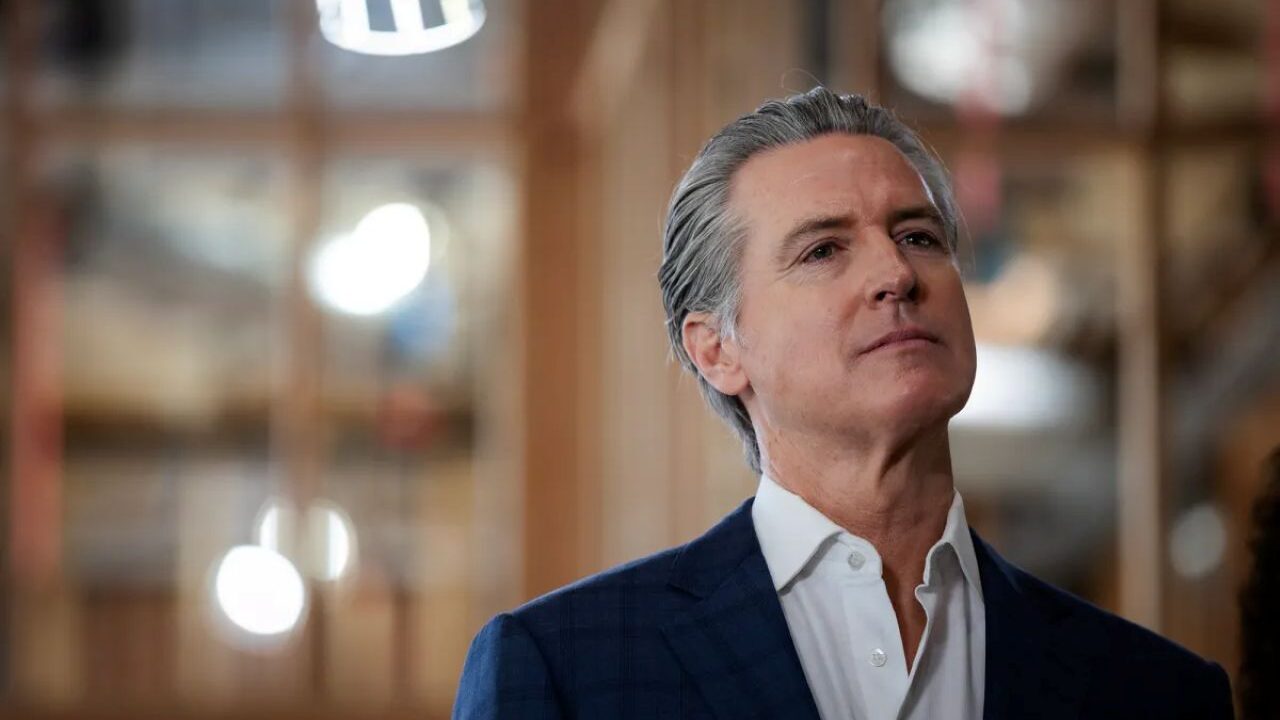
Gov. Gavin Newsom is in his populism era.

He started the year vowing to stop corporate investors from buying up large tracts of single-family homes, a desire shared by both socialists and President Donald Trump.
Last month, after he was unable to keep a proposal to tax California billionaires from appearing on voters’ ballots, he tried to get ahead of the debate by pitching nationwide higher taxes on the wealthy.

This story was originally published by CalMatters. Sign up for their newsletters.
‘Democratize Our Economy’
Last week, he spoke to a crowd of national Latino policymakers about the need to “democratize our economy” in the face of artificial intelligence-driven job losses.
Newsom’s populist appeals come as he prepares to leave office and looks toward an expected 2028 presidential campaign in which widespread anxiety about wealth inequality and the effects of AI on the economy will feature prominently.
“The old bargain is dead, and AI is going to finish it off,” he said last week in Los Angeles, of the concept that Americans could support families with working-class jobs. “We need to wake up to that foundational reality.”
The posture is new territory for Newsom, who is not a natural populist and who maintains his longstanding relationships with wealthy tech donors who have railed against the proposed billionaire tax, Proposition 40.
As governor, he’s kept his image as a liberal who favors progressive income taxes and expanding the social safety net without teetering too far into the overtly redistributive politics of democratic socialists. He eschewed most new tax proposals and stood by several state corporate tax benefits that progressives have longed to scrap.
By focusing on AI-driven inequality now, Newsom is choosing a popular issue to define his expected 2028 run. But it’s not yet clear whether voters will buy his solution.
“Newsom is balancing two pressures,” said Kevin Liao, a Democratic strategist who worked on billionaire Tom Steyer’s “tax the rich” gubernatorial campaign this year. “There’s a desire to meet the demands of his constituents and the current appetite to be against billionaires, and to address the massive wealth inequality in the state and the country, with the cold political reality that much of his career and presumably his future ambitions have also been built on the financial support from a lot of wealthy folks in Silicon Valley.”
Five Tax Measures on the California Ballot
Even as he adopts a more progressive posture while appearing in other states, Newsom is walking a fine line back home, where his vocal opposition to California’s billionaire tax proposal could confuse voters staring at multiple tax measures on the November ballot.
Proposition 3, sponsored by the California Teachers Association, is also a tax on the rich: It would make permanent the state’s higher income tax rates for the top 2% of earners. That money goes into the state general fund, 40% of which pays for schools.
Voters approved those rates temporarily in 2012 at the behest of then-Gov. Jerry Brown, and extended them again in 2016. If they expire as planned in 2030, the state stands to lose between $5 and $15 billion a year in revenue.
Early polling shows that measure is popular, but CTA President David Goldberg acknowledged it will be tricky to campaign in favor of it with another tax on the ballot. The union opposes the billionaire tax because it would not send the same proportion of its revenues to schools, instead prioritizing healthcare.
Voters will also be asked to weigh in on three other tax-related ballot measures: two backed by tech billionaires designed to undercut the billionaire tax, and one by an anti-tax advocacy group that would make it harder for cities to raise local taxes.
“It’s always hard when you have a bunch of things” on the ballot, Goldberg said. “It is going to mean that we have to really go out there and make the case for this.”
Asked whether his opposition to Prop. 40 could hinder public support for Prop. 3, Newsom told reporters recently: “I hope that’s not the case. … It’s a legitimate question.”
How Newsom Wants to Be Seen
For years, Newsom has defended California on Fox News and on social media against a national reputation that it is over taxed, often arguing that lower- and middle-income families pay more in taxes to live in states like Florida and Texas. The basis of his claim is a study from the left-leaning Institute on Taxation and Economic Policy that found Florida and Texas rely heavily on property and sales taxes, which effectively take a greater share of those households’ earnings than those of the wealthiest. The states do not tax personal income.
“He taxes low-income workers more than we tax millionaires and billionaires in the state of California,” Newsom said of Florida Gov. Ron DeSantis, during a 2023 debate hosted by Fox’s Sean Hannity.
Critics say those arguments don’t take into account the lower costs of goods and property in other states.
“California is a high-tax state,” said Jared Walczak, a senior fellow at the right-leaning Tax Foundation. “A state like California can get away with higher rates than some other states because the state has so much to offer. … It doesn’t mean there isn’t a tipping point.”
Now nearing the end of his term, Newsom is touting all the progressive programs California’s tax system has made possible, including universal school meals and subsidized child care.
At the same time, Newsom often chides more left-wing colleagues in the Legislature “not to be profligate” with public spending. He touts that he’s never raised taxes in his eight years as governor, though critics may quibble over limiting businesses’ tax deductions or a law he signed this month raising a tax on health insurance plans.
When Democratic lawmakers pushed to raise new revenue in the face of budget deficits the last three years, he quickly quashed the idea.
“We have among the highest tax rates in the United States of America for high-wage earners, we have among the highest tax rates … for corporate taxes,” he said in 2024. “I feel strongly that we have to live within our means.”
This year, some Democrats insisted on a proposal to tax corporations whose workers earn so little that they qualify for public healthcare; Newsom would agree only for the state to study the idea.
‘He’s Never Banged This Drum’
He’s taken a similar stance with the state billionaire tax. Along with a cadre of Democratic allies like Planned Parenthood, he argues that billionaires could easily move their assets to another state — as some, like Google co-founder Sergey Brin, have done with their homes and businesses. Early polling shows a slim majority of Californians support the measure.
Newsom pressured SEIU United Healthcare Workers West to drop the measure in exchange for concessions, but when he didn’t succeed, he pivoted to proposing his own federal billionaire’s tax, taking a page from progressives like Elizabeth Warren.
He’s calling for a minimum tax rate on anyone making more than $100 million, undoing corporate tax cuts that President Trump and Congress approved in 2017, boosting inheritance taxes and closing loopholes used by the wealthy to borrow from unrealized capital gains without paying income taxes.
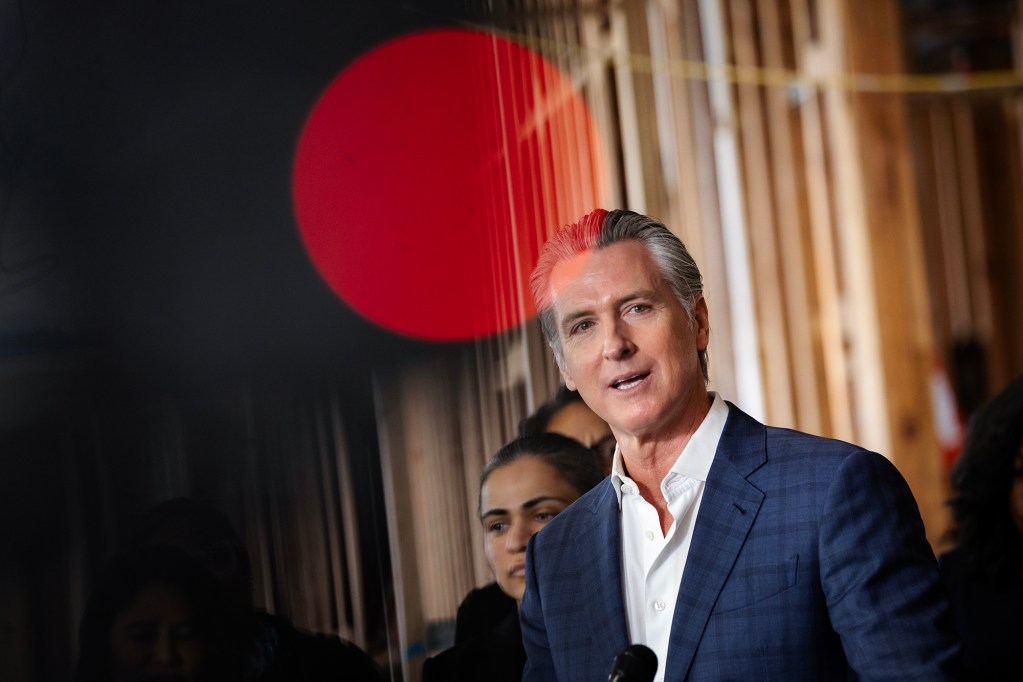
Without getting into details, he also said he supports the idea of a public fund using AI-derived wealth to support displaced workers.
Rob Stutzman, a Sacramento Republican strategist, said Newsom risks being seen as inauthentic in a primary campaign.
“He’s never banged this drum … he’s a big spender but not a big taxer,” Stutzman said. “This whole jiu-jitsu he has to do to oppose the (billionaire) tax in his state and then support it federally, it doesn’t sound as authentic as others might sound on the soapbox at the Iowa State Fair.”
Voters Are Anxious About AI
The call for sharing wealth also opens doors for anti-tax attacks from the right, which is eager to link a wide swath of Democratic policies to communism.
“Most Democrats have the foresight to tie their tax hikes to a far-left policy, but Newsom just wants to take your money because he wants to take your money,” Republican National Committee spokesperson Nicholas Poche said in an emailed statement, criticizing Newsom for trying to “have it both ways with progressives and establishment Democrats.”
But political strategists agree that framing tax proposals as a response to AI anxiety is appealing across the ideological spectrum.
“A wealth tax is more simplistic and falling along ideological lines,” Liao said. “If we’re talking about broad societal change, it is much more than wealth redistribution. It is something that’s going to touch every single person.”
More than half of Americans worry the technology will leave someone in their household jobless; a growing sense of precarity has seized workers from customer service representatives to Silicon Valley’s own elites. Meanwhile, the upcoming public offerings of AI companies like OpenAI and Anthropic are expected to turbocharge the nation’s already unequal distribution of wealth. The top 10% of the country owns nearly 70% of its wealth, and the bottom half own just 2.5%.
Politicians of All Stripes Share Concerns About AI
Former Chicago Mayor Rahm Emanuel, known as a moderate Democrat, is floating more aggressive regulations on the technology as he weighs a run for president and is open to basic income payments for displaced workers. Progressive standard-bearer U.S. Sen. Bernie Sanders is proposing a national sovereign wealth fund paid for with a 50% tax on AI companies that would directly pay Americans, making the nation essentially a part owner of AI.
Even Vice President J.D. Vance is considering the issue, telling a podcaster last month that his biggest concern about AI is not mass unemployment but the breakup of “social harmony” that comes with increasing inequality.
“If you make rich people way richer, you are going to have significant problems,” he said. “That is one of the consequences that I see from AI.”
He added that Trump is generally supportive of Sanders’ idea, though the president also has developed cozy ties with many tech leaders during his second term.
But many progressives are holding their applause for Newsom for now. Lorena Gonzalez, leader of the California Labor Federation, said she’s pleased he is taking on AI-driven inequality, but unions still want the state to curb AI in workplaces and stop mass displacement of workers. Newsom has been reluctant to back aggressive regulation or bans on the technology.
Flanked by labor leaders in important presidential primary states earlier this year, Gonzalez warned the governor that unions could withhold their political support if Newsom does not rein in use of the technology.
“It’s not enough to say, ‘I feel your pain,’ ” Gonzalez said. “We don’t think that catastrophic job loss is inevitable.”
This article was originally published on CalMatters and was republished under the Creative Commons Attribution-NonCommercial-NoDerivatives license.