
|
Getting your Trinity Audio player ready...
|
Oil prices rose to a six-week high on Wednesday as the U.S. and Iran traded more strikes, further threatening energy shipping in the Middle East, while U.S. equities were flat ahead of key Big Tech earnings.
Brent crude prices were last up around 2.7% to $93.40 per barrel, reaching levels not seen since early June. A brief détente between the U.S. and Iran ended earlier this month, once again restricting tanker movement in the key Strait of Hormuz. On Wednesday, U.S. President Donald Trump threatened more attacks on Iran infrastructure.
The nearly five-month war has depleted global stockpiles and stoked inflation worldwide. Shipping disruptions could worsen following threats of attack from Yemen’s Iran-aligned Houthis on another key artery in the Middle East, this one in the Red Sea.

Four oil tankers carrying Saudi crude to Asia reversed course in the Bab el-Mandeb strait following the Houthi threat.
“Two weeks ago, oil prices were going down, everybody was saying it was going to go back to $70 or $60 a barrel, and now (Hormuz) is closed again, so oil prices are going up, and everybody is saying it is going to go to $120,” said Kevin Thozet, a member of the investment committee at Carmignac.
The closure of both Hormuz and Bab el-Mandeb would mean the shipping routes for more than a quarter of the world’s oil-and-gas supply would be disrupted. Clearing both of those logjams would strain the U.S. military, analysts said, which has not been able to reopen Hormuz since the start of the war at the end of February.
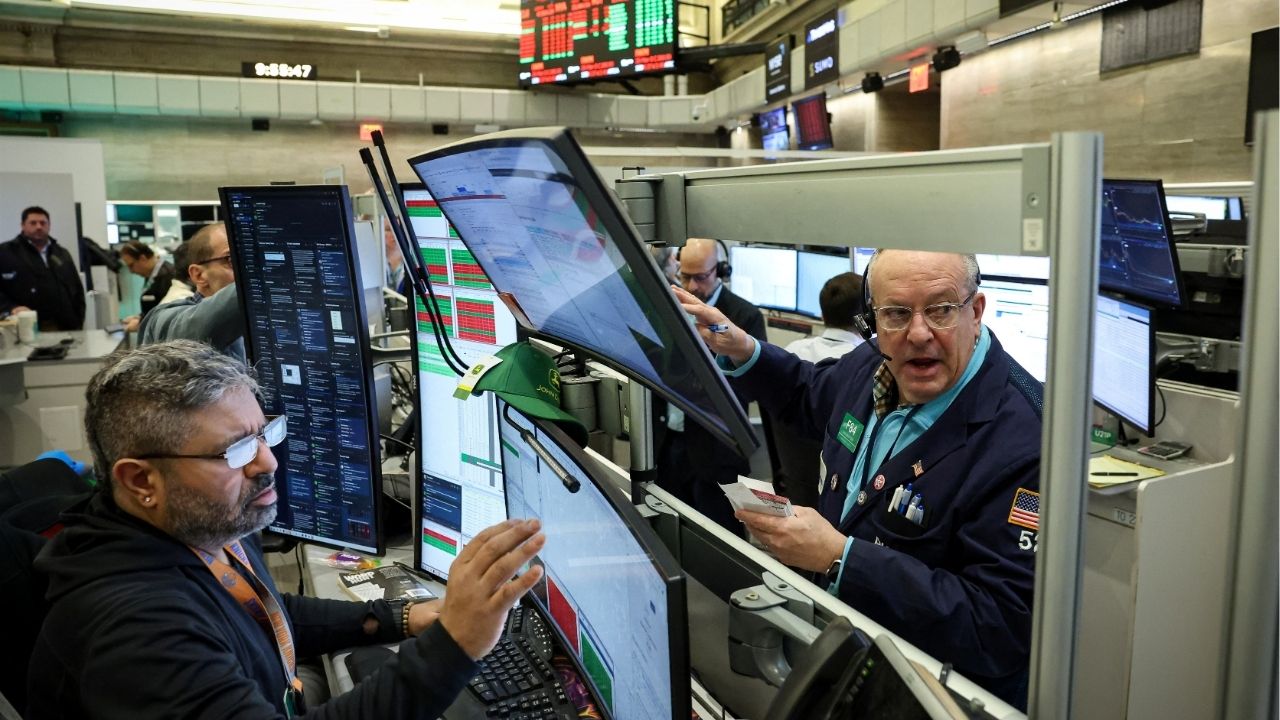
On Wall Street, the Dow Jones Industrial Average edged up 0.3%, while the S&P 500 added 0.1%, and the Nasdaq Composite dipped about 0.1% amid weakness in chip shares.
Escalating hostilities could reignite inflation, drive interest rates higher and knock global growth back to as low as 1.3%, down from 2.9% last year, World Bank chief economist Indermit Gill told Reuters.
Alphabet Kicks off Tech Earnings
The stock market’s focus will turn to earnings after Wednesday’s closing bell from Alphabet, which is facing heightened scrutiny over the delayed launch of a key AI model, and Tesla, which is widely expected to report its first quarterly cash burn in over two years.
Chip stocks that have been key drivers of this year’s AI-driven rally, such as Micron Technology and Nvidia, gained 0.3% and 3.2% respectively. Shares of major hyperscalers have come under pressure in recent months due to worries about growing capex.
“Even the slightest doubt about the monetization of artificial intelligence or the return on infrastructure spending could call into question the main driver of the market rally over the past nearly two years,” said John Plassard, head of investment strategy at Cité Gestion.
U.S. President Donald Trump’s fresh tariff pronouncements also fueled uncertainty. He said all generic drugs brought into the U.S. will carry a 100% tariff beginning in August 2028, and rise to 200% a year after that. The administration slapped a 50% tariff on some Canadian goods earlier this week.
The MSCI All-World index was marginally higher on the day, as Europe’s STOXX 600 rose 0.6%.
Yen Bounces off 40-Year Lows
The Japanese currency found its footing at 163 per dollar after hitting a new 40-year low on Tuesday as investors weighed the measures officials would use to shore up the drooping currency.
Japanese Finance Minister Satsuki Katayama said on Wednesday that the government remains ready to take “decisive action” in currency markets if needed, while refraining from commenting on specific foreign-exchange levels.
The dollar dipped from a one-week high on Wednesday after four straight daily advances.
Higher energy costs are complicating the work of central bankers who have also grown cautious in offering an outlook for monetary policy. The European Central Bank is expected to announce its rate decision on Thursday, and the U.S. Federal Reserve’s decision is due next week.
Both central banks are expected to leave borrowing costs on hold this month, but traders expect borrowing costs in the U.S. and the euro zone to rise by at least 25 basis points each by the end of the year, LSEG-compiled data showed.
The yield on the U.S. 10-year Treasury note ticked up 1.4 basis points to 4.64%, after touching a two-month high on Tuesday. The Treasury will auction $13 billion in 20-year bonds later in the day.
(Reporting by Lawrence Delevingne, Gregor Stuart Hunter and Johann M Cherian; Editing by Amanda Cooper, Anil D’Silva, Jan Harvey, and David Gaffen)