
|
Getting your Trinity Audio player ready...
|
WASHINGTON — House Republicans on Tuesday pushed through a stopgap spending bill to keep government funding flowing through early December, moving months ahead of time as they braced for a shutdown confrontation with Democrats before the midterm elections.
But the fate of the measure was deeply uncertain, with Democrats opposed and the Senate GOP leader casting doubt on the chances of quick action in his chamber, where legislation needs some degree of bipartisan backing to move.
On a 220-205 vote, mostly along party lines, the House approved the kind of emergency temporary spending measure that normally is advanced mere days or hours before federal funding is set to lapse in order to avert a shutdown. But this time, House GOP leaders offered the so-called continuing resolution months in advance of the Sept. 30 deadline, effectively daring Democrats to oppose it.

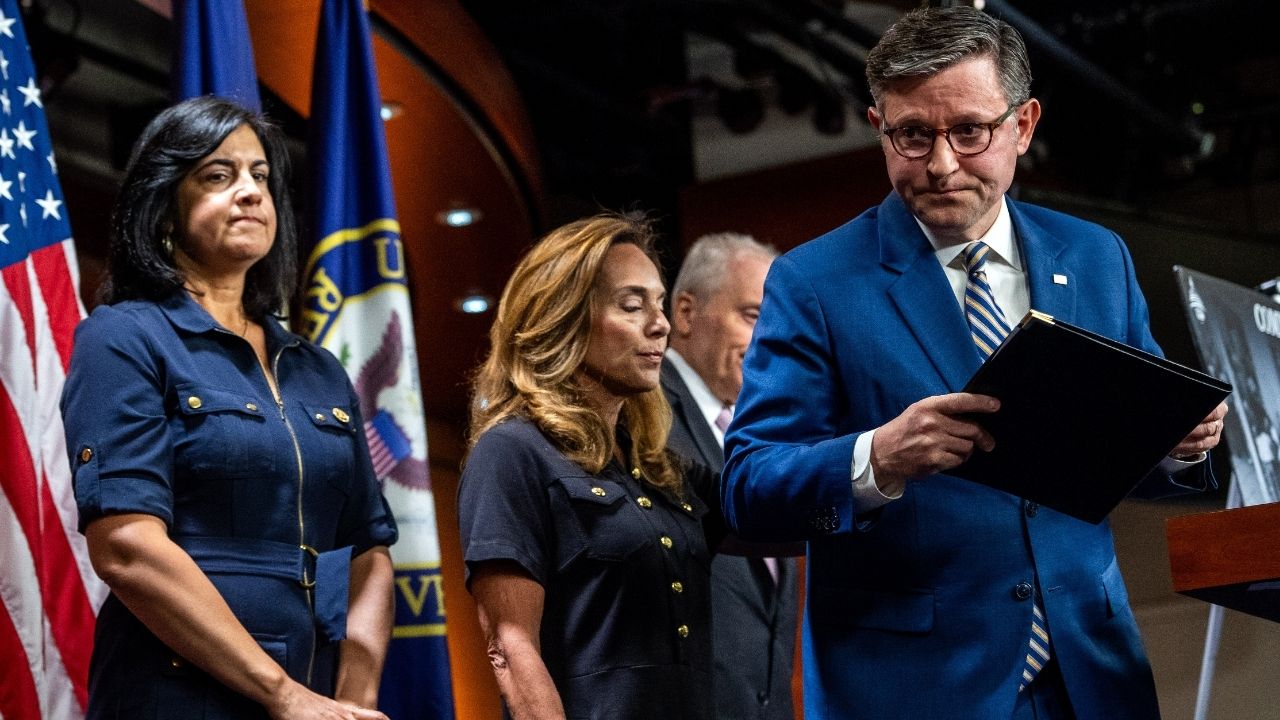
“They’ve shown there’s nothing they love more than a government shutdown, as tens of millions of Americans head to the polls in November,” Speaker Mike Johnson, R-La., said at a news conference at the Capitol. “But this clean CR is an opportunity for both sides.”
Six Democrats, most of whom are facing tough reelection battles in November, voted with Republicans to pass the legislation: Reps. Kathy Castor of Florida; Henry Cuellar of Texas; Don Davis of North Carolina; Jared Golden of Maine; Vicente Gonzalez of Texas; and Gabe Vasquez of New Mexico. One Republican, Rep. Thomas Massie of Kentucky, opposed it.
Its path in the Senate is murky at best. Senate Majority Leader John Thune, R-S.D., told reporters on Tuesday that he would “try” to put a stopgap spending bill to a vote before senators leave Washington for a five-week break beginning in August. But he said it was “possible” it could “get punted” later into September.
Democrats said they opposed the legislation, in part because it would not impose any new restrictions on President Donald Trump’s immigration crackdown. Rep. Rosa DeLauro of Connecticut, the top Democrat on the Appropriations Committee, said lawmakers should continue their bipartisan negotiations over the 12 spending bills that are supposed to fund the government.
“If I am going to support a continuing resolution, it needs to continue government operations, exclude any poison pills, and it must maintain Congress’ constitutional authority over spending decisions,” DeLauro said. “At this time, the continuing resolution does not meet that standard.”
Appropriators in both chambers are negotiating over spending levels, though few expect many of them to be passed into law by the Sept. 30 deadline.
Looming over the funding debate are the two government shutdowns Democrats have triggered since Trump took office. The first was in October 2025, when the party sought unsuccessfully to use its leverage over federal spending to force the president to cut a deal on extending expiring healthcare subsidies. The second was in February 2026, when Democrats tried and failed to pressure Trump to agree to new restrictions on federal immigration agents following the killings of U.S. citizens amid his deportation crackdown.
“After Senate Democrats forced the two longest government shutdowns in American history and abandoned previously negotiated funding agreements more than once, we have every reason to act early, and every responsibility to do so,” said Rep. Tom Cole, R-Okla., chair of the Appropriations Committee.
Democratic leaders countered that they did not want a shutdown, but could not support legislation that failed “to block funding for Donald Trump’s violent mass deportation machine.” Democrats have also been reluctant to support stopgap funding bills that simply maintain existing funding levels and do not carry any policy dictates to restrain how the administration can use the money.
“This continuing resolution is a premature and desperate attempt by Republicans to abdicate their responsibility to govern while there are still several months left to negotiate a bipartisan agreement,” the top three House Democrats, led by Rep. Hakeem Jeffries of New York, wrote in a letter to lawmakers. “We will be voting no.”
—
This article originally appeared in The New York Times.
By Catie Edmondson/Alex Kent
c. 2026 The New York Times Company