



|
Getting your Trinity Audio player ready...
|
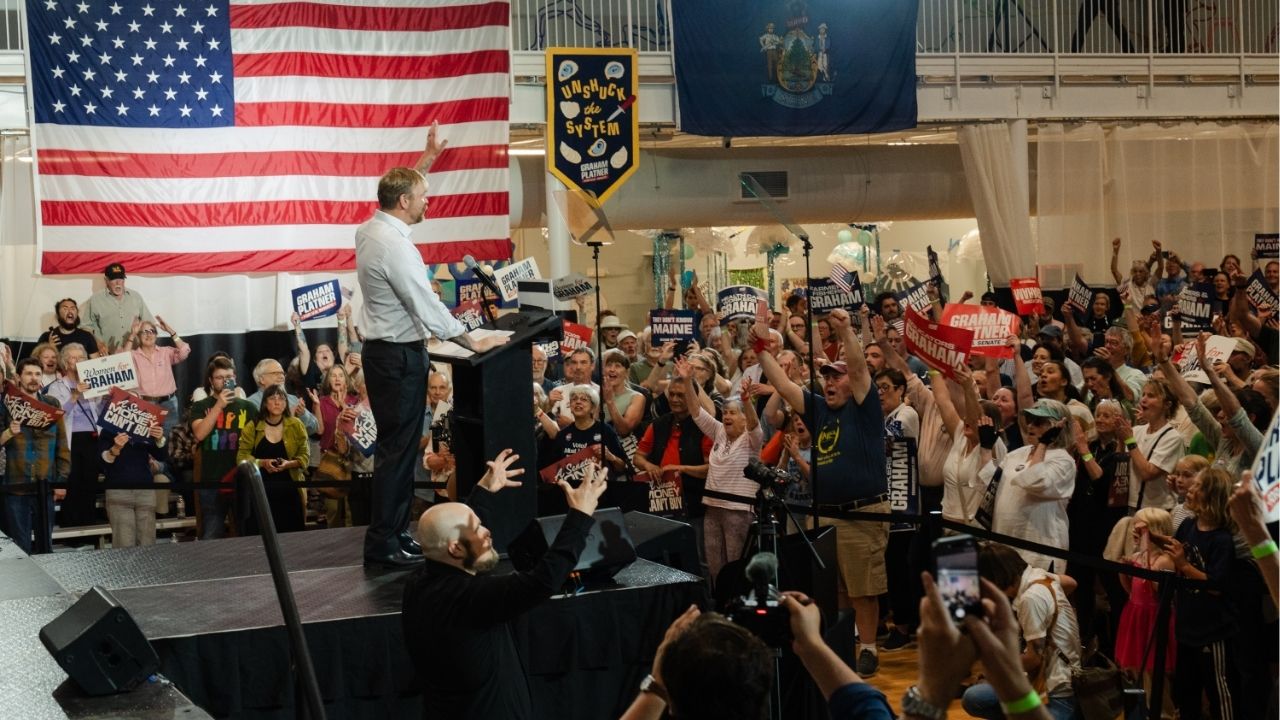
Maine Democrats will hold a convention on July 25 where they will select a new Senate nominee to replace Graham Platner, Charles F. Dingman, chair of the state party, said Friday.
The convention will be held at the Cross Insurance Center, a small arena in Bangor, according to rules released by the state party.
Maine Democrats are planning to hold county meetings to choose delegates next weekend and the state convention the weekend after that to pick a replacement for Platner, who filed paperwork to end his campaign on Friday. He had faced widespread pressure from party leaders and allies to bow out after a rape allegation, which he denies.

Officials in the state are trying to create a process to choose a Platner replacement by a July 27 deadline, a herculean task for a small state party.
“I have issued the call for a nomination convention to choose a new nominee for U.S. Senate,” Dingman said in a video statement released by the state party Friday night. “This call to convention provides the most inclusive, representative and transparent process possible under these unprecedented circumstances and the applicable laws.”
At the convention, 601 delegates will vote on the nominee, the state party said. The group will include 101 members of a state Democratic Party committee and 500 additional delegates appointed from the state’s 16 counties.
Each county party will hold a meeting to nominate its delegates, according to the rules set out by the state party. “All Democrats registered in the County as of June 9, 2026, are eligible to participate and vote in their county’s Delegate Nominating Meeting,” the rules say.
The specific manner of how the delegates will be chosen from each county was not articulated in the convention rules the Maine Democratic Party released Friday night. Kristi Johnson, a Maine Democratic Party spokesperson, declined to elaborate on the rules. Aides to the candidates for Senate were also seeking clarification on the rules.
A Democratic county chair, Bruce Bryant of Oxford County in western Maine, wrote on Facebook that his county party would hold a gathering on July 19 to determine its delegates.
With a little over two weeks to replace Platner and a tiny state party staff — the Maine Democratic Party touts on its website that it increased its employee head count to 18 from four in 2025 — Democratic officials from around the country are beginning to converge on Maine to assist. About 10 state Democratic parties have sent or are sending staff members to Maine to help with logistics and public relations.
One outsider who has taken on a senior role in organizing the caucus process is Troy Price, the executive director of the Association of State Democratic Parties, according to three people involved with the emerging plans, who spoke on the condition of anonymity to describe private discussions. Price has worked in senior positions in state Democratic parties in New Hampshire and Iowa, where he oversaw the disastrous 2020 presidential caucus. Price did not respond to messages on Friday.
Whoever is chosen as the new nominee will face Sen. Susan Collins, a five-term Republican who has defied political gravity in the past and defeated an array of Democratic challengers. Collins is the only Senate Republican facing reelection this year in a state President Donald Trump lost in 2024.
Democrats must flip at least four Republican-held Senate seats in this year’s midterm elections to take a majority in the chamber. The Maine seat has long been viewed as their best opportunity to seize a GOP seat.
A number of Maine Democrats who lost in recent high-profile primaries have piled into the nominating contest.
They include Nirav Shah, a former public health official; Troy Jackson, a former president of the Maine Senate; Shenna Bellows, Maine’s secretary of state; Jordan Wood, a former congressional staff member; Dan Kleban, a founder of a brewery; and Paige Loud, a social worker.
Shah, Jackson and Bellows all ran for governor and lost in the primary last month. Wood and Loud lost in the House primary in northern Maine’s swing congressional district. Kleban is relatively new to politics but briefly joined the Democratic Senate primary race last year before dropping out.
Under rules set by the state party this week, candidates must secure 500 signatures — including 50 from eight different counties — by July 21 to be eligible for the nomination. They must declare their intention to seek the nomination by Wednesday. And they must submit brief statements describing “how their campaign will continue to support and build on the currently existing grassroots energy and movement in Maine.”
Platner officially withdrew his candidacy on Friday, sending a letter to the Maine secretary of state. “Please consider this notice as my official withdrawal from consideration for this office,” he wrote. Platner’s departure was confirmed by Jana Spaulding, an aide to the Maine secretary of state.
–
This article originally appeared in The New York Times.
By Reid J. Epstein/Tim Balk/Sophie Park
c.2026 The New York Times Company











![[hubspot type=form portal=8576119 id=f5235c74-daca-46b2-b841-0fec24b5a509]](https://gvwire.com/wp-content/uploads/2026/09/GVH_LaborDaySavings_300x250_static.jpg)
