

|
Getting your Trinity Audio player ready...
|
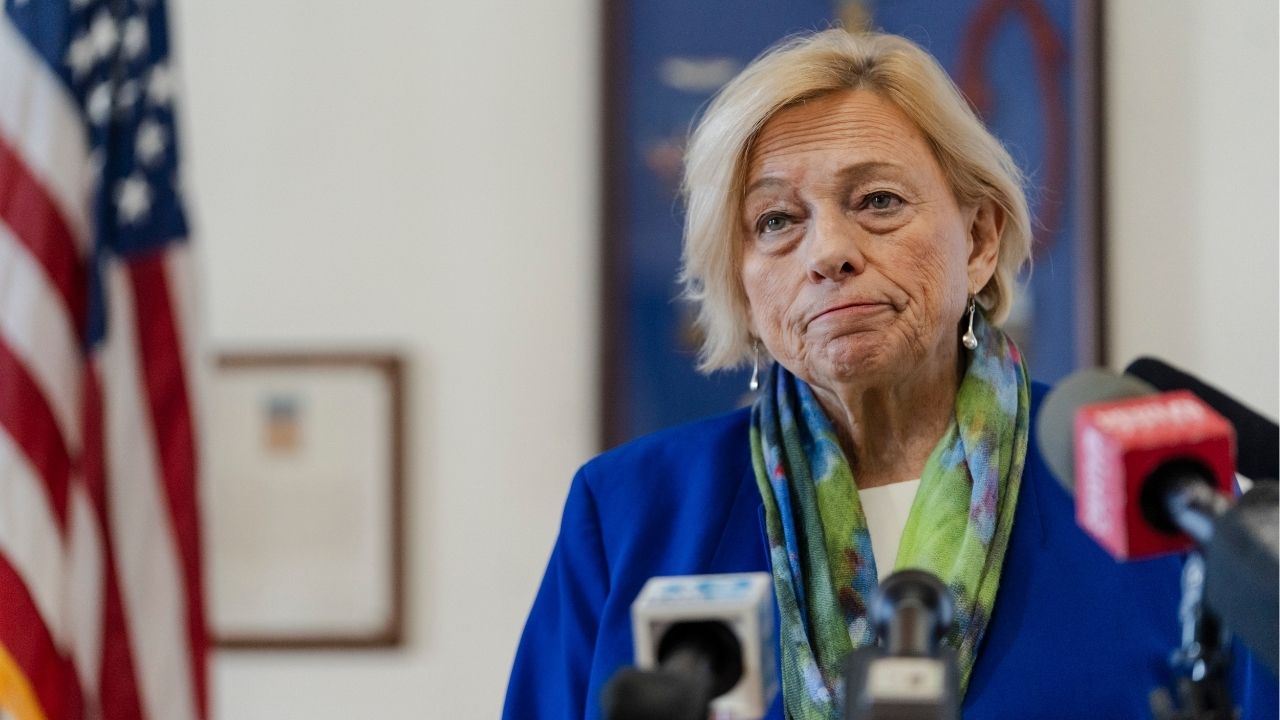
PORTLAND, Maine — Gov. Janet Mills of Maine, the Democratic establishment’s choice to run for the Senate seat long held by Sen. Susan Collins, a Republican, suspended her campaign Thursday, saying she no longer had the financial resources to compete against Graham Platner, a progressive political newcomer.
Her exit paves the way for Platner, an oysterman who has led her in polls, to become the Democratic nominee in one of the most important Senate races in the country.
“While I have the drive and passion, commitment and experience, and above all else — the fight — to continue on, I very simply do not have the one thing that political campaigns unfortunately require today: the financial resources,” Mills said in a statement.

Her exit is a blow not only to the two-term sitting governor but also to Sen. Chuck Schumer of New York and the Democratic Party establishment that he leads. Schumer, the minority leader, has for almost two decades chosen his party’s Senate candidates with little internal opposition.
That era may be coming to an end — and Mills’ ill-fated campaign is not the only evidence. In a year when Democrats have grown increasingly bullish about their chances to win back a Senate majority, several of Schumer’s handpicked candidates have struggled to gain traction in their primary contests.
In addition to Mills, Schumer and his political apparatus have backed Senate candidates in Iowa, Michigan and Minnesota who face formidable challengers in upcoming primary elections.
Several of those challengers have made opposition to Schumer’s leadership central to their campaigns. Last month in Illinois, Lt. Gov. Juliana Stratton won her state’s Senate primary while pledging to oppose a future Schumer bid to be party leader.
The rebuke will only grow stronger if those candidates do well in November, after which it is almost certain that Schumer would face a serious challenge to his leadership post in the Senate.
Schumer has also recruited candidates in Alaska, North Carolina and Ohio who are on glide paths to the general election.
Schumer and Sen. Kirsten Gillibrand of New York, the chair of Senate Democrats’ campaign arm, praised Mills on Thursday as she departed the race.
“We are grateful for her hard-fought and principled campaign, and we respect her decision to continue her service to Maine as governor,” they said in a statement.
No Democratic Senate primary has drawn as much attention as Maine’s. After Schumer recruited her last year, Mills entered the race in October. By then, Platner had already established himself as a potent progressive alternative with support from Sen. Bernie Sanders, I-Vt., and with current and former aides of Mayor Zohran Mamdani of New York.
Schumer saw Mills, an eighth-generation Mainer and two-term governor, as a proven statewide candidate with the renown and popularity to challenge Collins. The incumbent is a formidable campaigner who has long defied predictions of vulnerability, but Democrats argue that this year is different because of President Donald Trump’s teetering approval ratings and Collins’ votes for some of his Cabinet and Supreme Court nominees.
But Mills, whose delay in entering the race last year raised questions about her hunger for the job, could not catch up with Platner’s fundraising or standing in polls of Maine Democrats. Her campaign announced it had raised $2.6 million during the first three months of 2026, a relative pittance for a top-tier Senate candidate backed by Schumer and the party establishment.
Platner, an oyster farmer making his first run for public office, is an untested political commodity who has nevertheless proved popular with the party’s online donors. His town-hall meetings across Maine have drawn large crowds and even bigger audiences on social media.
A key subtext of Platner’s campaign was the idea of generational change in the party. Platner is 41; Mills is 78 and has been in elected office in Maine on and off since 1980.
The question now is how Platner will match up against Collins, a five-term Republican who has vexed generations of Maine Democrats. Collins, 73, has a well-manicured reputation as a moderate who has directed scores of federal projects to Maine.
Mills and her allies tried to knock Platner out of the primary with a series of damaging stories and then advertisements about offensive things he had written online about women and rape, along with revealing that he had a tattoo on his chest that resembled a Nazi symbol. Platner later obscured the image with a new tattoo.
But Platner has built a durable advantage among Maine’s Democratic primary voters. Recent polling has shown him up by more than 30 percentage points. He has also maintained a steady fundraising advantage over Mills, who was being aided by Schumer and the Senate Democrats’ campaign arm.
—
This article originally appeared in The New York Times.
By Lisa Lerer, Katie Glueck and Reid J. Epstein/Sophie Park
c. 2026 The New York Times Company