


|
Getting your Trinity Audio player ready...
|
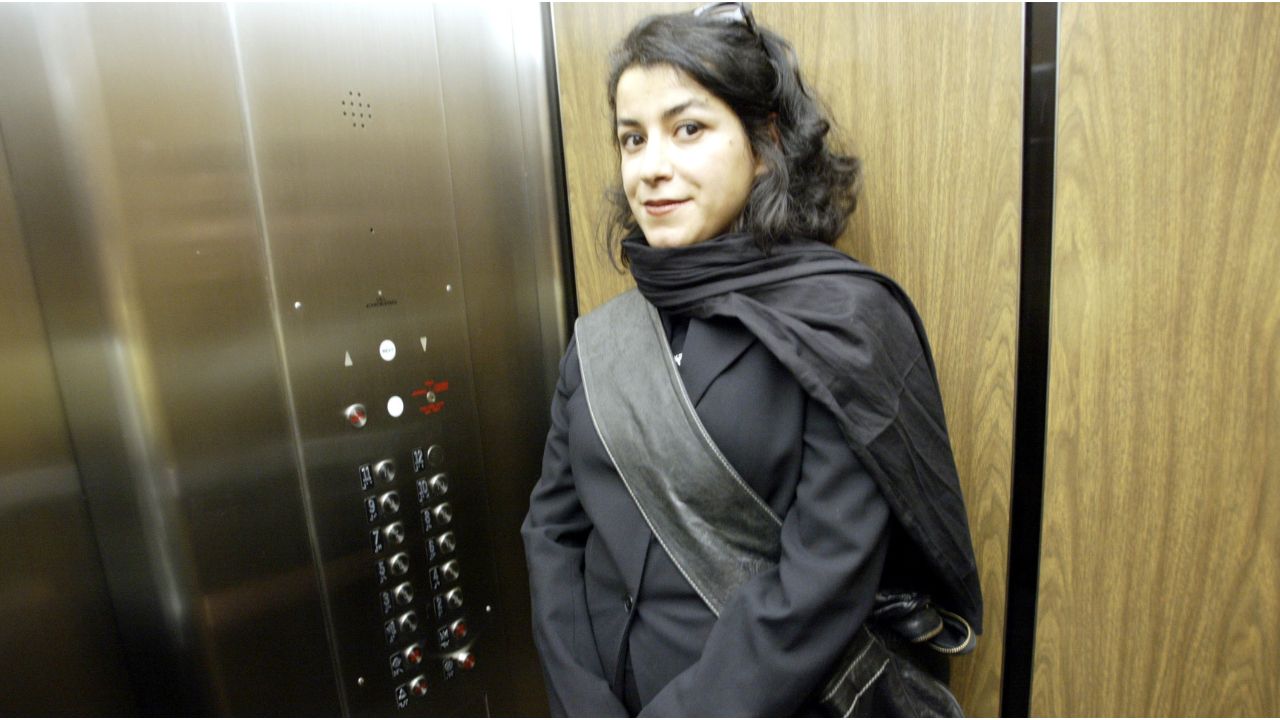
PARIS — Marjane Satrapi, the Iranian-French author whose graphic novel series “Persepolis” introduced millions of readers to the struggles of ordinary Iranians during the turbulent years around the Islamic Revolution, has died at 56.
The office of President Emmanuel Macron of France announced her death in a statement Thursday, but did not specify where, when or how she died.
“Her passing marks the loss of a leading figure in French culture and a freedom-loving artist whose work carried a universal message and earned her immense international acclaim,” the statement said.

With the publication of “Persepolis” in the early 2000s, Satrapi became one of the best-known exponents of a form of graphic novel — influenced by Art Spiegelman’s “Maus” — that combined political history and memoir.
The protagonist, Marji, was depicted living through some of the most difficult years of Iranian history, closely mirroring Satrapi’s own life.
Both author and character were born in Iran in 1969. Both were about 10 when the shah was overthrown. Both lived through the rise of the clerics and the horror of the Iran-Iraq war, and both left the country at 14 to study in Austria.
In 1994, Satrapi moved to Paris, where she wrote the “Persepolis” series. The books were published in France from 2000 to 2003; the first volume of an English translation was published in 2003, and the second volume was released a year later.
Millions of readers bought the books, which became a popular school assignment and among the widest-read works to explore the interior lives of modern Iranians. The series was adapted into a 2007 film that was nominated for an Academy Award for best animated feature.
“Persepolis,” author Fernanda Eberstadt wrote in a New York Times review, “dances with drama and insouciant wit,” its inky black-and-white drawings modeled on contemporary comics and Persian miniatures.
Not quite two decades later, Satrapi set to work documenting another tumultuous moment in Iranian history: the unrest in 2022 that followed the death, in police custody, of a 22-year-old Kurdish woman, Mahsa Amini, who had been detained and accused of violating a law requiring women to wear the hijab in public.
In protest, women across Iran tore off their veils, in one of the most significant cultural and political moments in the country since the 1979 revolution.
Satrapi’s work on the subject culminated in 2024 with the release of “Woman, Life, Freedom,” another work of graphic nonfiction. She contributed some drawings, but told the Times that she was more of a “director” of the project, which also featured work by other artists, activists, academics and journalists.
“Even basic human rights, they deny us,” she said of the Iranian government after the book was released. “You don’t have the right to dance; you don’t have the right to sing; you don’t have the right to do this; you don’t have the right to do that.”
Satrapi was born Nov. 22, 1969, in Rasht, Iran, near the Caspian Sea, and grew up in Tehran. She had aristocratic ancestors, and her parents were cosmopolitan leftists; her father was an engineer and her mother designed dresses.
They opposed the shah and protested against his government, but were disillusioned by the political and cultural crackdown that followed the revolution. Marjane’s uncle was accused of being a Soviet spy, jailed and executed.
Marjane bridled against the new restrictions on dress and behavior. When she was 14, she hit a school principal who had tried to confiscate her jewelry, and her parents, worried for her safety, sent her to live with an Iranian family in Austria. There, she was overwhelmed by the experience of a very different world.
“At her nadir,” Simon Hattenstone wrote in The Guardian in 2008, “she was peddling drugs, homeless, and she almost died from bronchitis. After four years in Vienna, she admitted defeat, put on her veil and returned home.”
Back in Iran in 1989, she studied art in Tehran and had an early marriage that ended in divorce, then returned to Europe.
“Probably I left Iran because I was not brave enough,” she told The Seattle Post-Intelligencer in 2003. “I just needed to have more social freedom to be able to do my work.”
She got a second art degree in Strasbourg, France, before moving to Paris.
Her husband, Mattias Ripa, who helped translate “Persepolis” into English, died last year. A list of her survivors was not immediately available.
Satrapi wrote several children’s books and other graphic novels, including “Chicken with Plums,” the story of the death of her great-uncle, which was also turned into a film. Another of her works, “Embroideries,” depicted Iranian women discussing love, sex and men over afternoon tea.
She directed several feature films, including “The Voices” (2014), with Ryan Reynolds, and “Radioactive” (2019), starring Rosamund Pike as Marie Curie.
She also won acclaim as a painter and was elected in 2024 to the Académie des Beaux-Arts, one of the highest honors in the French art world.
—
This article originally appeared in The New York Times.
By Amelia Nierenberg and Ségolène Le Stradic/Librado Romero
c. 2026 The New York Times Company