
|
Getting your Trinity Audio player ready...
|
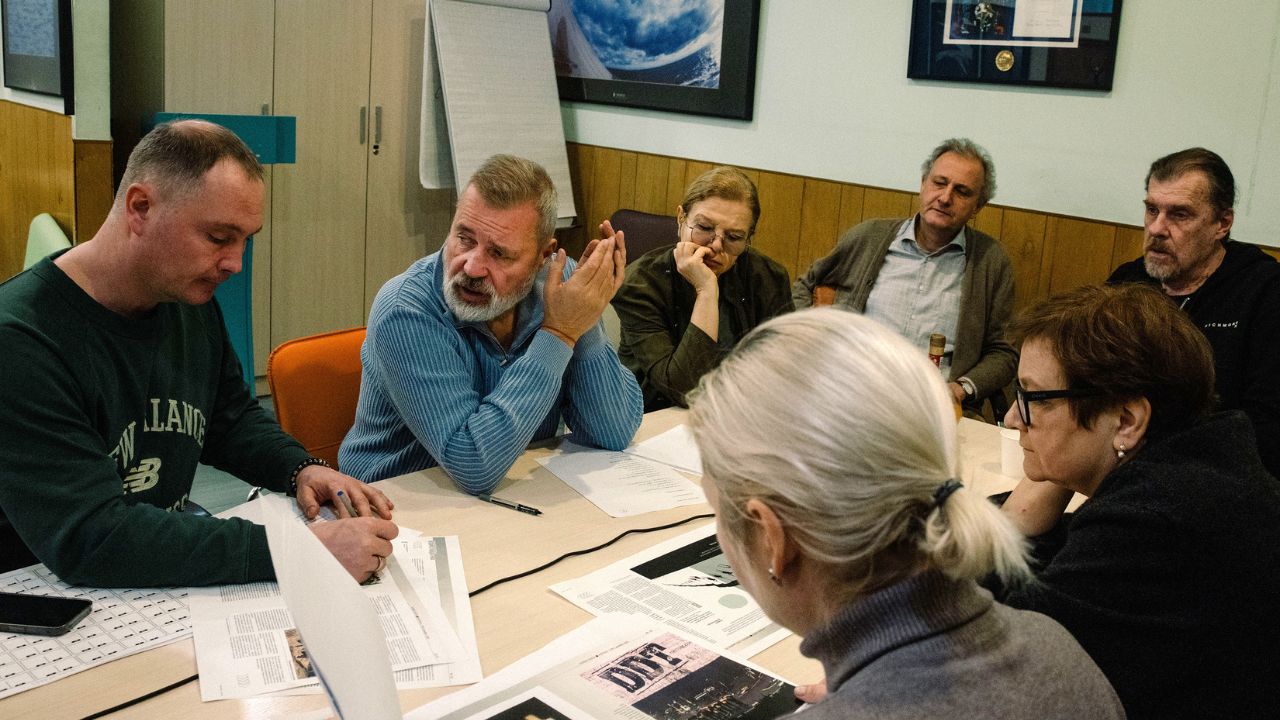
Russia’s security services on Thursday searched the Moscow offices of a leading independent news outlet, Novaya Gazeta, whose co-founder was awarded the Nobel Peace Prize in 2021, and detained its executive editor for questioning.
Hours earlier, Russia’s Supreme Court declared the country’s oldest and most respected civil society group, Memorial, which shared the Nobel Peace Prize in 2022, an “extremist” organization, effectively criminalizing its activities.
The two actions were the latest examples of the Kremlin’s widening crackdown on what little is left of Russia’s independent press and civil society operating inside the country.

A news release published by Moscow’s Ministry of Interior while the search of Novaya Gazeta was underway said its Main Investigative Directorate was “investigating a criminal case regarding the illegal use, distribution, collection, and storage of personal data of Russian citizens.” It did not mention the newspaper by name.
Representatives of Novaya Gazeta wrote on Telegram that their lawyers were not allowed to enter the building.
The newspaper was founded in 1993, during a brief period of Russian democracy when a free press flourished. Former Soviet leader Mikhail Gorbachev used some of the money he was awarded as a Nobel Peace Prize laureate to help get the publication on its feet.
Seven Novaya Gazeta employees have been killed or died in suspicious circumstances, including Anna Politkovskaya, a critic of President Vladimir Putin who was murdered in 2006 in the elevator of her apartment building.
One of the newspaper’s founders, Dmitry Muratov, was awarded the Nobel in 2021 for work that “defended freedom of speech in Russia under increasingly challenging conditions.” He auctioned his prize for more than $100 million and donated it to UNICEF, which directed much of it to refugees from Ukraine.
Muratov has remained in Russia and, despite physical attacks and limitations on his work, remains one of the few people there who still dare to regularly and openly speak out against Russia’s invasion of Ukraine and its mistreatment of political prisoners. Tightening censorship and government legal action against news outlets have driven many of them into exile or out of business. A group of journalists who left Russia founded Novaya Gazeta Europe, based in Latvia.
The Novaya Gazeta editor who was detained, Oleg Roldugin, was a co-founder of Sobesednik, a newspaper that stopped publication in September 2024. He has risked the Kremlin’s wrath by writing about corruption at the highest levels of the Russian presidential administration, the family of Chechen strongman Ramzan Kadyrov, and the new state-approved messenger app, Max.
The proceedings took place in a closed courtroom because they were classified as “top secret.” The court described the group not by its name but with a broad brush as “the Memorial international public movement.” No lawyer was allowed to participate, according to a statement from the group.
Memorial was founded in 1987, in the waning days of the Soviet Union, to document political repression and murders during the Stalin era, when millions toiled and perished in the Gulag. Its members discovered mass graves, scoured archives and preserved memories of those dark times.
The group was ordered to close in late 2021 but managed to continue some of its activities assisting prisoners and commemorating political prisoners of the past.
The Supreme Court labeling Memorial “extremist” means any Russian citizen deemed to be affiliated with the organization can be criminally prosecuted.
“As of today, the Memorial Human Rights Center is ceasing all operations directly within Russia, its statement read. “We have no employees, members, or volunteers in Russia. We do not accept donations from Russian cards, as this could put our donors at risk.”
The designation was condemned by human rights groups, including Amnesty International, which said that authorities were “effectively criminalizing human rights work itself.”
Both developments constitute a major blow to Russians who support independent media and are appalled by their country’s authoritarian turn. Moscow is also stifling internet access and attempting to throttle Western apps and VPNs.
“The state no longer hides its pro-Stalin character; it’s even proud of it,” wrote Andrei Kolesnikov, a columnist for Novaya Gazeta, on Thursday. “And there’s no clearer criterion than not simply destroying Memorial, but also trampling it into the dirt.”
Mocking the “extremist” label, he wrote, “To think is extremism, to preserve memory is extremism, to be a humanist is extremism,” and compared it to the contortion of language described in George Orwell’s 1984.
Memorial called the ruling “illegal” and said its operations in exile will continue.
Hours before the search at Novaya Gazeta, the security services arrested Alexander Andreyev, a 65-year-old reporter in Chita, in the country’s far east, who had previously contributed to the U.S.-funded media outlet Radio Liberty.
On Wednesday, six young anti-war activists from St. Petersburg, Russia, part of the protest group Vesna, or “Spring,” were sentenced to a combined total of 65 years in prison. Vesna was founded in 2013 in St. Petersburg and was declared “extremist” after members staged demonstrations against Russia’s full-scale invasion of Ukraine.
Memorial immediately recognized all six as political prisoners.
This article originally appeared in The New York Times.
By Valerie Hopkins / Nanna Heitmann
c. 2026 The New York Times Company