



|
Getting your Trinity Audio player ready...
|
In the final weeks before the June primary, California GOP leaders took an unusual step. They sent a cease-and-desist letter to a sitting assemblymember accusing him of purposefully deceiving voters for his own benefit.
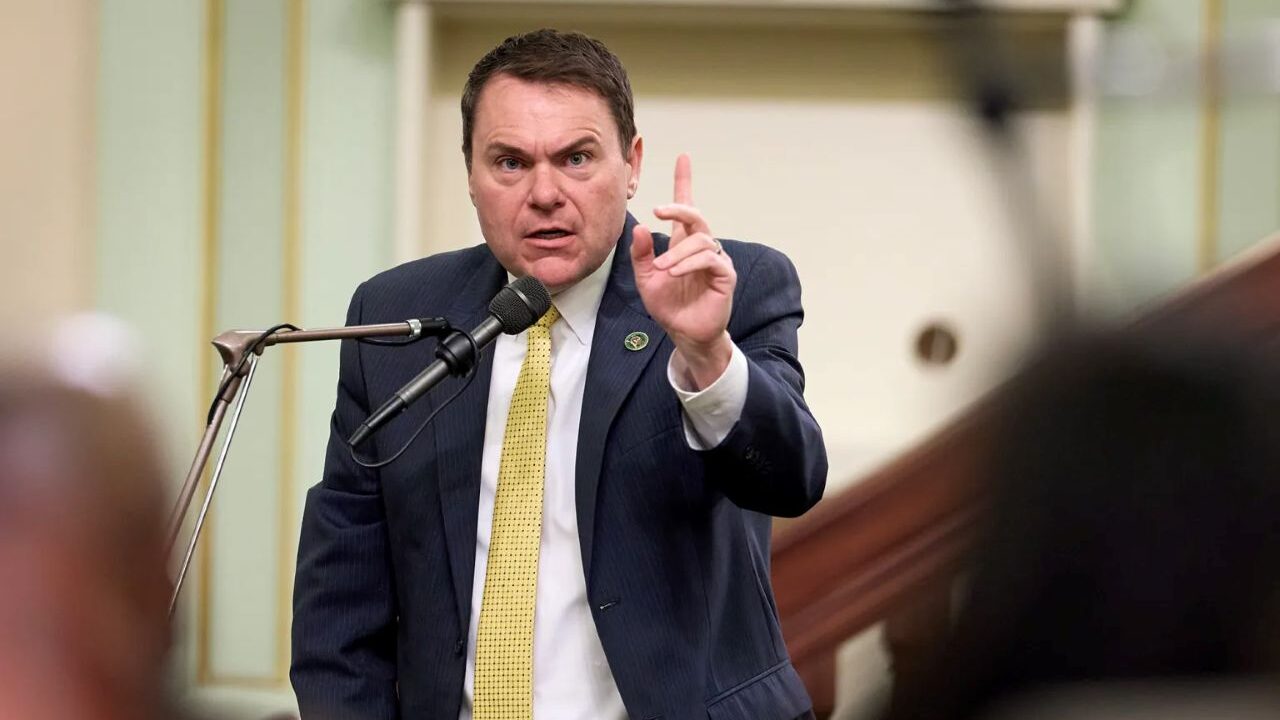
Officials alleged that San Diego lawmaker Carl DeMaio co-opted the official California Republican Party branding for his group Reform California’s campaign materials, calling them “a calculated deception of California’s Republican voters.”
It didn’t matter.

On Election Day, candidates backed by DeMaio’s Reform California performed well without the party’s endorsement, a sign of the growing influence of the renegade movement to the right of the California party.
This story was originally published by CalMatters. Sign up for their newsletters.
Several of his candidates beat establishment Republican picks in the San Diego area, including in a closely watched state Senate race in which big tech and business groups spent $2 million to defeat Reform candidate Kristie Bruce-Lane. Despite that, Bruce-Lane beat out San Marcos City Councilmember Ed Musgrove and will face former Democratic San Diego City Attorney Mara Elliott in November.
As California Republicans brace for a challenging midterm election, they must navigate a reality in which DeMaio’s rabble-rousing politics prevail over pragmatic conservatism.
Strong Success in the Primaries
Reform also scored a win in the Central Valley, where Merced City Councilmember Darin DuPont advanced to compete against Democrat Esmeralda Soria for Anna Caballero’s termed-out state Senate seat.
The group even prevailed in local races, including a San Diego County supervisor race, in which Reform-backed San Marcos Mayor Rebecca Jones secured 38% of the vote, besting Vista Mayor John Franklin, the establishment pick.
Republican gubernatorial candidate Steve Hilton also has a friend in DeMaio, according to Hilton spokesperson Hector Barajas. Hilton appeared on DeMaio’s daily podcast in the run-up to the June primary.
“Steve is proud to have the support of Reform California and values his relationship with Carl DeMaio,” Barajas said in a statement. DeMaio’s group had endorsed both Hilton and Riverside County Sheriff Chad Bianco in the primary.
DeMaio declined multiple interview requests from CalMatters for this story in person and did not respond to phone, email and text messages.
San Diego Senate Race
Bruce-Lane’s candidacy in Senate District 40 was a top concern for local Republicans. After she lost two previous legislative races, some worried she wouldn’t be their best shot at holding the seat currently held by Senate Minority Leader Brian Jones, who terms out this year.
This dispute was at the center of an explosive February meeting when San Diego GOP committee members couldn’t agree on whether to back Bruce-Lane or Musgrove, who was endorsed by established Republicans including Jones and outgoing U.S. Rep. Darrell Issa.
The two are similar on policy, but not on temperament. DeMaio and others call Bruce-Lane a “fighter” who will tussle with Democrats on the chamber floor, something DeMaio is known for in the Democratic-controlled Legislature, where his caucus is outnumbered three-to-one.
Musgrove and those who backed him represent the party’s more diplomatic old guard who cut deals with Democrats behind the scenes to advance their legislative priorities.
Musgrove received $1.3 million in support from super PAC California Leads, a joint Meta-Google venture to boost candidates who oppose strict tech regulations, and nearly $530,000 from a super PAC funded by Chevron and other oil companies, according to campaign finance records.
Bruce-Lane raised about $250,000 and received $2,000 in independent expenditures from DeMaio’s Reform Local Government PAC and nearly $13,000 from the San Diego County Gun Owners PAC.

Reform corrected the fliers and website misusing the official party branding, said California Republican Party Chair Corrin Rankin, who has a poor relationship with DeMaio.
DeMaio’s Motto: ‘All We Have Is Our Voice’
DeMaio and the candidates he backs are fighters who are willing to be agitators, Republican political strategist Jon Fleischman said. Republicans’ pragmatism in the statehouse largely comes down to the kind of people supported and elected by the official party infrastructure, he said.
DeMaio frequently votes against bills, an anomaly in the California Legislature where most lawmakers — Democrats and Republicans — choose not to vote at all to maintain relationships and donors.
“Carl will always err toward finding somebody who’s willing to actually make noise in Sacramento,” he said. “Carl’s argument is: We don’t have the votes, all we have is our voice.”
A longtime local official with a low-key demeanor, Musgrove likely wasn’t going to be that.
“What a nice guy, I met him a few times, and I thought, you know, ‘He’s a very pleasant fellow. I wouldn’t mind having dinner or lunch with this guy,” Fleischman said. “But is this guy going to be a bomb thrower on the floor of the state Assembly? He’s gonna be more of a gentleman.”
Musgrove said it’s possible Bruce-Lane beat him because of her outspokenness, but being pragmatic is how bills get passed.
“I have to believe she has a strategy to go up there and effectuate change rather than continuing to point out problems,” he said.
To Moderate or Activate the Base?
As Democrats outnumber Republicans 45% to 25% in voter registration and haven’t won a statewide race in California for 20 years, a longstanding question remains at the forefront for the state party: whether to moderate its positions to broaden the membership or lean right to rile up support among the base.
Reform California’s aggressive approach poses one potential answer, with its ability to raise millions of dollars from small-dollar donors, bringing in a total of $5.8 million during the 2024 campaign cycle, about a quarter of what the entire state Republican Party raised in the same period.
Reform California also successfully put a voter ID initiative, Proposition 39, on the November ballot and it’s bringing life — and hopefully voters — back into the party, strategists say.
“DeMaio has built a very formidable and good political organization,” even though some people may not like it, GOP consultant Tim Rosales said. “California state politics is big league baseball. You got to have thick skin and you gotta be able to roll with it.”
But Republicans are expected to face an uphill battle in the San Diego Senate race and elsewhere come November.
“This is a seat that’s going to be very difficult for Republicans to retain in a midterm election, so it’s not surprising that the leadership was preferring a more mainstream candidate,” Republican strategist Rob Stutzman said.
“The primary base in each party often does not pick the most competitive candidate in a swing seat in a general election. But it also doesn’t mean it should be written off.”
Bruce-Lane did not return multiple calls from CalMatters seeking an interview.
A sought-after target for Democrats, the inland San Diego district leans Republican but has trended increasingly purple in recent years. Former Vice President Kamala Harris won it by nearly 4 percentage points and nearly 35% of registered voters there are Democrats, while 34% are Republicans and 24% have no party preference.
Rankin, the state GOP chair, wouldn’t say whether she’s concerned about the party’s ability to retain Jones’ seat with Bruce-Lane as the candidate.
“The only thing I’m saying from my position is that we have a Republican who made it past the primary. I think it’s going to be up to the voters,” she said.
An Old Playbook
DeMaio’s strategy reflects a longstanding feud over the party’s direction that has caused problems for Republican Party chairs throughout the last several decades, as agitators within the party tried to push it rightward, consultant Rosales said.
Former George W. Bush administrator Gerry Parksy attempted to remake the California Republican Party from the inside out in 2001 by restructuring its budget committee and pushing for moderate platforms in an effort to appeal to women and nonwhite voters. It wreaked havoc as party officials feared moderating would forgo traditional viewpoints on sex, marriage and immigration.
“What’s the point of a minority party if you’re not expressing the minority view?”
Republican political strategist Jon Fleischman
Then-Gov. Arnold Schwarzenegger, one of the last two Republicans to hold statewide office, famously implored the state party to broaden its tent, telling delegates in 2007 that the party was “dying at the box office” and alienating women and nonwhite voters by ignoring things like the environment and healthcare. Party officials largely ignored his pleas.
Other rifts have appeared under Rankin’s leadership since she took over last year.
Some questioned her fundraising ability. In response, Jones and other party leaders announced a change in how campaign donations from their committees are distributed to the party, further weakening its electoral power.
Some welcome the divisiveness.
“I happen to be on the side of more voices like Carl would be better, because I don’t think there should be a free pass on the floor of the Legislature,” Fleischman said. “What’s the point of a minority party if you’re not expressing the minority view?”
This article was originally published on CalMatters and was republished under the Creative Commons Attribution-NonCommercial-NoDerivatives license.