

|
Getting your Trinity Audio player ready...
|
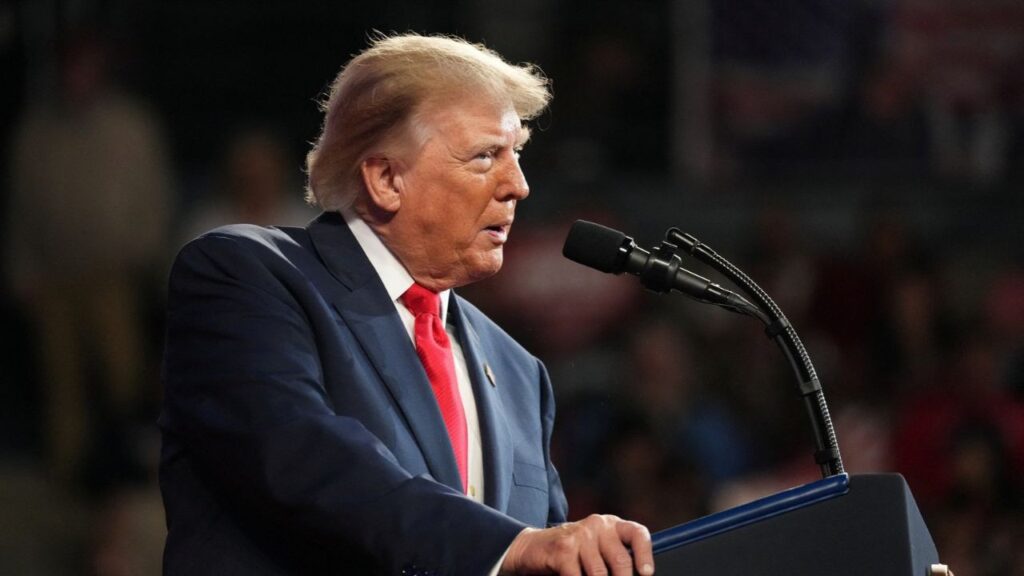
President Donald Trump’s approval rating hit a new low just a few weeks before the midterm elections, driven down by broad disapproval of his handling of the economy, the war in Iran and high gas prices, according to a new national poll from The New York Times and Siena University.
Just 36% of likely voters said they approved of Trump’s performance, while 59% said they disapproved. That is his lowest approval rating recorded in any Times/Siena poll. More than two-thirds of independent voters said they disapproved of the way he has handled his job as president.
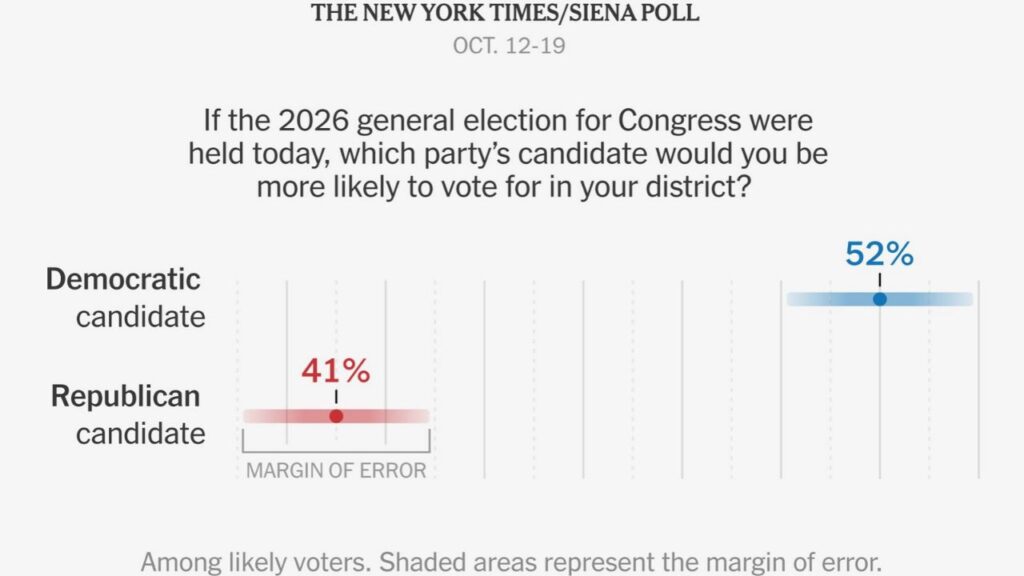
Likely voters said they preferred Democratic candidates over Republicans by 11 percentage points in their congressional districts in the final Times/Siena national poll before the midterm elections, a slight improvement for Democrats since last month. The metric is widely seen as a strong indicator of political momentum.

The national political environment is bleak for Republicans. Americans broadly disapprove of economic conditions under the Trump administration, with three-quarters rating the economy as fair or poor. A majority of voters blame Trump for the decline: 69% disapprove of his handling of the cost of living, 65% disapprove of his handling of the war in Iran and nearly three-quarters disapprove of his handling of gas prices, which are above $4 a gallon.
Democrats Still Face Big Challenges
But Democrats still face serious challenges, particularly as they seek to win control of the Senate. To do so they are trying to flip seats in Republican-leaning states including Texas, Iowa, Alaska and Ohio, which Trump won by double digits in 2024. Other polls show that Democrats and Republicans are locked in tight races in several key Senate contests.
Still, the deep economic frustration has even broken into the coalition that elected Trump to his second term. Over the past year, Democrats have improved their standing among men, young voters and Hispanic voters — winning back some voters in those groups who helped propel Trump to victory two years ago.
Paul Gettings, a Republican who lost his job running a logistics company in June, said he supported Trump in 2024 but plans to back Democrats this year. He cited frustration with high gas prices, the war in Iran and what he sees as harsh immigration enforcement in Simi Valley, California, where he lives.
“I’m very disillusioned with the Republican Party and how they can continue to support Trump,” said Gettings, 62, who is unemployed. “He’s turned into a politician just like the rest of them and it’s a lot of empty promises.”
Among all registered voters, including those who are less likely to vote, Trump’s approval rating was even worse, with 34% approving of his job performance. Trump built his 2016 and 2024 wins partly on the strength of his support among white voters without a college degree, but the poll found that group is about evenly split in its approval of his job, with 48% approving and 46% disapproving.
As views of Republicans have declined, public perceptions of Democrats have grown increasingly positive over the last two years on an array of measures.
A majority of likely voters now see the Democratic Party as the party of the working class — a shift from 2022, when voters gave the Republican Party the edge. Voters also see Democrats as more likely to keep their promises than Republicans, a striking reversal from two years ago, when Republicans held an advantage on that question.
Americans View Dems as More Understanding of Their Problems
And majorities across nearly every demographic group now view Democrats as more understanding and able to fix the problems of average Americans.
“The Republican Party is, if anything, causing more problems for people like me: being Latino, feeling the weight of that kind of prejudice that I think the Republican Party tends to kind of portray,” said Vince Cordero, 25, an independent in Oak Lawn, Illinois, who said he plans on voting for Democrats this year. “I also think the Democratic Party deserves an opportunity to see if they’re really up to snuff.”
By a 15-point margin, more voters trust the Democratic Party over the Republican Party to tackle the cost of living, the single most important issue to voters. The party holds an 8-point advantage on the economy, an area that has historically been a strength for Trump. Democrats have also grown their lead since September on who voters trust to handle foreign wars and artificial intelligence.
But even amid his declining numbers, Trump has held on to strong support from his base. The vast majority of Republicans, 82%, still approve of his job performance and his signature policies, including the Iran war and tariffs.
“People are upset, ‘Oh, Trump put these tariffs on people and now our food costs go up,’” said Sheila Murdock, a retired nurse from Shelley, Idaho, who has already voted absentee for Republicans this year. “Well, yes, but if you look at the bigger picture and what it eventually does, it makes things better.”
Immigration Resurfaces as an Important Issue
The poll also found immigration reemerging as a defining concern for voters. Ten percent of voters now say it is their top issue this fall, up from 6% in September. Among Republicans, almost 20% now say it is their top priority — nearly double the percentage who said the same last month.
While Democrats still hold an edge over Republicans in who voters trust to handle immigration — which had long been a Republican strength — that advantage has shrunk since September. Now, 46% of voters say they trust Republicans on immigration, 50% say the same of Democrats.
Still, the survey indicates that even as Democratic candidates gain support, there is lingering discontent with their party. Just 28% of voters said they are satisfied with the Democratic Party, 8 points lower than the share who express satisfaction with the Republican Party.
Much of the unhappiness stems from Democratic voters themselves. Forty-three percent of Democrats said they are unsatisfied with their party, compared with just 16% of Republicans who said the same about the GOP.
—
Key Things to Know About New York Times/Siena Poll:
Interviewers spoke with 3,494 voters from Oct. 12 to 19, 2026. The polls were conducted by telephone using live interviewers. Overall, nearly 99% of respondents were contacted on their cellphones. Voters were selected for each survey from a list of voters. The list contains information on the demographic characteristics of every registered voter, allowing us to make sure we reach the right number of voters of each party, race and region. For these polls, interviewers placed more than 412,000 calls to more than 185,000 voters. To further ensure that the results reflect the entire voting population, not just those willing to take a poll, we give more weight to respondents from demographic groups that are underrepresented among survey respondents, like people without a college degree. The margin of sampling error is plus or minus 1.9 percentage points among the likely electorate and registered voters. In theory, this means that the results should reflect the views of the overall population most of the time, though many other challenges create additional sources of error.
–
This article originally appeared in The New York Times.
By Lisa Lerer and Ruth Igielnik
c. 2026 The New York Times Company