


|
Getting your Trinity Audio player ready...
|
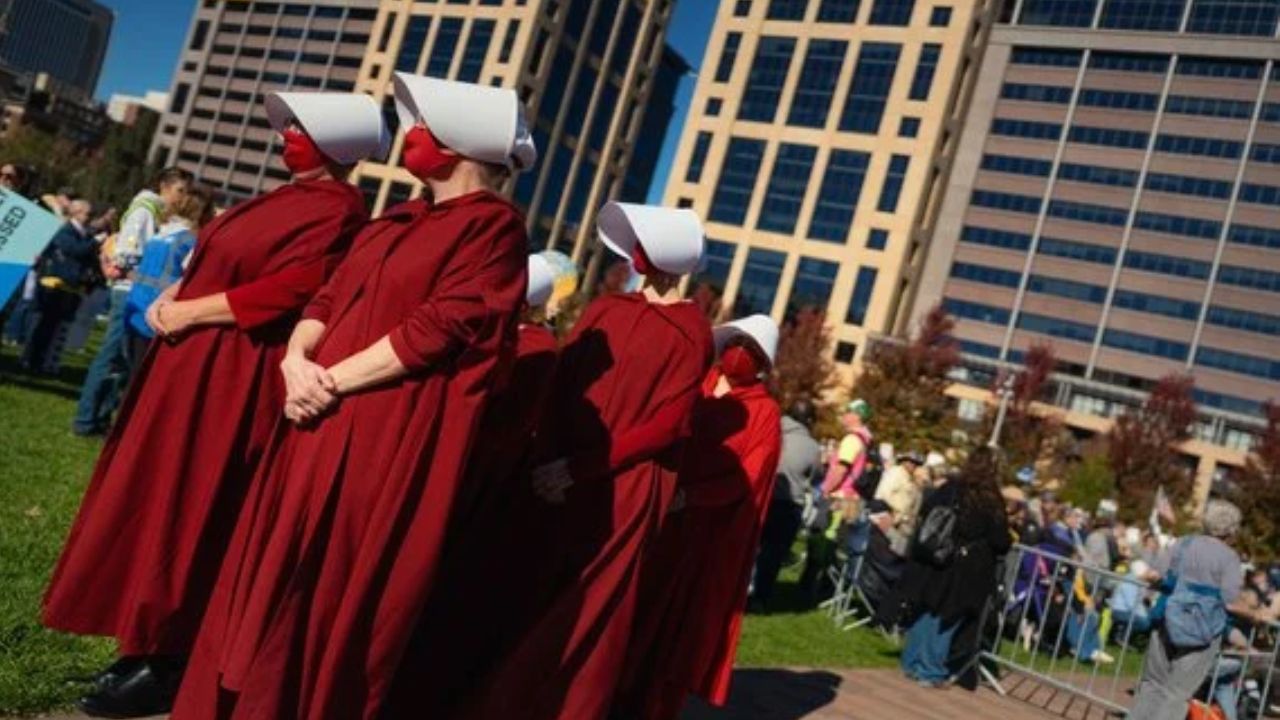
A fresh round of No Kings events took place across the nation on Saturday, drawing participants determined to show the collective power of free speech and demonstrate the tenets of a democracy.
In the past, those who showed up did so to protest myriad issues. Immigration raids, budget cuts, government layoffs — the list was long and varied. The central goal was to publicly and vehemently denounce the Trump administration.
But this time, the message was meant to be singular. Get out and vote. And do it early.

The national No Kings coalition had said the gatherings would be nonpartisan and focused solely on voter participation. But many participants ignored that directive as they expressed their frustrations with much of the second Trump administration’s agenda, echoing sentiments in earlier rounds of nationwide No Kings rallies.
Instead of mass mobilizations, multiple “hyperlocal” gatherings were encouraged. More than 2,500 U.S. events were planned, including a virtual option.
With the midterm elections approaching, organizers urged people to become proactive and cast their ballots at an early voting site or send in an absentee ballot.
“Voting early is how we use our power,” they declared on the website for the coalition, which includes about 200 organizations, including the American Civil Liberties Union and the League of Women Voters.
Here is how gatherings looked across the country.
Atlanta
At Piedmont Park, speakers made pleas for voter mobilization as well as declarations of how large numbers of voters could create change.
“In the spirit of these civil rights icons and the nameless foot soldiers, it’s our time,” said Gerald Griggs, a civil rights lawyer, nodding to Martin Luther King Jr., John Lewis and other leaders. “So go vote early, contact five of your friends, and tell them go vote early.”
The crowd reflected a particular anxiety specific to the area, with attendees recalling how President Donald Trump tried to overturn his 2020 election loss in Georgia.
For Felicia Murray Jackson, who led participants in a march from the park to a church, the moment was personal. Her older sister was killed in February when a man fleeing immigration agents smashed into her car.
“I don’t want to hear you tell me how sorry you are for my loss — I want to hear you say, I took your loss straight to the ballot box,” she declared to the crowd. “We’re going to take human trafficking, child rape and the Epstein files straight to the ballot box.”
Oklahoma City
In Oklahoma City at Mayflower Congregational Church, people came out to support the movement, even though voter registration in the state ended Oct. 9. The day’s rally was limited to holding signs outside along Portland Avenue or filling out voter reminder postcards.
“We can send them to voters who need an extra nudge, and a reminder that voting in the midterms is just as important as voting in the presidential election,” said Nina Lawrence, an organizer who hoped to combat Oklahoma’s low voter turnout.
Lu Eyerman, a spokesperson for Indivisible, a grassroots voter movement, said the focus on the election was to prepare voters for anything that could come in the run-up to November’s election.
Dallas
Near Pacific Plaza in downtown Dallas, Stephanie Williams with the Black Voters Matter Fund led the crowd in a vibrant chant.
“Our democracy is under attack!” she shouted. The crowd replied, “We fight back!”
Williams then listed how government policies showed up in their daily lives, from healthcare costs to SNAP funding to their electricity bills.
Across the lawn, a steady stream of people held signs ranging from “Save democracy” to “Be a hero, vote!”
Among the attendees were Pam and Royce Mitchell, both 73 and married 51 years, who were attending their first No Kings rally. Mitchell, a retired kindergarten teacher, said the two had been George W. Bush supporters but were now Democrats. The political climate now, she said, was no longer about Democrats versus Republicans.
New York City
Families, retirees and teenagers stood on the steps of Moynihan Train Hall in midtown Manhattan, banging on cow bells and chanting, “We are the voters, we are the change!”
Leslie Wolfe, 60, came with her sister. The two held a sign decorated with tie-dyed cotton balls that read, “Free balls for members of Congress who have lost theirs.”
“Some people voted for the president for reasons that I think they now realize are not coming to pass,” Wolfe said. “If Democrats can take control of the House and, God willing, the Senate, we could maybe put a stop to the direction our country is going.”
Others gathered on a pedestrian bridge in Washington Heights in upper Manhattan, about five miles from where an ICE-involved shooting took place earlier this month. They hung banners bearing the faces of those who have died in Immigration and Customs Enforcement custody along with signs encouraging people to vote as cars honked in approval.
“I like expressing my righteous dissatisfaction with what is going on in our country,” said Claire Bushy, 46, a freelance writer.
Bushy, who once worked for The Financial Times, said she had left journalism because she wanted to openly express her politics. “I wanted to be able to look back in 20 years and say I tried.”
Seattle
In Seattle, the intended focus on voting and nonpartisanship drew pushback, and some organizers dismissed it as a watering down of a movement.
“This disregards the literally horrifying things that are going on right now,” said Charlette LeFevre, co-director of Capitol Hill Pride, a longtime gay rights nonprofit that put together a “No ICE March” to take place before the No Kings”event.
Clad in a neon yellow vest, LeFevre, 62, said she was not interested in a “little postcard party with little information booths.”
“We don’t need to be told how to fill in those little bubbles on our ballot or to be reminded to vote,” she said as she readied her group to hold a long banner with the word “Abolish ICE” before they walked down a main thoroughfare, with funk and pop songs playing on a speaker.
Near the Space Needle, where the No Kings voter fair was set to take place, Elinor Cromwell said the central goal was to educate voters on the use of ballot boxes, which are overseen by local election officials in the all-mail-voting state.
“At this point our mail system is not reliable enough, and we can’t truly count on it to get ballots in on time,” said Cromwell, 71, a former public defender. “There’s a specific group of people who are tearing down our democracy, and that’s what we’re standing up against.”
Los Angeles
In 90-degree heat, attendees filled two blocks as they marched in downtown Los Angeles, some carrying umbrellas to shield them from the sun as a band followed them on a rolling stage.
The crowd, smaller than at previous No Kings events, reacted with wild cheers to a string of speakers at a park near City Hall who demanded the abolishment of ICE and the passage of California’s billionaire tax. Trump, they declared, had mired the country in wars, inflation and human rights violations.
“I teach medieval history so I know what a society looks like when rights are abrogated and we have a king,” said Christine Chism, 63, a professor at UCLA.
Attendees also said environmental policy and immigration were among their priorities.
Shannon Rivers, who works in education outreach for the nonpartisan California Native Vote Project, said that the issues facing the country today felt eerily familiar.
“Indigenous people have seen this authoritarian playbook before,” said Rivers, a member of the Akimel O’odham nation.
Minneapolis
A park near the home of the Minnesota Vikings brimmed with people who wanted to show support for a place that has been a flashpoint for Trump’s policies.
Students from the Minneapolis College of Art and Design recalled being locked in their dorms when Alex Pretti was shot a couple of blocks away from campus in January. Now their school was a polling location.
“Everyone needs to vote as early as they possibly can,” said Eliza Harris, 20. “Trump has tried to stage a coup in the past. There’s no guarantee he will accept the results of the election if it doesn’t go the way he wants.”
Nearby, Kathryn Klibanoff, 56, held a sign in support of her Somali neighbors.
“It’s been a horrible couple of weeks in Minnesota,” she said, referring to the president’s recent comments that Somalis had “fleeced” the state and to the search of Rep. Ilhan Omar’s residence.
“I was motivated to tell our Somali immigrants and citizens that they belong here,” said Ms. Klibanoff, a retired management consultant.
Raleigh, North Carolina
Despite the drizzle and cool temperature, a crowd gathered outside the John Chavis community center, an early voting site in Raleigh. Wearing ponchos and wielding umbrellas, they toted posters that said: “Stop the billionaires juggernaut,” “Grab ‘em by the midterms” and “I’ll take a reign check.”
Leonard King, 82, a retired teacher and principal, said he sensed a political transformation in the wings. “The Trump era will end,” he said. “I do believe the momentum is shifting, people are waking up.”
Ariel Carlin, 27, one of the protest organizers, said that issues like Flock cameras and executive overreach felt more weighty than those in the past. “There’s been such a disregard for the rule of law, and there’s more at stake in this election,” said Carlin, an environmental science student.
Dianne Mayer agreed. At 72, she has never missed a No Kings rally. Once a staunch Democrat, she became frustrated with the party and left a couple months ago. Still, it seemed the lesser of two evils, she said, which is why in early voting she said she marked a straight Democratic ticket.
Overall, she hoped the day’s event would encourage young people to vote. “I can’t imagine what the world is going to be like for them,” she said.
—
This article originally appeared in The New York Times.
By Corina Knoll/Ben Brewer
c. 2026 The New York Times Company