
|
Getting your Trinity Audio player ready...
|
Forty days before the midterm elections, a growing number of Republican candidates across the country are openly seeking to distance themselves from President Donald Trump, breaking with a leader who has long held an iron grip on his party.
On Monday, the Republicans running for Senate in both Michigan and Iowa called on the president to end the war in Iran as a way to reverse the escalating price of gas. On Tuesday, GOP candidates for governor in Wisconsin and Michigan, along with an embattled Republican senator in Ohio, followed.
“The war with Iran needs to end — and end quickly,” former Rep. Mike Rogers, the Republican Senate nominee in Michigan, said in a video filmed in a grocery store. “When it does, energy costs will plummet.”

On Capitol Hill, three other Republican senators called for an investigation into the president’s son over his lavish wedding after-party paid for by a Russian businessperson with ties to President Vladimir Putin.
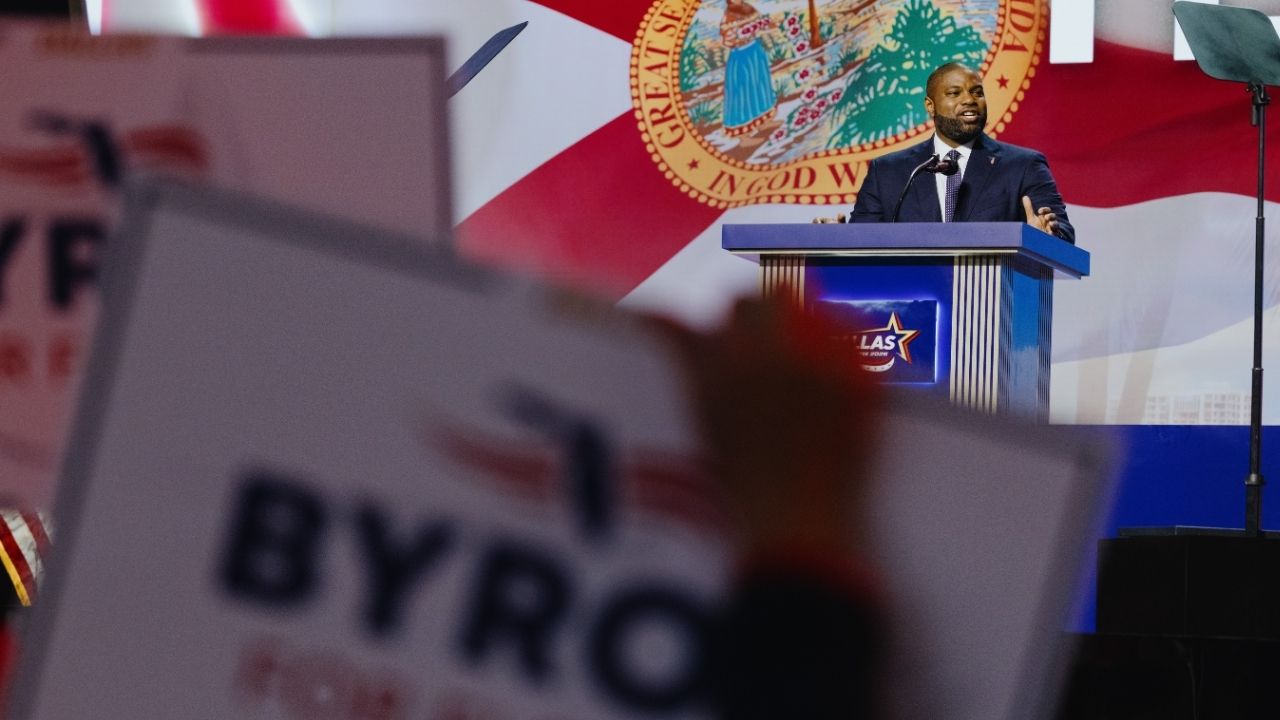
And in Florida, one of Trump’s close allies, Rep. Byron Donalds, the Republican nominee for governor, recently overhauled his website to make Trump’s endorsement far less prominent.
The dissent reflects growing unease about the party’s prospects in November, as Republicans struggle to overcome the unpopularity of the president and his signature policies.
Trump’s approval rating is languishing near record lows. On issues on which he once was strong — like the economy, national security and immigration — he is now underwater. His approval rating on the economy hit an all-time low of 27%, according to a CNN poll released Tuesday.
“It’s ‘Not great, Bob!’, as they say on Mad Men,” said Nachama Soloveichik, a Republican political strategist, of the darkening political environment for Republicans. “Trump’s approval numbers are down. That’s not good. They’re making strategic decisions based on polling numbers — that’s what happens in political races.”
A White House aide disputed the idea that there is any distance between the president and his party, passing along statements and photos from more than 60 Republican candidates praising and appearing alongside the president.
“President Trump is the unequivocal leader, best messenger and unmatched motivator for the Republican Party,” said Davis Ingle, a White House spokesperson, in a statement.
There’s a long tradition in American politics of vulnerable candidates running away from unpopular, second-term presidents in midterm elections.
In 2006, a midterm cycle that Democrats often compare to this one, Republicans distanced themselves from President George W. Bush amid backlash to the war in Iraq. Eight years later, Democrats running in red states criticized President Barack Obama, even skirting questions about whether they had voted for him.
But for Trump, the experience of Republicans publicly criticizing his agenda — and, perhaps most notably, targeting his family — is relatively new. The breadth of Republican opposition will be tested this week, when the Senate votes again on a Democratic-led war powers resolution.
Marc Short, who served as the White House legislative affairs director in Trump’s first term, said the distancing by Republican candidates in the final weeks of the midterm elections is more pronounced than what happened in 2018 and “does feel somewhat like desperation.”
“If you’ve been carrying the president’s water on all his legislation priorities and his issues, it’s hard now to distance yourself,” said Short, who also served as former Vice President Mike Pence’s chief of staff. “It appears now as if it’s just for political convenience.”
After facing the indignities of two years in Washington with virtually no power, Democrats can barely contain their glee.
“For the last 10 years, Republicans have been more afraid of Donald Trump than they have the voters they’re supposed to represent,” Rep. Hakeem Jeffries of New York, the minority leader, said in an interview. “It’s clear that Republicans are in full panic mode, because Donald Trump’s approval ratings are at extinction levels.”
In past elections, Republicans have struggled to turn out their base when Trump was not on the ticket. Now, the president and his aides are focused on motivating his most loyal supporters by working to center the midterms around Trump himself. This month, he hosted a splashy gathering for his supporters in Dallas, where he spoke for nearly two hours.
“Pretend that I’m on the ballot,” Trump begged his supporters. “I’m on the ballot. I’m on. Just one more time.”
But at least a few candidates are trying to pretend he’s not even in the White House. Some vulnerable Republicans skipped the event in Dallas, a step widely interpreted as an effort to put distance between their campaigns and the unpopular president.
In the past, breaking with Trump has ended the careers of many Republicans, who lost primaries or retired from office to avoid an electoral defeat. The trend continued into this cycle, when Trump successfully backed challengers to Rep. Thomas Massie of Kentucky and Sen. Bill Cassidy of Louisiana, among others.
The decision now to openly criticize signature policies like the Iran war reflects the deep political peril perceived by many in the party.
“The president’s greatest power is his influence in Republican primaries, and now all the primaries are behind him,” said Carlos Curbelo, a former Republican representative from Miami who lost his seat in 2018. “This is survival mode time for Republicans.”
Last week, Rep. María Elvira Salazar of Florida — who represents a district Trump won with 57% of the vote — released an ad breaking with Trump on immigration. It was seen as a sign both of Trump’s collapsing support in Hispanic communities and the degree to which districts he carried by 10 percentage points or more in 2024 have become swing districts in 2026.
Trump has sometimes cracked down on dissidents in his party. But Friday the president said that while he “disagreed” with Salazar, he was not pulling his support — and took credit for her past victories.
Sen. Roger Marshall of Kansas, whose reelection is getting fresh attention, also seemed to raise questions of the Trump administration’s immigration operations Wednesday. “When ICE operates in Kansas, it needs to coordinate with our local law enforcement,” he wrote on the social platform X.
But Democrats say escaping the president’s pull may be difficult for candidates who marched in lockstep with him for nearly a decade. Many are now running ads linking their Republican opponents directly to the president.
“He votes 100% for Trump,” Manny Rutinel, a Democrat running for Congress in Colorado, says of Rep. Gabe Evans, the Republican incumbent, in one ad.
In Iowa, the decision by Rep. Ashley Hinson, the Republican Senate candidate, to declare that “the war needs to be brought to a successful and immediate end” brought guffaws from Democrats who noted that she had voted multiple times — including last week — against a war powers resolution that would have constrained the president.
Two other Iowa Republicans running in swing districts — Reps. Zach Nunn and Mariannette Miller-Meeks — recently reversed their previous positions to help push through a Democratic measure directing Trump to halt the conflict.
The movement away from Trump has stretched into some of the most consistently Republican states in the country, where Republican candidates are trying to walk a careful line between distancing themselves from the president without alienating his supporters.
In Florida, the changes to Donalds’ website — which included removing a “Trump-Endorsed” box at the top, a yellow banner featuring the endorsement and a photo depicting the president, Donalds and his wife — were notable coming from such a staunch Trump ally.
Gates McGavick, a spokesperson for Donalds, said the U.S. representative was “proud” to have Trump’s endorsement and disputed that there was meaning to be drawn from his revamped website, which was first reported by the Miami Herald. “Our campaign website reflects Byron’s focus on the issues that matter most to Floridians — affordability, insurance costs, and government transparency,” he said. “This angle of reporting is FAKE NEWS.”
—
This article originally appeared in The New York Times.
By Lisa Lerer and Shane Goldmacher/Shelby Tauber
c. 2026 The New York Times Company