
|
Getting your Trinity Audio player ready...
|
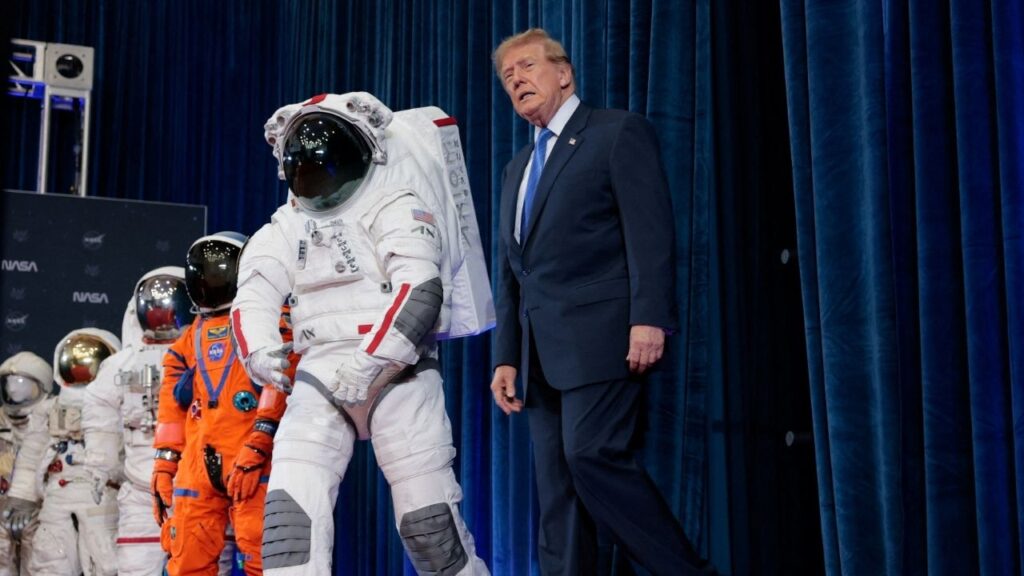
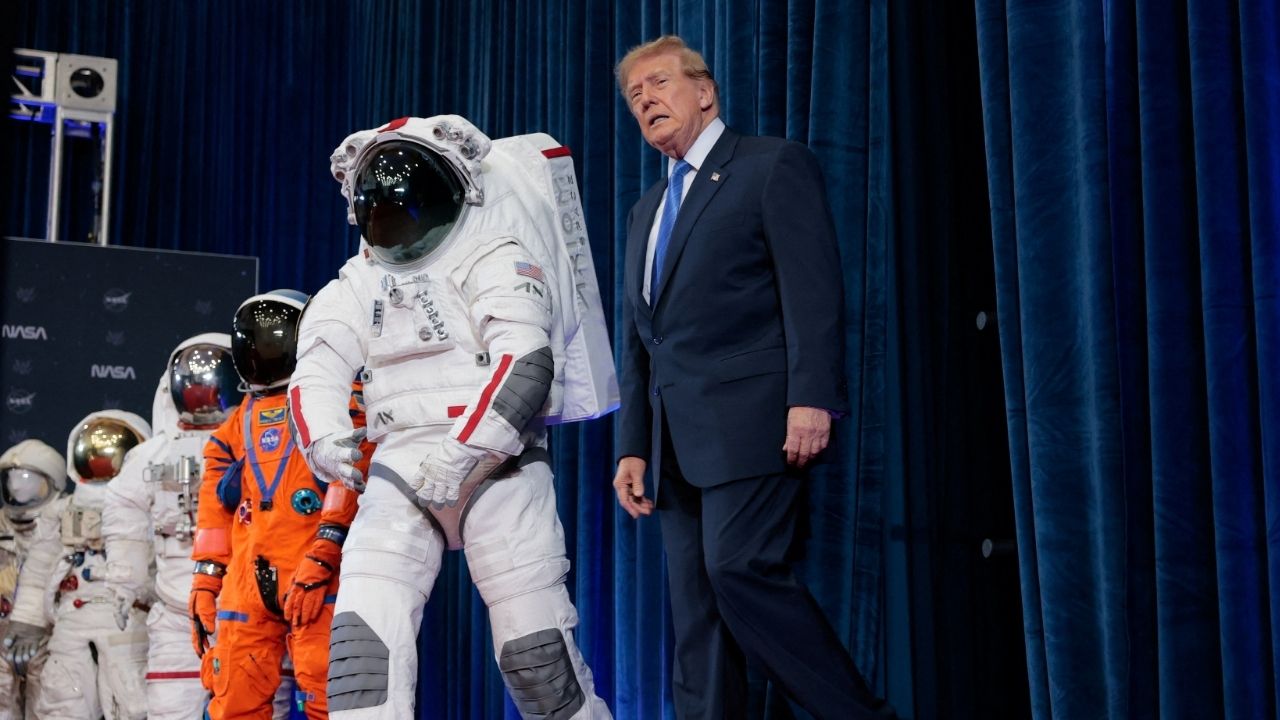
President Donald Trump signed an order on Friday creating a U.S. Space Academy, billing it as a new military and civilian institution modeled after West Point and other military service academies.
The proposed academy would build on Trump’s space agenda, which he and White House officials have described as a key component of his legacy. Trump launched the U.S. Space Force as a sixth branch of the military during his first term, has attended multiple NASA launches and now aims to return Americans to the moon and eventually reach Mars.
An eight-member commission, led by NASA Administrator Jared Isaacman, will advise the president on launching the institution, which Trump’s proclamation said would “develop a professional corps of civically grounded leaders prepared to advance American interests within the space domain.”

Speaking at the Lyndon B. Johnson Space Center in Houston, Trump said he would choose the location for the academy “very shortly,” and hinted that the Texas congressional delegation in attendance wanted the institution in the Lone Star State.
He has pledged that the U.S. will land astronauts on the moon during his final year in office.
“A nation cannot be first on Earth if we’re going to be second in space,” Trump said during a ceremony to award the Congressional Space Medal of Honor to the four crew members of the Artemis II mission.
That crew — Commander Reid Wiseman, Pilot Victor Glover, Mission Specialist Christina Koch and Canadian Space Agency Mission Specialist Jeremy Hansen — spent more than nine days in space, circumnavigating the moon and traveling deeper into space than any human before.
Moon Program
The multibillion-dollar U.S. moon program is targeting its first astronaut landing in 2028, involving SpaceX’s giant Starship rocket system. That rocket’s development has been delayed, risking the timeline – but another moon lander from Jeff Bezos’ Blue Origin that is also under development might make the 2028 deadline instead.
The Artemis program rivals the lunar ambitions of China, which is aiming for its own crewed moon landing around 2030 following a series of increasingly ambitious robotic missions.
Both countries are seeking to establish a long-term crewed presence on the lunar south pole, where coveted water ice embedded in the lunar soil could be a key ingredient for fuel on the moon.
Trump added that the U.S. would launch a separate nuclear-powered spacecraft to Mars in 2028 that would be the gateway to broader interplanetary travel.
Isaacman said the missions would “inspire the next generation to carry the fire of exploration even further.”
Trump’s order said implementing those goals requires new institutions to recruit and train future astronauts, engineers and scientists.
Staffing Challenges
It is unclear how logistics for the space academy — including building the campus, creating the programming and recruiting students — would work. Funding would need to be approved by Congress, which is historically gridlocked.
Space Force officer candidates are generally commissioned through the Air Force Academy in Colorado Springs, Colorado. The Naval Academy in Annapolis, Maryland, also has a long tradition of its graduates becoming astronauts.
“You think of West Point, and you think of Annapolis, and you think of the Air Force Academy, and you think of the Coast Guard Academy. They’re all good,” Trump said. “But we’re going to have now the Space Force Academy for what the people in this room love the most.”
Many U.S. space companies have struggled to attract new talent as the industry rapidly expands, with demand for spacecraft services and rocket launches soaring. Major players such as Elon Musk’s SpaceX and Bezos’ Blue Origin have ramped up competition in the sector, driving up the cost of new hires for some smaller companies, analysts say.
Staffing challenges have also snagged the U.S. Space Force, whose workforce is 25% lower than what Congress requires for the branch, according to a 2025 watchdog report.
Trump also spent part of his two-day trip in Texas raising money for Republican Senate nominee and Texas Attorney General Ken Paxton ahead of November’s midterm elections.
(Reporting by Jacob Bogage and Nandita Bose and Katharine Jackson; editing by Michelle Nichols, Colleen Jenkins and Deepa Babington)