
|
Getting your Trinity Audio player ready...
|
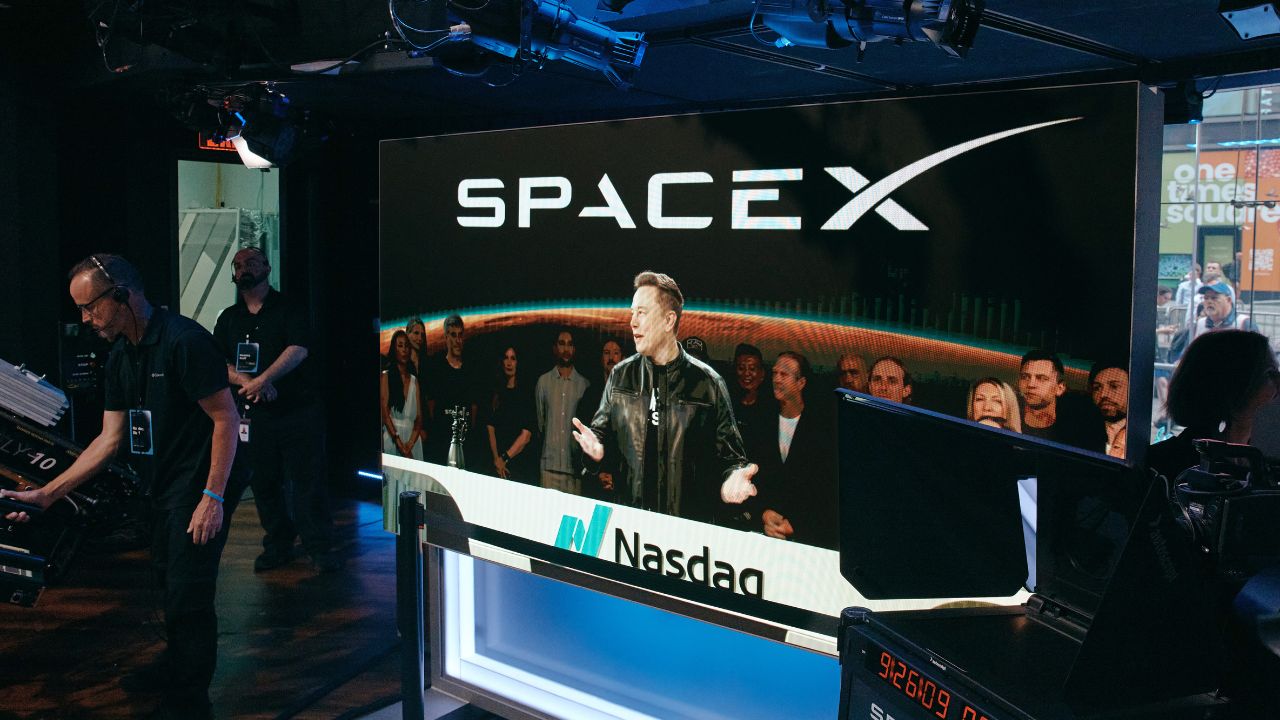
Elon Musk became the world’s first trillionaire Friday when shares of his rocket company SpaceX began trading on the stock market, signaling a new era of ultra-affluence and widening wealth inequality.
Musk reached the milestone when trading of SpaceX shares opened at $150, up 11% from their initial public offering price of $135. His net worth — which comprises his stock in SpaceX and his electric carmaker, Tesla, as well as ownership stakes in other ventures including brain implant company Neuralink and tunneling firm the Boring Co. — stood at around $1.1 trillion.
Musk, 54, was already the world’s richest person. He claimed that title from Amazon founder Jeff Bezos in January 2021, after Tesla’s shares surged to take his net worth past $185 billion.

Since then, the South African-born entrepreneur’s fortune has more than quintupled in a 5 1/2-year period, during which he bought social media company Twitter, founded an AI startup, fused them together with SpaceX and then took the conglomerate public. In that time, Musk also spent more than $250 million to help elect Donald Trump and advised the president.
And Musk’s wealth-making has only accelerated, cementing his influence over society, culture and global politics. Since October, his net worth has doubled.
“The fact is that wealth for some and wealth inequality is growing in dimensions that we’ve never seen before,” said Steven Durlauf, the director of the Stone Center for Research on Wealth Inequality and Mobility at the University of Chicago.
When oil tycoon John D. Rockefeller’s fortune was at its height in 1937, his $1.4 billion net worth amounted to about 1.5% of U.S. gross domestic product, Durlauf said. Musk’s net worth is now equivalent to more than 3% of U.S. GDP.
Such wealth is so extraordinary that it can be hard to make meaningful comparisons. The median American household had a net worth of just under $200,000 in 2022, the year with the most recent data available from the Federal Reserve. That means Musk’s net worth is 5 million times as large as that of the typical family.
His wealth dwarfs even that of the everyday wealthy. The top 10% of households by income had an average net worth of $6.5 million in 2022, less than 0.001% of the SpaceX leader’s total. The world’s second-richest person, Google co-founder Larry Page, is worth around $304 billion, according to the Bloomberg Billionaires Index.
Inequality is notoriously difficult to measure, but the explosion of wealth at the top is hard to dispute. The net worth of the middle 40% of households, adjusted for inflation, has risen slightly more than 50% over the past decade, according to data from French economists Emmanuel Saez and Gabriel Zucman. The top 1% have seen similar gains. But the richest 0.001% have seen their wealth roughly double over the same period.
Beyond Musk, the ultrawealthy have experienced significant increases in their fortunes. In 2016, a net worth of $100 billion — a mark that Musk crossed about six years ago — would have easily placed someone at the top of the Forbes Billionaires list. Today, $100 billion would rank them as the 20th richest person in the world.
“Christ, when I was a kid, we only talked about millionaires,” said Bernie Sanders, 84, the progressive senator from Vermont. “If this isn’t an example of oligarchy, I don’t know what is.”
Musk’s rapid accumulation of wealth largely comes down to the appreciation of his nearly 50% stake in SpaceX, which is worth more than $900 billion. During its IPO, the company sold more than 555 million shares, which valued it at $1.77 trillion, up from a $400 billion valuation on the private market last summer. Starting in January, SpaceX also granted Musk pay packages totaling 1.3 billion shares, which he cannot sell until he hits certain operational milestones.
Musk did not respond to a request for comment. But he has previously acknowledged the trillionaire milestone.
In February, he replied to a post on X about possible trillionaire status by noting that he had created significant wealth for shareholders and held less than 0.1% of his net worth in cash. In May, he responded on X to the financial musings of Peter Diamandis, a friend and SpaceX investor, saying he would reach “$10T or bust.”
Adeo Ressi, Musk’s college roommate at the University of Pennsylvania, said the SpaceX chief never cared as much about financial gain as obtaining resources to help him achieve his entrepreneurial goals. For Musk, “money is a means to an end,” Ressi said, comparing his friend’s mindset with a gamer accumulating coins in a video game to beat a level.
“He’s amassing resources to do things, and the thing he wants to do most is colonize Mars,” Ressi said. “That’s a really big driving force behind his wealth accumulation.”
He added that Musk was “not a poster child of wealth inequality” and pointed to the tech leader’s lifestyle, in which he is known to work around the clock and avoid the typical trappings of the rich, like islands and megayachts.
“It’s not like he’s planning to leave this in a massive family trust,” Ressi said. “It’s literally going to be used to make humanity into a multiplanetary species.”
But critics say the way Musk chooses to lead his life is beside the point. His net worth has already provided him with the means to personally acquire companies and spend hundreds of millions of dollars to help elect a preferred presidential candidate, Durlauf of the University of Chicago said.
Becoming a trillionaire will only magnify how “economic inequalities are spilling over into the political domain,” he added.
Sanders called Musk’s trillionaire status “a moral travesty,” noting that 60% of Americans live paycheck to paycheck.
—
This article originally appeared in The New York Times.
By Ryan Mac and Ben Casselman/Andres Kudacki
c. 2026 The New York Times Company