
|
Getting your Trinity Audio player ready...
|
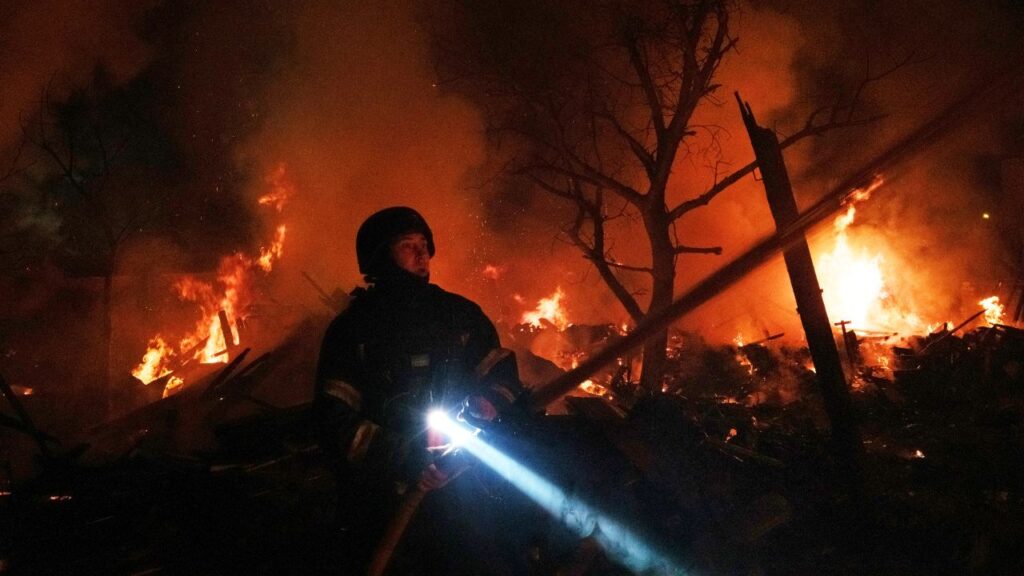
For weeks, Prime Minister Benjamin Netanyahu of Israel has presided over the shelling of Hezbollah positions in southern Lebanon, the targeted killings of more than 20 people in the Gaza Strip and the bombing of an air base in northern Syria, a warning to Turkey.
He has also failed to crack down on settler violence in the West Bank that his own generals have warned risks igniting a new Palestinian uprising.
The ratcheting-up of tensions in every direction is straining an army that was already overstretched after nearly three years of war, not to mention a citizenry that remains frazzled and exhausted by it.

However valid the national security rationale for Israel’s actions, though, Netanyahu has his own reasons to be looking for a fight.
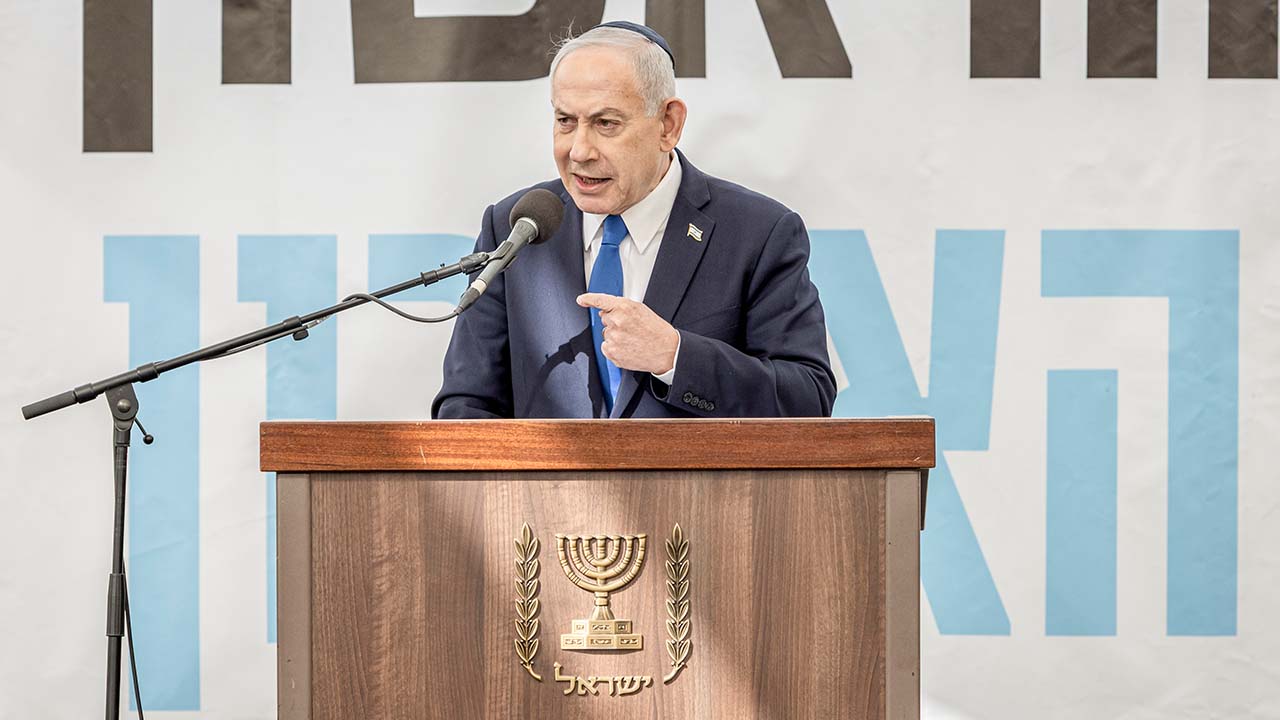
The Israeli leader is up for reelection Oct. 27 and is trailing in the polls, which show his opponents with nearly enough support to send him and his coalition packing.
Allies and rivals alike are attacking him from the right on national security matters, prompting him to adopt a more bellicose tone himself. Even so, his chief rival, former army chief of staff Gadi Eisenkot, now leads him in polling on how much voters trust each candidate on security matters. Clearly, Netanyahu is still weighed down by his having been in charge when Hamas launched its devastating attack on Israel in October 2023.
Yet incumbency, at this late stage, still offers one unbeatable advantage for a sitting prime minister: the rally-around-the-flag effect.
“Netanyahu wants to light every front on fire, because it positions him as Mr. Security,” said Shira Efron, an Israeli analyst at the Rand Corp., a U.S.-based research group.
“But it also helps him deflect from the failures of Oct. 7 and the last three or four years in office, because the conversation will be about the security situation and not the damage his government brought on Israel,” Efron said.
Indeed, Netanyahu is openly trying to turn the regional tensions to his political advantage. In a video he posted Tuesday, he says he heard that the Palestinian president, Mahmoud Abbas, “wants me to lose the elections.”
“The ayatollahs want me to lose the elections,” he continues, grinning. “Hezbollah and Hamas want me to lose. Turkey does too, by the way. They say this openly. Ask yourselves, who do Israel’s enemies want to win these elections?”
And Wednesday, Netanyahu posted a video from a visit to Gaza, in which he wore a flak jacket and army helmet and told Israelis, “We’re doing everything to reach our goal, which is to disarm Hamas, to demilitarize Gaza. Gaza will no longer be a threat to Israel.”
Israeli pollsters say that if national security is at the top of voters’ list of concerns on Election Day, it could be worth as many as three seats in parliament to his Likud party. That would perhaps be enough to deny the opposition a majority, which could keep Netanyahu in power until another election can be held.
There is one big issue standing in the way of the kind of national security emergency that could aid Netanyahu. In almost every theater of conflict, Israel’s most important ally, the United States, is urging the country to chill out.
Israel has been benched from the battle with Iran by President Donald Trump, who for the moment is letting economic sanctions serve as a substitute for military action. In southern Lebanon, Israel is participating in a slow-moving political negotiation overseen by Secretary of State Marco Rubio, under which it has agreed to give the Lebanese military time to clear out Hezbollah forces and take over security control of certain areas near the Israeli border.
In Syria, far from posing an immediate threat to Israel, the government of President Ahmad al-Sharaa has sought U.S. help to try to negotiate a security arrangement with Jerusalem that could lead to the withdrawal of Israeli troops from the buffer zone.
In the West Bank, where violent Israeli settlers and some soldiers have been harassing, attacking and displacing Palestinian civilians, Israel’s government has come under a degree of pressure from the U.S. ambassador, Mike Huckabee, ordinarily an ally of the settlers, to rein in what he has called “Israeli terrorists.”
And in Gaza, Israel has had its hands tied somewhat by Trump’s Board of Peace, an entity largely overseen by Jared Kushner, the president’s son-in-law and unofficial project manager for the Middle East.
In July, the board got Hamas to agree for the first time to a full disarmament plan. Israel rejected it and ordered renewed strikes in Gaza. On Aug. 26, the board’s high representative for Gaza, Nickolay Mladenov, criticized Israel for those strikes in a speech to the U.N. Security Council, saying they accomplished little and only delayed the demilitarization of Gaza.
Nimrod Novik, a former foreign diplomatic adviser and envoy for Shimon Peres, whom Netanyahu defeated to become prime minister in 1996, said Netanyahu appeared to be casting about in vain for a conflict that he could heat up unimpeded by Washington.
“It’s like a thief in a hotel; you try every door to find out which one will open,” he said. “Which is the point of least resistance by the Trump administration?”
That may help explain the curious case of Israel’s surprise Aug. 18 bombing of a defunct air base in northern Syria only 40 miles from the Turkish border.
It was not only left-leaning Israelis who saw a possible political motivation. In a podcast interview after the attack, Tom Barrack, the U.S. ambassador to Turkey and special presidential envoy to Syria, said that “one theory” for why Israel had ordered it was as a “well-received preelection concept.” Barrack did not respond to requests for comment.
Israeli officials described the attack on the Abu al-Duhur air base as a warning to Turkey not to try to establish its own military presence at the site. A Turkish delegation had recently visited the airfield, in Idlib province, as part of discussions on its rehabilitation, according to two Syrian officials. Israel asserted that Syria planned to allow Turkish troops to deploy there, and that “Syria chose to ignore” Israel’s warnings not to.
Israeli experts said that the main threat to Israel could arise if Turkey installed air-defense systems at the base that could threaten Israeli jets operating in Syrian airspace. Israel has used Syria as a key corridor through which to attack Iran. The Syrian government has complained about Israel “violating Syrian airspace.”
Absent from the Israeli messaging was any recognition that Syria is a country with its own prerogatives and that Israel had violated its sovereignty. Rather, Israel seemed to be treating the Syrian skies as another Israeli buffer zone — much like the 400 square kilometers of land in southern Syria that Israeli troops are already occupying as a forward defense of their country’s border.
Notably, Israel’s statements seemed to operate on two frequencies. For international consumption, Netanyahu’s office said in English that Israel merely wanted to restore the “status quo” between itself and Syria.
For a domestic audience, however, the Israeli leader released a video in Hebrew in which he was more bellicose and sounded more as if his saber rattling was aimed at Turkey. “We will not tolerate the establishment of a Turkish military presence that extends southward, because it threatens us,” he said, adding, “We’ve conveyed the message. How shall I put this message? ‘Don’t.’”
That last word, which Netanyahu said in English, has a special resonance in the Middle East. It was memorably employed by then-President Joe Biden in October 2023, a week into the Israel-Hamas conflict, when he warned Hezbollah and Iran against joining the fight against Israel. “Don’t,” Biden said on “60 Minutes,” adding, “Don’t, don’t, don’t.”
For Netanyahu to issue a similar warning in relation to Turkey was worrisome, said Gallia Lindenstrauss, an expert on Israeli-Turkish relations at the Institute for National Security Studies in Tel Aviv, Israel.
“He’s presenting to the Israeli public that Israel has unlimited power, and that’s very dangerous,” she said.
Talking tough to Turkey is not the same as to Hamas, Hezbollah or Syria, however. Turkey has the second-largest military in NATO, and its president is a close ally of Trump.
Turkey also had reason to expect Israeli deference rather than an abrupt airstrike so close to its border, Lindenstrauss said: “Northern Syria is an area where in the balance of interests, Turkey’s are greater than Israel’s.”
Still, she said, judging from Turkish media coverage, Turkey did not appear to take Netanyahu’s warnings too seriously as a threat of military confrontation, at least for the moment.
“Luckily,” she said, “Turkey is understanding this Israeli action as part of Netanyahu’s political campaign.”
—
This article originally appeared in The New York Times.
By: David M. Halbfinger/Avishag Shaar-Yashuv
c.2026 The New York Times Company