

|
Getting your Trinity Audio player ready...
|
A business group filed a lawsuit on Monday arguing that Mayor Zohran Mamdani’s plan to create five city-owned grocery stores would hurt smaller businesses.
The lawsuit claims that city officials did not properly study how the new stores could adversely affect neighborhood supermarkets and would discriminate against Latino and Asian business owners.
The suit was filed in state Supreme Court in Manhattan by the Multicultural Business Coalition, a group that says it represents the owners of some smaller stores. The group’s president, Kenneth Roldan, said in a statement that Mamdani’s plan would have a “devastating” toll on competitors.

“It is a direct assault on minority business by a mayor who claims to be a champion of disenfranchised poor and working-class New Yorkers,” Roldan said.
Mamdani ran for mayor on an affordability platform that included creating city-owned grocery stores in an effort to lower prices. The city plans to open five stores, one in each borough, by 2029 that will offer a 30% discount on some items.
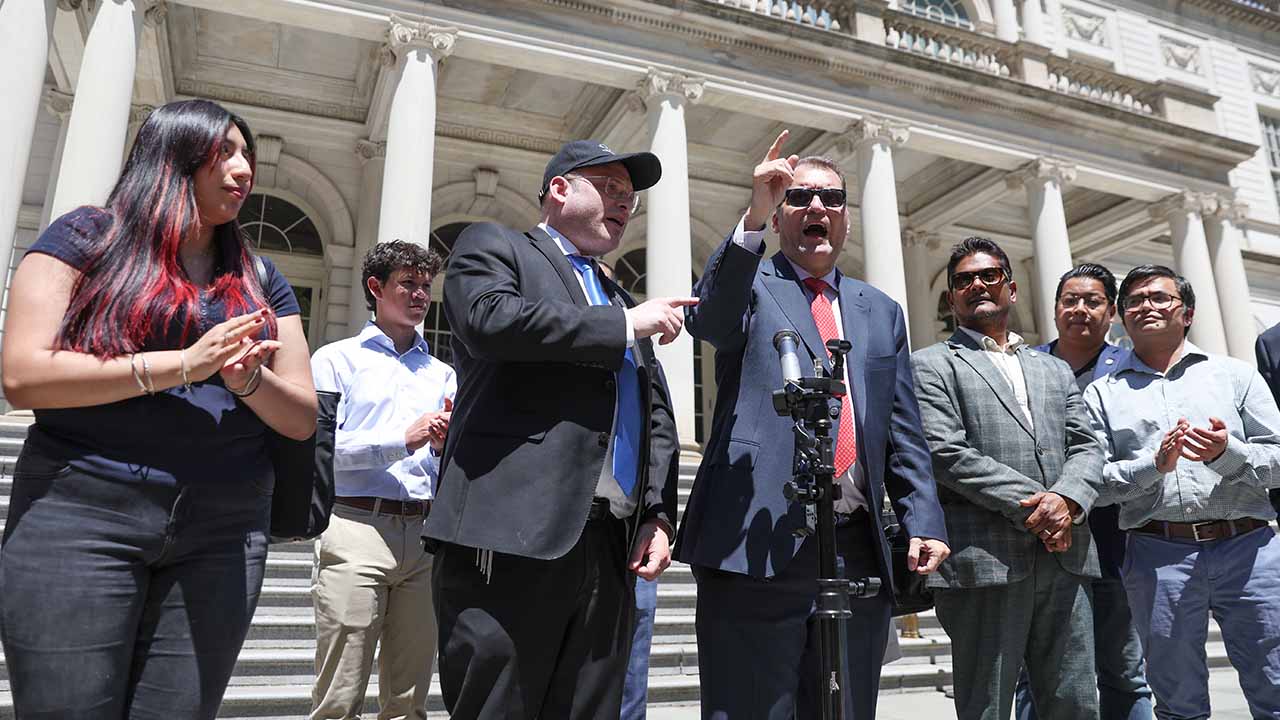
At a news conference Monday, the mayor defended the grocery plan, saying that the stores were needed to address the high cost of living. He argued that five stores would not hurt competition in a city of 8 million people and 1,000 grocery stores.
“I’m confident both in the legality of this, that it will stand up in court and the importance of delivering it,” Mamdani said.
Many of the mayor’s signature initiatives have been challenged in court, including a rent freeze and a tax on second homes. Several cases were handled by Randy Mastro, a lawyer and top official under former Mayor Eric Adams. The grocery store lawsuit is being overseen by a less prominent team, led by lawyers E. Dubois Raynor Jr. and Damond Carter.
Even so, the lawsuit could be the strongest opportunity to stop the stores from moving forward. It argues that the plan violates state civil rights laws and the equal protection clause of the state Constitution. A second lawsuit, which was also filed by the same group Monday, argues that the city does not have the authority to create the stores.
In addition to saying that the city had not sufficiently studied the “adverse effects of the proposed development,” the lawsuit also claimed that the selection of sites was “arbitrary.” The group plans to hold a news conference in the coming days with store owners who could be affected.
The plan has also received criticism over whether it is the best use of city resources. The city plans to spend $70 million to build the stores and will most likely provide funding each year to make sure that basics such as meat and milk are discounted.
The first store is expected to open next year in the Hunts Point neighborhood in the Bronx. Another store is being built in East Harlem by 2029. The sites in Brooklyn, Queens and Staten Island have not been identified.
The Multicultural Business Coalition is one of several groups that work with supermarket and bodega owners. Another group, the National Supermarket Association, has also criticized the mayor’s plan.
When a city official recently raised the prospect of providing grants to local businesses that are affected by the stores, city officials clarified that grants were not being considered, but that the stores may receive help in other ways.
A spokesperson for the city’s Economic Development Corporation, which is overseeing the stores, said in a statement that the city was “evaluating programs and policies to support local grocers.”
“We are looking at the potential for tax abatement, incentives and zoning benefits through existing city programs to ensure that the city is doing everything in our power to alleviate cost pressures for small businesses across the city,” he said.
—
This article originally appeared in The New York Times.
By: Emma G. Fitzsimmons/Heather Khalifa
c.2026 The New York Times Company