
|
Getting your Trinity Audio player ready...
|
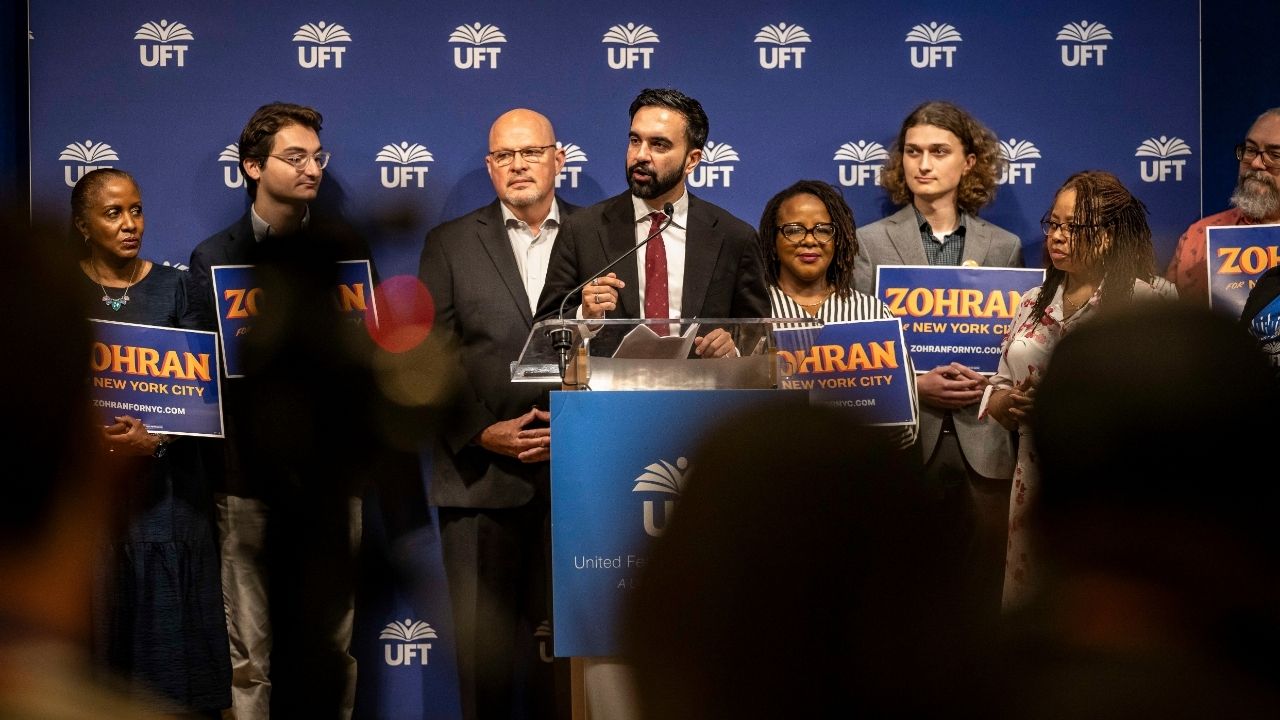
NEW YORK — Mayor Zohran Mamdani sued the New York City Council on Wednesday, arguing that its bill granting hefty bonuses to some of the city’s lowest-paid school workers violates collective bargaining law, a city spokesperson said.
The decision to sue comes the same day that the City Council bill became law, after the mayor declined to issue a veto, knowing that the council had the votes to override it.
The suit, filed in state Supreme Court in Manhattan, could set the scene for the mayor’s highest-profile fight so far with a public sector union and stands to embitter his already fraught relationship with the council’s speaker, Julie Menin, who championed the legislation.

But a spokesperson for the mayor said the city was acting to protect labor rights.
“We will not allow the political process to replace the collective bargaining table,” said the spokesperson, Matt Rauschenbach. “The city is filing a lawsuit to protect the right of every union to negotiate on behalf of its members, to fight for the workplace they deserve and ensure that workers — not politicians — determine their own futures.”
The council bill, backed by the influential United Federation of Teachers, would grant $10,000 bonuses to New York City teaching assistants, who often work one-on-one with children with disabilities and are among the worst-paid workers in the city’s public school system.
Mamdani, a democratic socialist who often closely aligns himself with organized labor, supported the bonuses on the campaign trail, but came out against them once he became mayor. He argued that the bill violated labor law, which requires such issues to be hammered out via collective bargaining.
The teachers union backed Mamdani for mayor only after he won the Democratic primary last summer.
Rauschenbach said the administration was committed to raising paraprofessional pay by other means.
“We want to engage in productive conversations with the UFT to permanently address this inequity,” he said. In a later statement, Rauschenbach clarified that those discussions were already underway.
The mayor, who campaigned on the promise of making New York more affordable for all, now finds himself in the politically awkward position of fighting the teachers union and potentially blocking bonuses for low-income city employees who work with vulnerable children.
Nor is Menin’s position without political complications. The speaker often casts herself as a more fiscally moderate foil to the mayor, but the legislation she has championed would, according to critics, amount to an expensive end-run around collective bargaining that other unions would be eager to emulate.
As evidence, opponents of the legislation note that Joann Ariola, the council member who chairs the Committee on Fire and Emergency Management, recently pointed to the paraprofessional bonuses in her request to raise the pay for the Fire Department’s emergency medical technicians, some of whom make as little as $18 an hour.
In an interview Wednesday morning on “The Brian Lehrer Show” on WNYC, Menin said that it made fiscal sense to fund the bonuses and help fill paraprofessional job vacancies, at a time when the city is spending more than $1 billion a year to send children with disabilities to private schools where they can receive more specialized services.
“Every member of the council, in a unanimous and bipartisan vote, supported the RESPECT Check Act because it is unacceptable that paraprofessionals who support some of our highest-need students are earning as little as $32,000 a year,” said Menin on Wednesday afternoon, in a joint statement with Carmen De La Rosa, the council member who sponsored the legislation.
The first tranche of the bonuses is not due until Jan. 1.
The ambiguity surrounding the legislation’s future did not stop the teachers union from declaring victory.
In an email to paraprofessionals Wednesday, Michael Mulgrew, the union’s president, wrote, “Today, the RESPECT check became law! All of our hard work has gotten us to this moment. As of today, paraprofessionals can expect to receive their first RESPECT payment in January.”
Mulgrew had threatened “all-out war” on the mayor if he tried to block the legislation.
In an interview Wednesday, Mulgrew said the city’s claim that it was suing to protect workers was “a joke.”
“The lowest-paid workers in my union, majority Black and brown women, you’re trying to stop them from getting this check, good luck with that,” he said, adding that he was somewhat encouraged that Mamdani had become more personally involved in this issue in recent weeks.
The roughly 26,000 paraprofessionals who work in New York’s public school system, America’s largest, have a starting salary of about $32,000 a year.
The legislation would cost an estimated $325 million, according to the nonpartisan Citizens Budget Commission, a watchdog group.
The commission, and the mayor’s allies, also warned that the law threatened to sow havoc in the city’s half-century-old collective bargaining practices, by establishing a precedent that when unions did not get what they wanted at the bargaining table, they could just turn to the City Council for help.
Robert W. Linn, who worked as the city’s labor relations commissioner under Mayor Bill de Blasio and continues to advise City Hall under Mamdani, said that the state and city labor laws had been put in place to stop the chaos that typified collective bargaining in the 1960s, when there were strikes by teachers, social service workers and sanitation workers.
“There are almost 150 bargaining units in New York City,” Linn said. “If you don’t have a rigorous collective bargaining approach, then parties are going to be running to the City Council, to the state Legislature, they’re going to be engaging in work stoppages. I think there is the potential to return to that chaos.”
—
This article originally appeared in The New York Times.
By Dana Rubinstein and Eliza Shapiro/Dave Sanders
c. 2026 The New York Times Company