

|
Getting your Trinity Audio player ready...
|
The Iranian army said on Friday that it had launched drone attacks on U.S. military targets in Kuwait, as a new wave of hostilities between the United States and Iran reignited fears of a return to full-blown war in the Middle East.
The attacks targeted U.S. assets at Ahmad al-Jaber Air Base, Iran’s military said in a statement published by state media. A U.S. Defense Department official, who spoke on the condition of anonymity, confirmed that Iran had launched multiple projectiles, mostly at Kuwait, but that there was no major impact on U.S. military bases in the region.
In a statement, the Kuwaiti military said that it had detected and destroyed multiple drones in its airspace, adding that the interceptions had caused material damage from falling shrapnel but no injuries.

Iran’s military said the attacks came in response to recent U.S. military strikes, which have increased in recent days. U.S. Central Command, which oversees U.S. military operations in the Middle East, said on Thursday that it had struck sites in Iran, including military command centers and missile and drone facilities, in response to Iran’s launching of ballistic missiles at American forces in the Middle East a day earlier.
The exchanges this week ended a pause in direct attacks between the United States and Iran, who have whipsawed between conflict and negotiation in recent months. Several U.S. allies also faced renewed drone and missile fire this week, including Jordan and Saudi Arabia.
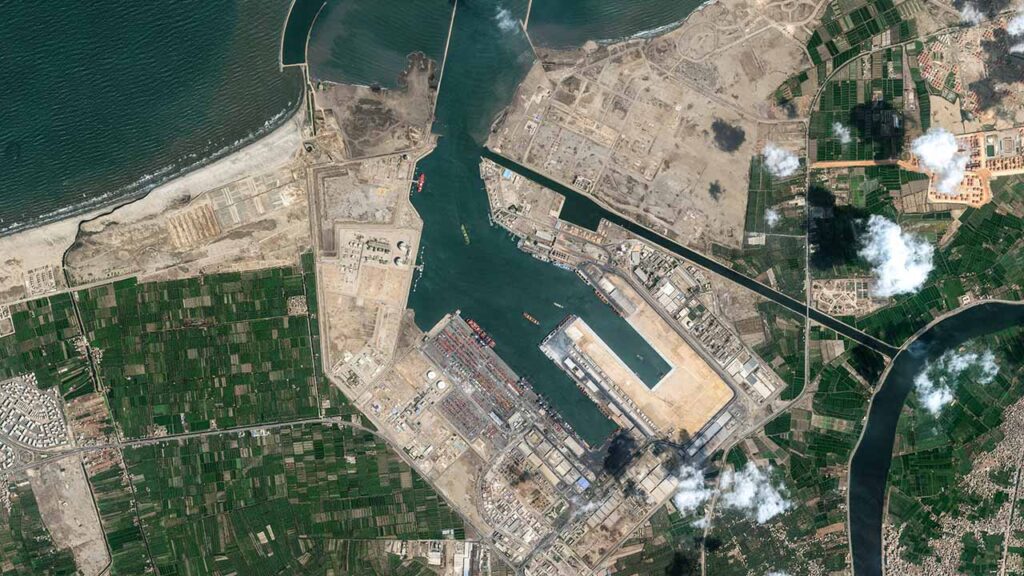
There was also a strike for the first time in Egypt, where authorities said Thursday that an unidentified drone had caused an explosion at the Mediterranean port of Damietta the previous day.
That attack ignited a fire on two ships, including a U.S.-owned gas storage tanker. It did not appear to disrupt traffic to the Suez Canal, but analysts said it demonstrated how the conflict in the Middle East could further disrupt global trade. Commercial ships, including oil tankers, have been regularly targeted, particularly in the Strait of Hormuz, normally a key passage for global energy supplies.
The threat to shipping has also expanded to other parts of the Middle East. The Houthis, an Iranian-backed Yemeni militia, have announced a blockade of Saudi vessels and targeted ships in the Red Sea, which has become a vital route for oil exports during the war.
Saudi Arabia said on Thursday it was forming a military coalition to protect shipping, with support from more than a dozen countries. It was unclear how the coalition would operate and what assets, such as warships or aircraft, the participants would contribute.
The Saudi foreign ministry also announced joint strikes with the U.S. military against Iranian-backed militias in Iraq, which the ministry blamed for attacks on Saudi oil facilities.
On Friday, a Saudi official, speaking on condition of anonymity, sought to reassure Baghdad in the wake of the attacks, stressing that the strikes were confined to militia weapons depots and were not directed against the Iraqi people or government. The official claimed that the strikes came only after diplomatic measures had been exhausted.
Months of threats and attacks on shipping have throttled oil exports from Persian Gulf states. Saudi Arabia’s economy shrunk in the last quarter by 4.8%, the worst quarterly contraction since the COVID pandemic, the kingdom said on Thursday.
—
This article originally appeared in The New York Times.
By Qasim Nauman and Euan Ward
c. 2026 The New York Times Company