
|
Getting your Trinity Audio player ready...
|
In the aftermath of the major earthquake in southwestern Japan, emergency workers and thousands of displaced residents are mounting a grueling recovery amid sweltering heat.
Four days on, the death toll from Tuesday’s magnitude 6.8 earthquake in Kumamoto has risen to 36. Rescue workers have been navigating aftershocks — around 300 so far, according to the Japan meteorological agency — as well as temperatures nearing 100 degrees to reach any remaining survivors trapped in collapsed buildings. More than 9,000 people are sheltering in evacuation centers.
In the muggy evening heat at the mangled Aeon shopping mall, hundreds of rescue workers toiled in rotating shifts hoisting slabs of concrete and twisted metal in search of survivors. Seven people were killed when the building’s second floor collapsed, while five were pulled from the rubble alive.

“We don’t know if that’s everyone, so we’re still going nonstop,” said Takeshi Ueda, a Kumamoto police official stationed at the mall Thursday evening. Heat trapped inside the gutted building from heavy equipment has been “brutally tough” for workers wearing heavy gear and masks, he said.
It is also dangerous, with “steel framework held up by threads,” he added. “Operating under those conditions is grueling.”
In Kumamoto, relief efforts in the coming days and weeks will be critical.
When powerful earthquakes struck the region in 2016, direct casualties initially numbered around 50 from collapsing structures. The disaster’s total death toll eventually surpassed 270 as evacuees succumbed to secondary health complications, brought on by stress and prolonged stays in cramped shelters and cars.
This time, the main challenge is likely to be battling heat.
Tuesday’s tremor was the first of this seismic intensity to strike the earthquake-prone country during the height of its blistering summer months.
Since the quake, dozens of people in Kumamoto have been transported to hospitals with suspected cases of heatstroke, according to local officials’ tallies.
“This summer’s intense heat represents a situation that can truly be described as a double disaster,” Minoru Kihara, Japan’s chief Cabinet secretary, said at a news conference Friday. Kihara promised support from the national government to help the prefecture secure air-conditioning equipment.
A Tragedy Compounded
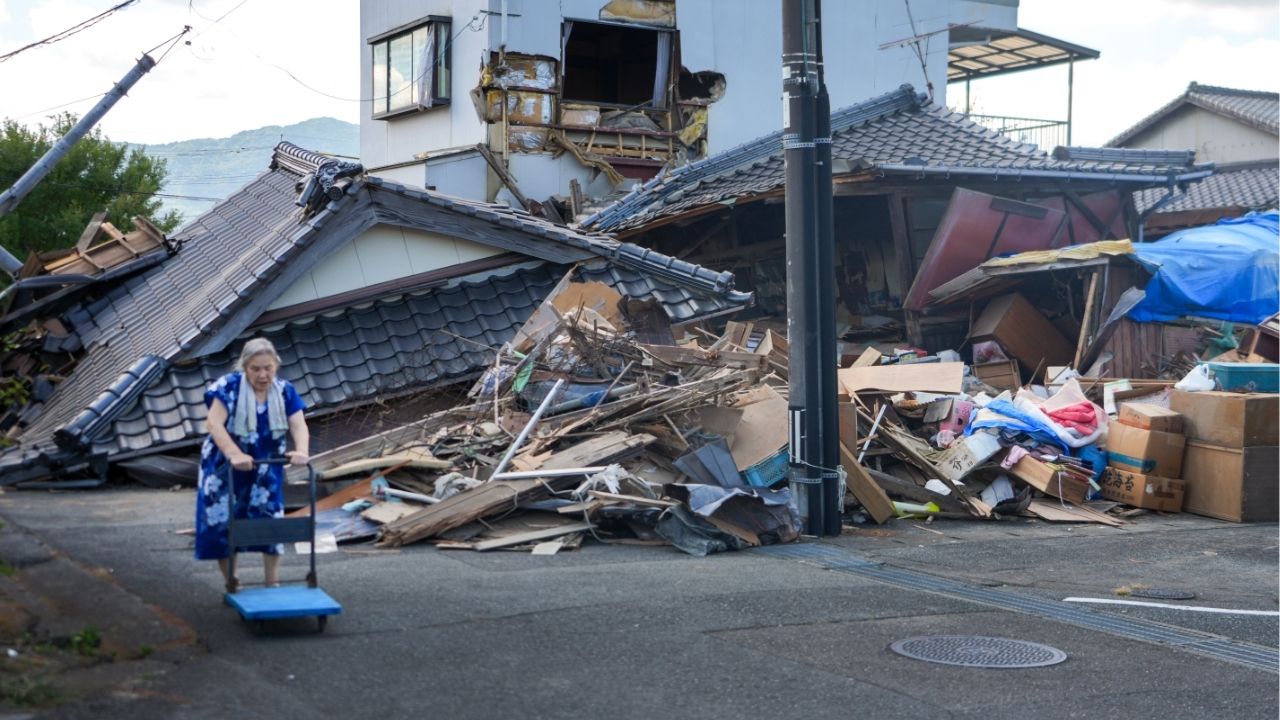
Conditions in Kumamoto City, the biggest in the prefecture, were largely undisrupted in the days following the quake. But south of the city, the roads were cracked and buckled and plumes of black smoke were visible in the distance. In Yatsushiro, near the epicenter, rows of old wooden homes with tile roofs lay flattened, their contents spilling into the streets.
Eiko Ishibashi, 69, went to an evacuation center in Yatsushiro, a converted middle-school gymnasium, to escape the heat after violent shaking from the earthquake had broken the air conditioner in her home. The major earthquake that struck Kumamoto 10 years ago occurred in the more temperate month of April, she noted.
“But this time it’s just so hot,” she said.
On Monday, temperatures in some parts of the prefecture are projected to hit 40 degrees Celsius (104 degrees Fahrenheit), the threshold for what meteorologists in Japan are now calling “kokushobi,” or “cruelly hot days.”
According to prefectural officials, 374 evacuation centers have provided refuge for residents whose homes were destroyed or left without functioning utilities. But many of these facilities lack air conditioning.
In Yatsushiro, the evacuation center at the middle school had roughly 280 families and does have climate control. Volunteer students checked in residents at the entrance, while evacuees rested inside, many napping on blankets spread across the cool gym floor. The facility had recently begun bringing in evacuees from a nearby elementary school that lacked power for air conditioning.
“Given the time of year, places without functioning air conditioning are basically unusable,” said Atsuko Koide, a Yatsushiro City government worker overseeing operations at the site. Even with air conditioning at the middle school, several evacuees were hospitalized with heatstroke after returning to their damaged homes during the day to clear debris, she said.
“Unless the lifelines of water and electricity are restored, we’re not going to see a decrease in evacuees here anytime soon,” Koide said.
Masae Taniguchi, 73, was among the Yatsushiro residents clearing debris from her home Friday. When the earthquake hit, she was sitting on a couch, which slid across her house in the shaking. “The tremors were so unbelievable — they just wouldn’t stop,” she said. “At one point I completely gave up and thought ‘I’m going to die right here.’”
On Friday, Taniguchi’s home had electricity but no running water, forcing her to step out into the heat three times a day to fill buckets using a hose connected to a groundwater supply at a store across the street.
Taniguchi lives a few streets away from the Nippon Paper Industries factory, where nine people died when a chimney collapsed. The last missing worker at the facility was found dead Thursday.
Taniguchi, who had worked until retirement at the plant, said that she knew several of the workers who had died. “I watched smoke from those chimneys my whole life,” she said. “It’s so heartbreaking.”
–
This article originally appeared in The New York Times.
By River Akira Davis/Hisako Ueno/Kiuko Notoya/Chang W. Lee
c.2026 The New York Times Company