
|
Getting your Trinity Audio player ready...
|
Matthew Taylor officially holds one role in the Trump administration as a senior adviser at the National Endowment for the Humanities, but he has quietly become a key player behind many of the president’s bold initiatives to transform Washington and its cultural legacy.
This year, President Donald Trump appointed Taylor to the Commission of Fine Arts, a federal agency that reviews government construction in Washington, to rubber-stamp approvals for projects such as the White House ballroom and the world’s tallest triumphal arch. He secured a role overseeing the National Garden of American Heroes, which would include the installation of 250 new statues in the capital.
Taylor consulted on the White House’s scathing report about the Smithsonian, which accused the National Museum of American History of promoting “extreme ideological activism.” And he was a constant presence at the U.S. Pavilion at the Venice Biennale, where he appeared alongside the curator in orange aviator sunglasses and a Super Mario Bros. hat.

Unlike other culture czars for the administration who have quickly come and gone, Taylor has an artistic background that makes him a distinct and persistent champion of the president’s vision.
He is a Marcel Duchamp devotee with a degree in sculpture. He is a filmmaker behind right-wing documentaries produced by Steve Bannon and FBI Director Kash Patel. He is a campaign strategist who hosts podcasts and makes music videos.
“He is an artist first and then he is a conservative,” Bannon said. “We don’t have enough of those people on our side.”
Vince Haley, the director of the White House’s Domestic Policy Council, asked Taylor to help fulfill the president’s desire to overhaul the capital’s cultural institutions.
“Matthew Taylor is absolutely committed to elevating beauty in the arts and culture and showcasing the best of American creative genius to the world,” Haley said.
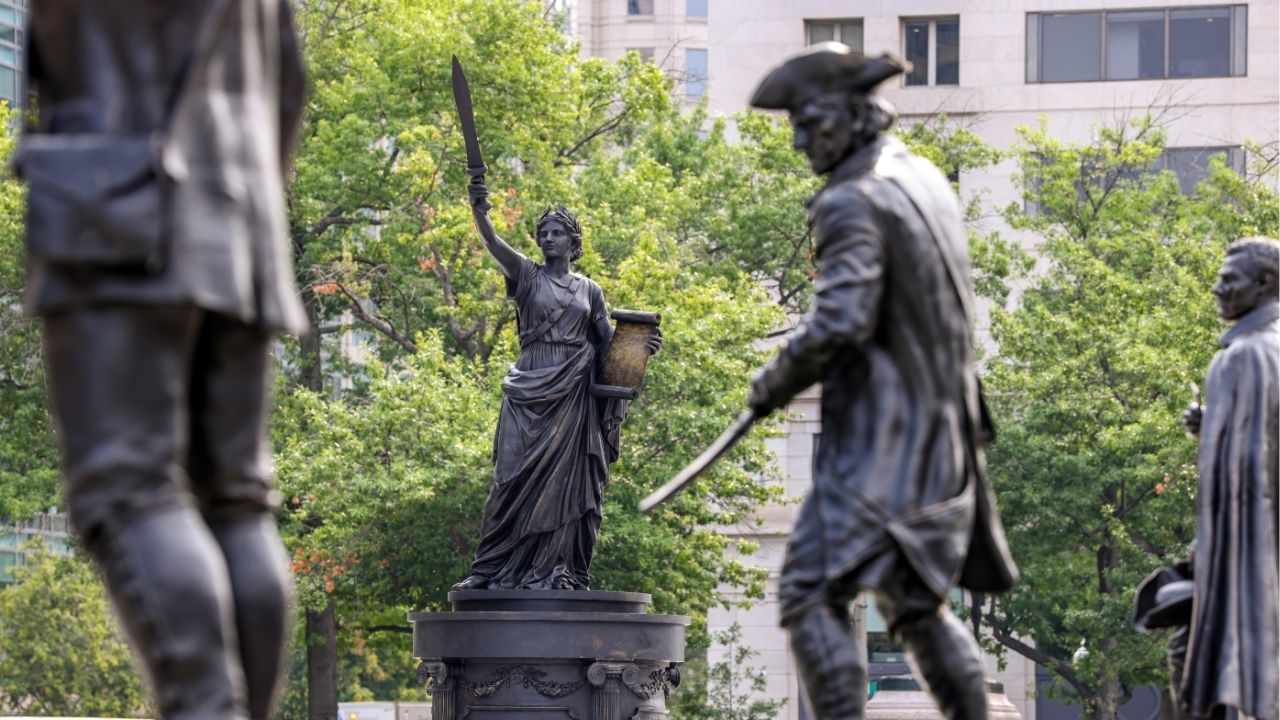
Blocks away from the White House, Taylor’s handiwork is on display. Under the blazing sun last month, he unveiled 21 statues of soldiers and Revolutionary scenes that he designed to commemorate a $10 million renovation of Freedom Plaza. “A new icon of American liberty,” he said on Bannon’s talk show, pointing to a statue of a woman holding the Declaration of Independence in one hand and a raised sword in the other.
As a filmmaker, Taylor has been producing work on parallel tracks. He has directed a lauded documentary about Duchamp, the godfather of conceptual art. But under a different name, M.A. Taylor, he has promoted conspiracy theories and played an instrumental role in some of the most influential videos in modern political history.
He edited the windsurfing ad that characterized John Kerry as a flip-flopper while he was the Democratic presidential candidate in 2004. And he was the editor and cinematographer of “Hillary: The Movie,” which the Federal Election Commission said could not be aired on television in 2008 because of election rules. That dispute led to the Supreme Court ruling known as Citizens United, which ended political spending limits for corporations.
“He is still one of the best editors I have ever seen,” said Bannon, who credited Taylor with developing the opening sequence of his film about the 2008 financial crisis, “Generation Zero.”
Taylor, who declined to comment, describes himself online as a “conceptual artist, filmmaker and messaging strategist.” Over the past decade, he has remained consistent about seeing art and politics as two sides of the same coin.
“To sell a candidate is simply to sell a concept,” Taylor said during a 2018 lecture in which he compared politicians to ready-mades, manufactured objects like a urinal or bicycle wheel that Duchamp removed from their original context and redefined as artworks simply by calling them so.
“What we do is we communicate with the public that our guy (the proverbial toilet) is art in a way,” he said during the lecture for the American Association of Political Consultants. “We sell ideas by reassigning thoughts. We tap into our audiences’ hearts and their minds the exact same way you sell a ready-made.
“He or she is not a candidate or a cause but a set of conceptual principles elevated above all to be a pure belief.”
Taylor worked on several projects with Bannon through the 2000s and 2010s, and had a breakout moment as editor of “Hillary: The Movie.” His 2016 directorial follow-up, “Clinton Cash,” was an adaptation of a book that accused the State Department under Hillary Clinton of giving favors to foreign entities that made payments to the Clinton Foundation and her husband. (A spokesperson for Hillary Clinton’s presidential campaign told The New York Times then that no one “has ever produced a shred of evidence supporting the theory.”)
“Taylor merged his love of cinema with sculpture and fashion to develop a unique perspective on messaging to broad audiences,” Taylor’s biography says on the website of a consulting group he founded with his wife. On YouTube, he has uploaded short artistic films like “Droidica,” which demonstrates his conceptual approach to filmmaking.
Taylor also worked as a media strategist in the 2016 presidential election, as part of a political action committee that supported Ted Cruz and, later, Trump. But instead of joining the new administration, Taylor continued to make documentaries with conservative talking points. The Verge described “The Creepy Line,” a 2018 movie directed by Taylor that accused internet companies like Facebook and Google of suppressing conservative voices, as a “conspiratorial playbook for right-wing tech backlash.”
He also spent years developing “Marcel Duchamp: Art of the Possible,” interviewing artists including Marina Abramovic, Jeff Koons and Carolee Schneemann. The 2020 film won some applause, with Taylor doing an interview for the Golden Globes’ digital publication, and ARTnews describing the documentary as “smart, searching and sophisticated.”
After his introductory conversation with Haley last year, Taylor landed a job in Washington at the National Endowment for the Humanities. By July 2025, Taylor was driving across the country to move into a brick town house.
A few weeks later, Taylor’s wife and business partner, Michelle Taylor, posted a screenshot on Instagram of a Wall Street Journal article headlined “White House to Vet Smithsonian Museums to Fit Trump’s Historical Vision.”
“The reason we moved from Austin to DC!” she wrote in the post, which included two American flags. “The storylines are all coming together.”
Last month, the Domestic Policy Council released a report about the Smithsonian that said the National Museum of American History was spreading “radical activist ideology” with programming that was “anti-white,” “pro-illegal alien” and “pro-abortion.” The leader of the Smithsonian pushed back against the report, saying it was “not a fair characterization” of the museum’s work, which he said was “driven by scholarship, accuracy and an uncompromising commitment to tell the fullness of America’s story.”
The museum’s director was called before a House subcommittee this week and was questioned by Republican members about whether she should keep her job, given the report’s findings.
Two people with knowledge of Taylor’s work in Washington, speaking on condition of anonymity to avoid blowback from the administration, said Taylor told them he was involved with the report. When asked about its authorship, the White House spokesperson said Taylor “didn’t write a word.”
During Taylor’s time within the Trump administration, he has also found ways of increasing his artistic profile.
As the John F. Kennedy Center for the Performing Arts looked this year to fill programming gaps created by Trump’s takeover, it turned in part to Taylor and his documentaries.
He had screenings of his Duchamp documentary as well as “Gotham: The Fall and Rise of New York,” a 2023 film produced by a longtime president of the conservative Manhattan Institute that attributed New York’s improved reputation in the 1990s to Republican leaders like Mayor Rudy Giuliani.
The Kennedy Center labeled his films “Extraordinary Cinema.”
–
This article originally appeared in The New York Times.
By Zachary Small/Valerie Plesch
c.2026 The New York Times Company