
|
Getting your Trinity Audio player ready...
|
It’s a tiny restaurant in the Little Morocco neighborhood of New York City’s Queens borough. But throughout this World Cup, it has swelled with pride, song and beating drums as the Moroccan national team pushed its way deep into soccer’s biggest international tournament.
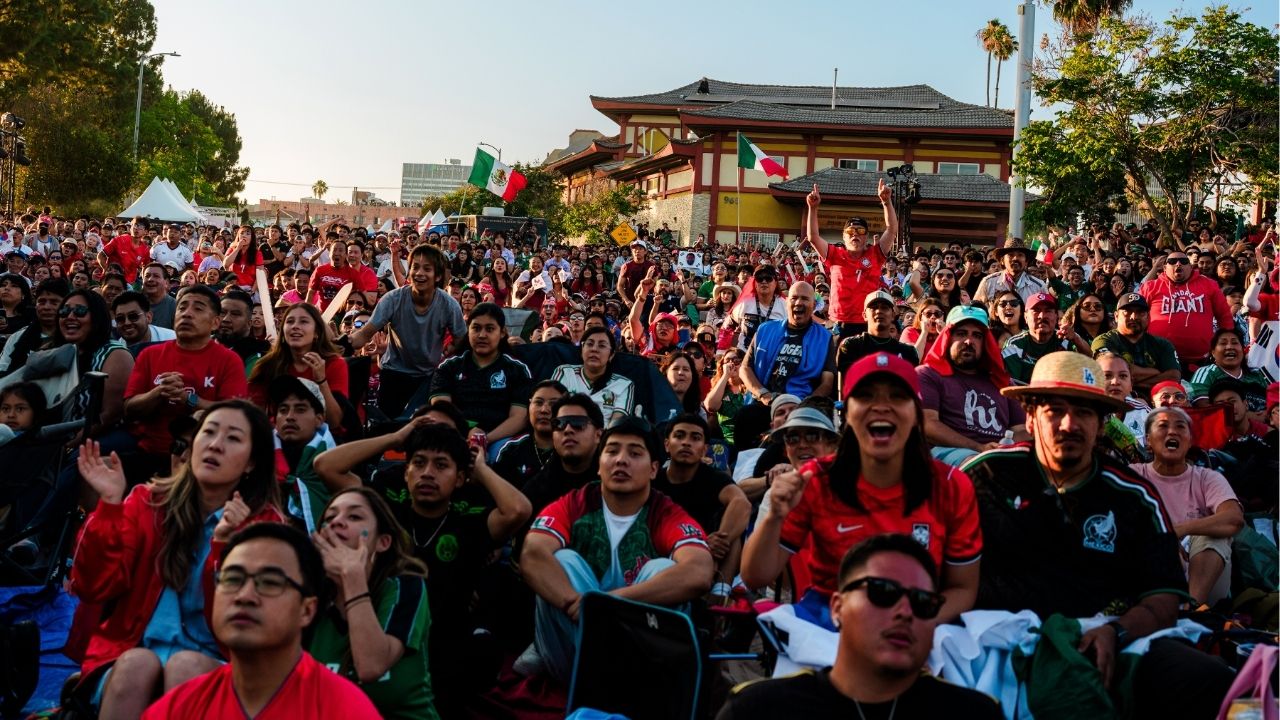
This scene has been echoed across the United States — in a multitude of languages and colors — as soccer fans from all over the world, many now making their homes in America, have packed bars, restaurants, living rooms and concert venues.
No matter where they came from or where they gathered, they all sought the same experience: a chance to watch their nations compete while surrounded by others who share passion and pride for the country they or their ancestors once called home.

Together, these fans have brought places throughout the United States to life.
Argentina vs. Austria: In Utah, Messi Mania Is a Family Affair
Sporting the colors is intergenerational in Provo, Utah. Luis and Lidia Peve moved there 25 years ago, following a son who emigrated first, and decorated their home with small Argentina flags before the team’s match against Austria on June 22.
As game time approached, about a dozen members of the family painted their faces with the sky blue and white of Argentina’s flag. Together, they sat around the TV with their eyes trained particularly on Lionel Messi, the team’s star, who is likely playing in his last World Cup.
He finished the game with three goals — a hat trick — and a new generation of fans in the Peve household.
Brazil vs. Haiti: A Brazilian Dance Party Near Boston
Massachusetts has a long history of Portuguese-speaking settlers, making Brazilians feel welcome in the Boston area. That’s especially the case in the southwest suburb of Framingham, where the Brazilian-born population rivals that of Boston.
They packed into Tropical Cafe, a Brazilian restaurant in Framingham, gathering around high-top tables as their team played Haiti on June 19. After Brazil secured a 3-0 win, fans made the restaurant an impromptu dance club to celebrate.
Morocco vs. Brazil: Moroccan Joy in New York City
Touria Lamtahaf worked as a chef four years ago at a restaurant in Astoria, Queens, in the heart of an enclave on Steinway Street known as Little Morocco.
After the Moroccan team upset Portugal in a World Cup quarterfinal, Lamtahaf remembers hundreds of Morocco fans surging onto Steinway Street, setting off flares and red smoke bombs to celebrate.
“It was a good memory for all of us,” she said. “We were very proud. You just needed something to be happy. After COVID, this was amazing.”
The neighborhood has long been a hub for immigrant communities from North African countries, including Egypt, and is also home to a large Greek community.
Many settled in Astoria decades ago, drawn by low rents and a neighborhood that could feel calm compared with other bustling parts of New York. Lamtahaf, who moved to the United States in 2007, said that she originally lived in the Ridgewood neighborhood of Queens, but word-of-mouth led her to Astoria, where she now runs her own restaurant.
The restaurant, Dar Lbahja, is just a few blocks from where she used to work. Lamtahaf said that when she opened it just over a year ago, she wanted to create a space where people could not just eat, but gather to watch soccer, like she did growing up with her father in Morocco.
“It was only one TV, and we had to watch with him,” Lamtahaf said. “So we grew up with the soccer.”
During this tournament, Morocco fans have packed into Dar Lbahja on game days, with many in Morocco’s red jersey and others in the team’s white kit. They were rewarded with a berth in the knockout stages, and then rewarded again Monday when their team won a tense matchup with the Netherlands in a penalty shootout.
Fans took to the streets in jubilant celebration, just as they did in 2022.
Bosnia vs. Qatar: Bosnians Rejoice in St. Louis
Thousands of Bosnians settled in the St. Louis area during the 1990s, as war and genocide ripped their communities apart. The city is now home to more than 60,000 Bosnians, scores of whom gathered at Bevo Caffe Lounge on June 24 to watch Bosnia and Herzegovina play.
This is only the second time the team has qualified for the World Cup — and the first time it has reached the knockout round, where it lost Wednesday to the United States.
Congo vs. Colombia: In Maryland, a Happy Return to the World Cup
Congolese fans in Silver Spring, Maryland, belted out their national anthem in a veterans hall, hands over their hearts, before the country’s match against Colombia on June 23.
Refugee aid programs have resettled many Congolese families in the suburbs north of the nation’s capital, as their nation has been rived by war, unrest and now an Ebola outbreak.
The Congolese team lost its match to Colombia on that day. But the team managed to advance out of the group stage for the first time in its history. Before this World Cup, the country had been to the tournament only once, in 1974, when it lost all of its matches.
France vs. Norway: In Chicago, Hope for Another French Title
The French love a good outdoor drinking venue. For the country’s June 26 match against the rowing Norwegians, fans gathered on the outdoor patio of Soccer House in Chicago, a city whose deep French roots stretch back to the colonial days.
France beat Norway that day, but both teams advanced to the knockout rounds.
Mexico vs. South Korea: A Backyard Party in a Texas Border Town
Roughly 4 out of 5 residents in the Texas border town of Weslaco are of Mexican descent, making the country’s June 18 match in Guadalajara feel like a home game.
For a youth soccer team, it was a chance to watch their heroes take another step toward the knockout rounds.
Under the night sky, they watched anxiously, breaking into dance after Mexico won.
Portugal vs. Colombia: A Block Party of Red and Green in Rhode Island
The go-to drink special June 27 in East Providence, Rhode Island, was a vodka cocktail called the CR7. And you’d be hard-pressed to find a resident of the region who didn’t know it was in honor of Cristiano Ronaldo, the 41-year-old Portuguese striker who was playing in his sixth — and likely last — World Cup, wearing his famous No. 7.
The drink was served at Portuguese restaurant O Dinis, a neighborhood staple. A large number of Portuguese immigrants settled in this corner of Rhode Island and nearby Massachusetts during the Industrial Revolution, finding work in the textile, whaling and manufacturing industries.
“Life is beautiful in Portugal,” said Natalia Paiva-Neves, who moved to the United States when she was 16 and now runs O Dinis, which was founded by her father. “But at the time, there was a lot of poverty, because there were no jobs and there was no tourism. There was none of that stuff going on, so you had to find a means to provide for your family.”
After pregaming over CR7s, along with beer, wine, meats and shrimp, some fans walked from O Dinis to a watch party that stretched for two blocks, from a screen in the parking lot of nearby Cafe Alma to Campino’s, another Portuguese restaurant.
“It’s just a great feeling,” said Kevin Matos, the cafe’s owner. “Everybody’s enjoying themselves. It doesn’t matter the result on the screen.”
Uruguay vs. Spain: Elimination Brings Anguish to Uruguay Fans in Miami
Uruguay needed this one. The nation that hosted the first World Cup in 1930, winning the tournament that year and again in 1950, was on the brink of elimination June 26 against Spain — considered one of the strongest teams in the tournament.
Fans at Doña Paulina, a Uruguayan restaurant in Miami, anxiously watched their team fight for a chance to stay in the competition.
It wasn’t to be. Spain emerged victorious, 1-0.
Iran vs. Belgium: In Los Angeles, Mixed Feelings About the Iranian Team
For Americans from Iran, supporting the Iranian national team has been a thorny issue.
Some refused to even watch the matches. To them, the team feels like an extension of the government, whose persecution drove many to flee the country. It’s especially difficult as their new home, the United States, and their old home are at war.
“That’s a little conflict for me,” said Roozbeh Farahanipour, who helped lead an Iranian student uprising in 1999 and fled the country the following year, seeking political asylum in America. “I am a little different from other fans, because no way I can cheer or stand for either Islamic Republic of Iran’s national anthem, nor for the flags.”
He added: “I am American now. My flag is the U.S. flag.”
Bijan Bahmani, who lives in Los Angeles, took his 2-year-old son to Iran’s match against New Zealand on June 15 with his father-in-law. While he opposes the Iranian regime and hopes for democracy one day, Bahmani said he still wanted to cheer on the national team.
“It’s complicated, because we have feelings a lot of different ways, with the complicated politics,” said Bahmani, 41, who moved to the United States in 2001. “I am definitely rooting for Iran because they represent Iran, not the government.”
Even as he took in the game with this family, Bahmani said the war was on his mind.
“I hope this peace lasts,” he said, referring to the fragile ceasefire. “Every day, we’re worried.”
Cape Verde vs. Saudi Arabia: Celebrating the Small but Mighty in New Bedford, Massachusetts
Every tournament has a surprise underdog. This year, it was Cape Verde, a small island nation off the western coast of Africa. Its team had an opportunity June 26 to become the smallest country by population ever to advance to a World Cup knockout round.
The pivotal match drew people of Cape Verdean descent to a veterans hall in New Bedford, Massachusetts, about an hour drive south of Boston. Like those from Portugal and Brazil, a sizable population of immigrants from Cape Verde were brought to southeastern New England by whaling and related industries.
A scoreless tie with Saudi Arabia was all it took for tears and roars to erupt in the veterans hall. Their team would keep playing, for at least one more game.
Germany vs. Curaçao: In Texas, German Fans Root, and Eat, to Honor a Neighbor
Bratwurst and steins of beer accompanied the match at Bavarian Grill in Plano, Texas, a Dallas suburb, as Germany played Curaçao in Houston on June 14. But perhaps the city’s most important fan of the German team was not there.
Jürgen Mahneke, who was born in Braunschweig, Germany, immigrated to the United States in 1984, and worked in hotels across the country before settling in Plano.
He opened the restaurant in 1993, and died at age 67 on June 10, a day before the World Cup began.
His restaurant went on with the planned festivities. One of the managers said Mahneke would have wanted them to. His team won its opener 7-1 but went home Monday, falling to Paraguay in a heartbreaking penalty shootout.
Haiti vs. Brazil: In Miami, Little Haiti Comes to Life
More than 100,000 residents of Miami-Dade County, Florida, are of Haitian descent, and the Little Haiti neighborhood of Miami has long been their central hub.
During the World Cup, fans of Haiti’s team have flocked to the neighborhood, packing restaurants, bars and even parking lots to watch the action. Many have come wearing jerseys, while others simply dressed in the red and blue of the Haitian flag.
Haiti ended up in a tough group, losing all of its matches, including a 3-0 defeat to Brazil on June 19. But for some fans, the fact that the team had qualified at all was its one victory. Before this year, Haiti had played in only one other World Cup, in 1974.
–
This article originally appeared in The New York Times.
By Jesus Jiménez/Gabriela Bhaskar
c.2026 The New York Times Company