
|
Getting your Trinity Audio player ready...
|
Birthdays are an opportunity to celebrate, but also to reflect and raise a glass to what makes the honoree unique — and also give a bit of a roast.
And so it goes with America and our approach to how we deal with money.
We are awash in choices, which is fantastic until it isn’t. There are so many credit cards, for instance — and influencers promoting them, and credit-counseling agencies to bail you out of debt, and bankruptcy lawyers standing by in case you’re about to go under.

We also have practices and policies that make little sense when we compare them with what goes on elsewhere in the world. We pay more for college and spend tons on tips and write paper checks, still, seriously. And do we even have to mention healthcare? (We do. And it will make you laugh, promise.)
Following is a list of six deeply American elements of personal finance. We’d fix them if we could.
Tipping — Everyone, Everywhere
Tipping is common in America, but it’s mostly absent elsewhere. And if you try to do it in some countries, you run the risk of embarrassing or even offending the person you’re trying to reward and feeling like the lughead American that you probably are.
But here, gratuitous gratuities keep creeping into ever more places. Would you like to add $1 while buying water at the airport? Do you understand — as DoorDash reminds some customers — that if you don’t tip when placing an order you might wait a long time?
The possibility of late or limp wontons might have been the moment when tipping culture reached its apex of absurdity, but President Donald Trump’s kinda-no-tax-on-some-tips law means that we may never quit this.
There will be a prompt for a tip before you can proceed to the next section of this article, asking if you would like to add $1, $2 or $3 to your subscription.
Paper Checks
Offended by our request for more money? We would be happy to refund your subscription via a paper check, which we’ll send to you through the mail.
If this were nearly any other country in the world, this ugly-colored, rectangular bit of dead-tree matter would not be available to you, since checks just aren’t a thing in most other places. So consider yourself lucky; it might even be suitable for framing, kind of like a first paycheck or royalty payment.
Banks and the federal government have been trying to move the country away from checks for some time now. But like your piano teacher, homeowners association and generous great-uncle at Christmastime, we believe in tradition, penmanship and American singularity.
The check is in the mail.
Moving Money
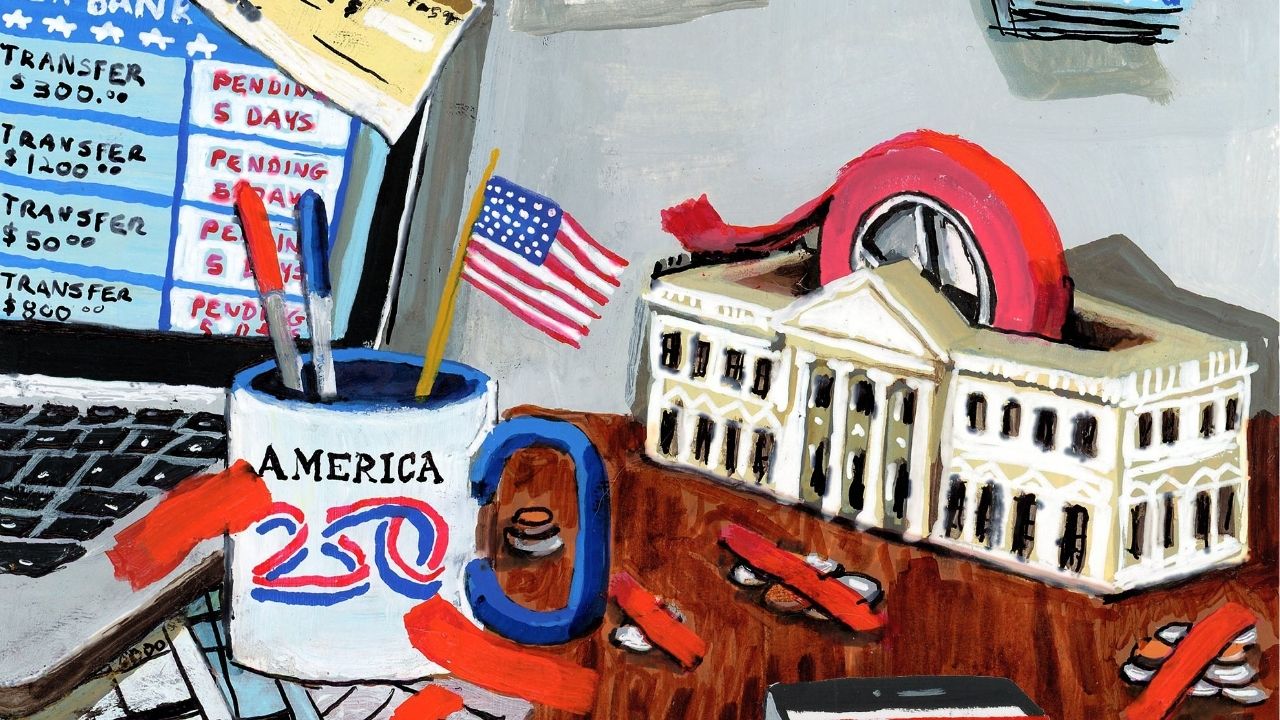
It doesn’t seem like too much of a stretch to assert that on the occasion of the country’s 250th birthday, it should not cost you money to move your money. Nor is it likely that these ticky-tacky fees in payment apps are anything but high-margin pickpocketing.
But the Federal Reserve’s gallant efforts to speed things up through its FedNow Service and other nudges haven’t worked very well yet. Until they do, we’ll probably pay more for fast or need to settle for slow if we have the temerity to transfer money from one of our bank accounts to a different one.
Filing Taxes
If the U.S. tax code were made into an audiobook, it would take roughly 19 days of continuous listening around the clock to finish, the National Taxpayers Union Foundation estimated. The entire code, after all, is roughly 4.26 million words long.
The sheer complexity is why it takes tax filers about eight hours to comply with the 1040 tax form and a full day — 24 hours! — for those with business income. Across the country that’s billions of hours, and $148 million in out-of-pocket costs, according to the Tax Foundation.
Even when there are efforts to streamline — doubling the tax deduction in 2018, for example, meant 30 million filers no longer needed to itemize their deductions — something new ultimately crops up, adding back a new layer of complexity (like the new kiddie savings accounts with Trump’s name on them). That has been happening for more than a century.
The Biden administration had created a promising and popular free filing service called Direct File, but the Trump White House dismantled it, citing high costs and limited participation.
College Costs and Borrowing
Yes, college is more expensive here than in most of the world. And yes, American students often shoulder more of the bill than counterparts in many other countries, which often subsidize costs with lower (or even free) tuition.
But we’d be remiss if we didn’t first acknowledge the role American culture plays in this game, where it’s a rite of passage to spend four years in what are really miniature cities, which are increasingly costly to run for many of the same reasons our regular lives are so expensive. Some families will celebrate admission into these small cities by spending hundreds, if not thousands, of dollars lavishly decorating beds with university swag, processed foods in the school’s colors and other landfill fodder, then post it on social media.
If you can’t afford to pay for education inside one of these private gated cities — even after saving since your newborn arrived — you can attend a local state-run college and hope that state subsidies are sufficient to make it affordable. Or you can commute to a community college and transfer later. Income inequality, it’s the American way.
Healthcare
Darlene Bereznicki, a Canadian-born comedian living in New York, knows her way around both countries’ healthcare systems. But she mastered the inner workings of the American scheme while working at a payroll and human resources company, where she spent significant amounts of time listening to brokers explain healthcare plans to employers.
She knew their spiel so well that she drew on that deep expertise when trying to come up with a new bit when she had writer’s block — she used the old trick of just putting words on a page about anything you know to get the creative juices flowing.
“I just wrote out how health insurance works, and then I was like, ‘Oh, that’s actually it,’” she said. “That’s the joke.”
The resulting bit is both incisive commentary and the funniest thing we’ve seen in a while. Laughing at the absurdity of it all is better than the alternative, particularly when the state of healthcare has driven so many Americans to tears or, like many of Bereznicki’s comedian friends, to simply go uninsured
–
This article originally appeared in The New York Times.
By Ron Lieber/Tara Siegel Bernard/Brandon Celi
c.2026 The New York Times Company