
|
Getting your Trinity Audio player ready...
|
SAN FRANCISCO — It began like any other Monday morning commute, with drivers zooming south from Marin County to the Golden Gate Bridge as they headed toward San Francisco.
At 7:55 a.m. on April 15, 2024, some cars stopped in unison, right in the middle of one of the world’s most iconic spans. Out poured 26 protesters, determined to make a dramatic statement on Tax Day against U.S. tax dollars funding Israel’s military while it attacked the Gaza Strip.
Most of them stood in front of their vehicles and held banners, including one that read, “Stop the World for Gaza.” A smaller group — some remaining in their cars, others standing just outside them — locked their arms together in metal tubes and refused to budge.

It did not take long for traffic to clog and thousands of vehicles to snake through the rainbow-painted Robin Williams Tunnel and into the lush green hills to the north. Many people missed work that day. Others missed important medical appointments. Nobody died, and no one was believed to have been injured, but the protest infuriated plenty of people.
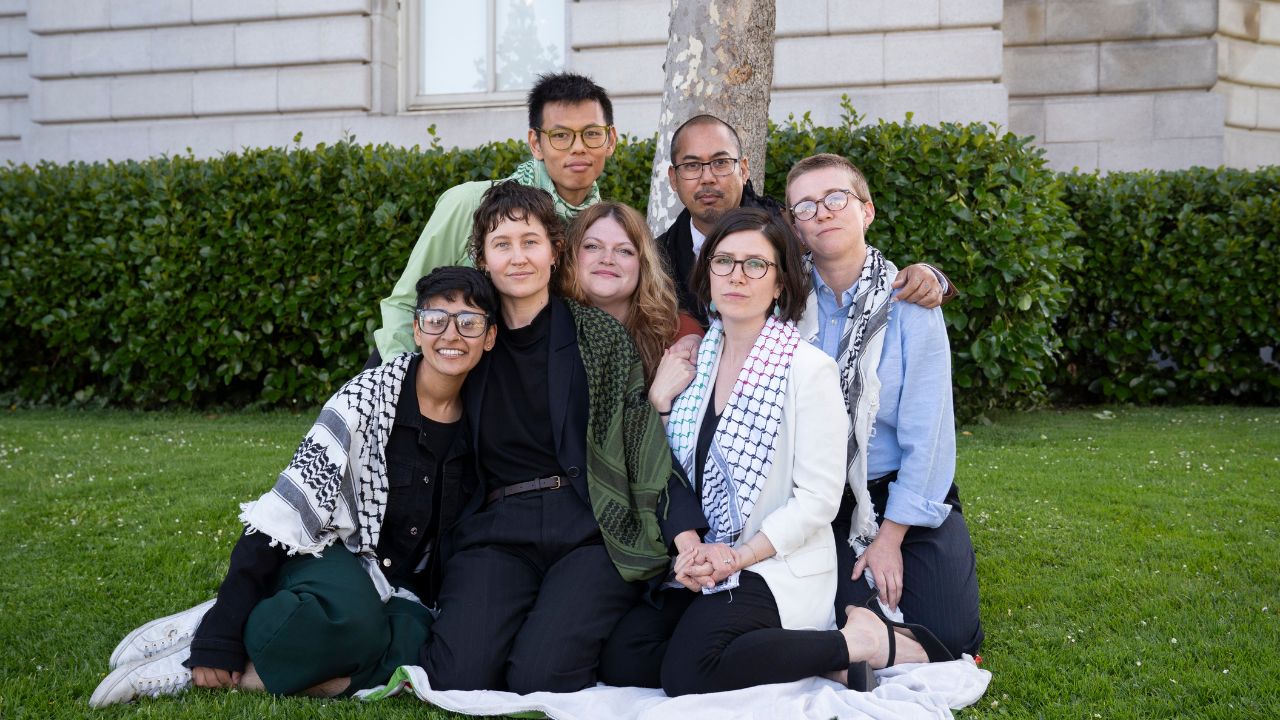
The protesters were arrested and their vehicles towed after about four hours. Traffic moved on, but the protesters’ lives did not. The seven who chained themselves together are now in a multiweek criminal trial in San Francisco Superior Court, where they could face up to 14 or 15 years in state prison.
In a liberal region where roadway protests have been part of the fabric for decades, many activists see the possible sentence as extraordinarily severe. In the past, protesters have avoided felony charges and agreed to perform community service and pay restitution, as was the case for activists who blocked the Bay Bridge in 2023 to call for a ceasefire in Gaza when President Joe Biden was in town for the Asia-Pacific Economic Cooperation Summit.
“Saying that you will face 15 years in jail, that’s outrageous,” Walter Riley, an Oakland civil rights lawyer who was at the courthouse to offer moral support, said during a trial break. “We cannot support this DA.”
San Francisco is far removed from its Haight-Ashbury counterculture days of more than a half-century ago. The city has become a tech mecca, with seemingly endless riches pouring into companies that are part of the artificial intelligence boom. Voters in 2024 elected a wealthy heir to the Levi Strauss fortune, Daniel Lurie, to run the city as a moderate Democrat.
As part of the city’s centrist tack, residents ousted Chesa Boudin, their social reform-minded district attorney, in 2022 as frustrations mounted over crime, drug use and homelessness. His replacement, Brooke Jenkins, was appointed with something of a mandate to punish criminals, violent or not, and improve the city’s quality of life.
The jail population in the city is now 50% higher than it was in 2022.
Jenkins declined to address the specifics of the Golden Gate Bridge case, saying she could not comment on a trial currently underway, but she discussed protests generally.
“When it violates the law and puts public safety in jeopardy,” she said, “I have a job to do.”
But to the protesters and their supporters, Jenkins’ charges are shockingly draconian in modern-day San Francisco. The seven on trial are facing several misdemeanor charges and one felony count of conspiracy.
After starting May 20, the trial began winding down with closing statements Thursday, and jurors will likely begin deliberating Friday.
Joseph Cotchett, a Bay Area trial lawyer who is not involved in the case but has been following it, said that if the jury finds the defendants guilty, he would expect Judge Teresa Caffese to hand down time behind bars. But 15 years in prison would “be absurd,” he said.
For much of the past couple of weeks, scores of people — many of them wearing a kaffiyeh, the scarf that signifies support for Palestinians — have filled a courtroom across the street from San Francisco’s gold-domed City Hall in support of the defendants.
Some of them are the ones who held banners but did not link arms during the bridge closure. Those protesters planned the demonstration with those now on trial, but they had their records wiped clear after they paid restitution and performed five hours of community service.
Still, the group has banded in solidarity, calling itself the Golden Gate 26.
On the trial’s opening day, Angela Roze, an assistant district attorney, told jurors that the protesters had prioritized their personal cause over the well-being of everybody else trying to cross the bridge.
“Children were forced to defecate in bags. People had little to no water,” she said in her opening statement. “Because these seven individuals decided that their cause, their message, was more important.”
She added that the protest ended only when law enforcement officers told the seven that they would cut into the vehicles to remove them. The protesters were using metal tubes that law enforcement officers call “sleeping dragons” because the devices seem innocuous but are actually difficult to extricate people from.
The seven protesters, each with a different defense lawyer, have stressed that they tried other, lawful ways of protesting first. They called their representatives in Congress. They wrote postcards. They attended rallies. Nothing worked to stop the war.
Rocky Chau, 37, grew up in the Tenderloin neighborhood of San Francisco and now works by providing in-home care for his mother, who is elderly and disabled, in the city of Richmond, across the bay.
He testified that he started following news of Israel’s attacks on Gaza and grew increasingly disturbed. One article, about a 92-year-old grandmother in Gaza who was found dead weeks after an Israeli raid, left him particularly distraught, he said.
“It reminded me of my mom,” he said, pausing as he wept on the stand. “I knew I needed to do more.”
He said he had heard before the protest about the “necessity doctrine” — a legal theory that criminal behavior can be defensible if it prevents a greater harm from occurring during an emergency — and believed it applied in this case. He added that the protesters had taken care to assign one person to be a liaison to the police, leave space for emergency vehicles and bring food and water for people who were stuck.
“The only thing I wanted to do, the only thing I ever intended, was to send a message and get the United States government to stop the genocide,” he said.
Regina Schneider, a retired legal secretary who lives north of the Golden Gate Bridge, in Novato, California, testified about the effects of being stuck in her friend’s car for hours. In an interview later, she said she missed an important oncology appointment.
She said that she wanted the defendants to be sentenced to some detention time, though she declined to say how much.
“A lot of us are horrified by things that are happening in Gaza, Ukraine, Iran, all around the world,” she said. “You do not adversely impact the lives of thousands of people to make your point.”
—
This article originally appeared in The New York Times.
By Heather Knight/Minh Connors
c. 2026 The New York Times Company