
|
Getting your Trinity Audio player ready...
|
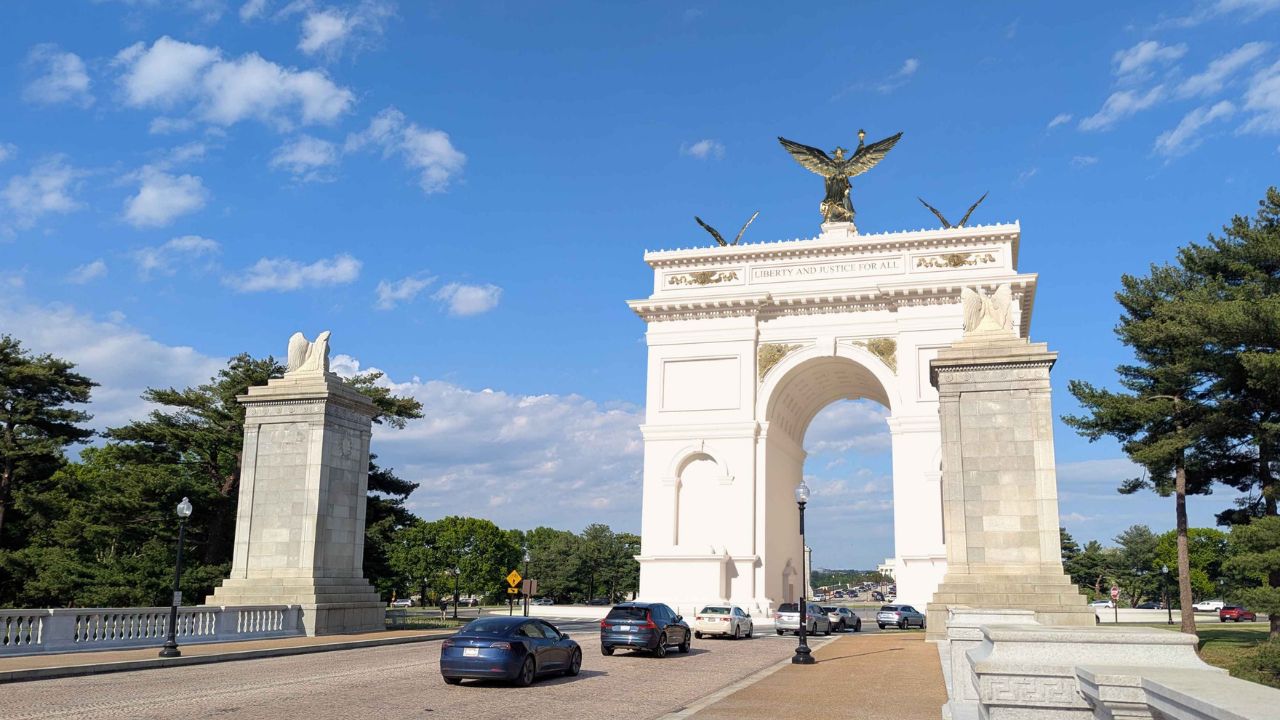
The Commission of Fine Arts on Thursday approved President Donald Trump’s plan to build a 250-foot triumphal arch in Washington, even after the president rejected the panel’s suggestion to remove the large statues of golden eagles and a winged angel atop the structure.
“Washington is not a static city,” the panel’s chair, Rodney Mims Cook Jr., said before making a motion to fast-track approval of the project. “It must grow to allow the next 250 years of Americans to celebrate their accomplishments.”
He added that the arch was “beautiful.”

Trump did agree to accommodate some of the panel’s suggested changes, including removing the statues of gold lions that were positioned lower on the arch.
The arts panel, which is filled with Trump’s appointees, has an advisory role on the design of the project but no enforcement power. The same panel also fast-tracked approval of Trump’s $400 million ballroom, bypassing the normal review process on a project that would transform the profile of the White House.
The president has sought to overhaul any entities that might normally stand in the way of his plans to remake Washington, including firing the entire Commission of Fine Arts board and replacing its members with his appointees.
Thomas Luebke, the panel’s secretary, said to the board members before the motion that a project such as the arch would normally undergo an additional review.
“There is a final design that would normally come after this with more documentation of the issues of details, structure, everything else about it,” Luebke said. But, he added, the panel could also “choose, just like you did with the ballroom, to say, ‘We’re done.’”
The future of the arch is still uncertain, however. The plans are scheduled to go next month before the National Capital Planning Commission, which is also controlled by allies of Trump. The project also faces a legal challenge.
A group of Vietnam War veterans has sued to stop construction of the arch, citing a lack of congressional authority and arguing that the arch would obstruct the view between the Lincoln Memorial and Arlington National Cemetery. Many critics of the plan have contended that the grandeur of the arch detracts from the solemnity that should be observed at the cemetery nearby.
The architect designing the monument, Nicolas Leo Charbonneau, said Trump had rejected the suggestion to remove the large statues atop the structure because the arch is a monument for the living, not the dead.
“The intent of the arch is a celebration in America of 250 years of greatness, freedom and posterity, for which we can only thank the wisdom of our founders and God’s providence,” he said. “While it may celebrate the victories of America in various theories of war and the sacrifice of our fallen heroes,” it is not primarily dedicated “to the dead, but to the living.”
The structure will allow 80 visitors per hour to go inside the arch, Charbonneau said.
Before the vote, Luebke informed members that they had received about 600 new messages about the project. Only one letter writer was in favor of the project without major changes, he said.
Luebke said about half of those writing letters raised concerns about the arch’s closeness to Arlington Cemetery, “that this in fact disrespects the cemetery and military sacrifice,” he said. “The other ones have to do with misuse of public funds, that it’s a gaudy or synthetically incompatible design,” and that it’s authoritarian, among other concerns.
Elizabeth Merritt, deputy general counsel for the National Trust for Historic Preservation, testified that her organization “remains extremely concerned about the location, the height, the scale and the design of the proposed arch.”
“Arlington National Cemetery is a living memorial that hosts hundreds of funeral services every month,” she said. “The arch, as proposed, would dominate the national cemetery.”
In the lawsuit seeking to block construction of the arch, Vietnam War veterans maintain that Trump cannot build it without the authorization of Congress. They cite the Commemorative Works Act of 1986, which details a multistep process for authorizing and designing commemorative works in the District of Columbia and says any such work must be “specifically authorized” by Congress.
But in legal documents, the Trump administration has argued that congressional actions in the 1920s connected to the design of the Arlington Memorial Bridge already give it the legal right to build the arch.
Congress at the time authorized “construction of two tall columns surmounted by statues on Columbia Island,” the administration wrote. “Although those columns have not yet been built, the statutory authority to build them remains.”
The Federal Aviation Administration is also reviewing whether the arch could pose an aerial hazard, an evaluation that it requires for all structures more than 200 feet tall. The arch would sit about 1 mile from a Pentagon heliport and about 2 miles from Reagan National Airport, one of the country’s busiest flight hubs.
–
This article originally appeared in The New York Times.
By Luke Broadwater/U.S. Commission of Fine Arts
c. 2026 The New York Times Company